When Alex Freeman was a six-year-old kindergartner, she was already injecting herself with insulin on a regular basis.
“I was going to kindergarten, so I wanted to learn how to do it so that my mom didn’t have to come to school every day,” Freeman said.
After Freeman was diagnosed with Type 1 diabetes when she was 4, her blood sugar required constant monitoring ““ a task she willingly took upon herself.
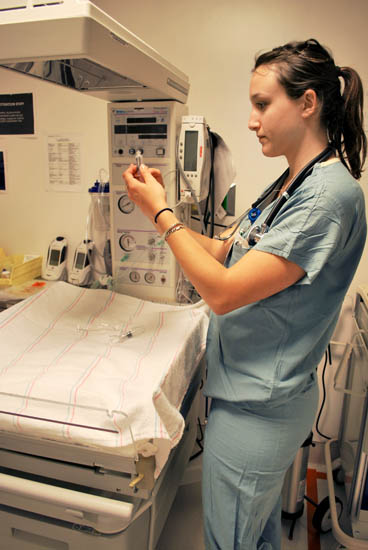
Now, Freeman is using her experience and independence to help others as a third-year nursing student. Along with her third- and fourth-year classmates in the UCLA School of Nursing, Freeman makes rounds twice a week in a hospital, working directly with licensed nurses and physicians to perform medical assessments and set up IVs.
“Having diabetes (gives) me a better understanding of my patients and how frustrating taking care of your health can be at times,” Freeman said. “I think it makes me a better nursing student, only because I’ve been on the other side of it.”
Unlike any other major at UCLA, nursing forces students to jump right into the hospital environment before they graduate. This quarter, Freeman finished a five-week rotation on a medical/surgery floor before moving onto the maternity floor for the last three weeks of the quarter.
“The first time you knock on (a patient’s) door, you’re really nervous,” Freeman said. “You don’t know what’s behind that door.”
Nervousness aside, as Freeman checks a patient’s vitals while decked out in scrubs with a stethoscope draped around her neck, it is easy to mistake her for an actual nurse. She appears completely at ease navigating the hallways of the hospital while searching for supplies and assisting patients.
However, when she reaches the nurses’ station, she becomes a student again. Her nurse instructor is ready to give her direction.
At one point, Freeman informed her nurse supervisor that a newborn baby was deemed healthy after she tested the infant’s vital signs. Her supervisor let out a squeal of delight and gave Freeman a hug.
“Thank you! You guys are so sweet,” said Jennifer Barnato, a registered nurse in Ronald Reagan UCLA Medical Center’s postpartum ward, to a beaming Freeman.
Barnato, who graduated from the School of Nursing herself, said nursing students are given the opportunity to do everything nurses do.
“Teaching here happens on a continual basis,” she added.
While doing her rotations on the medical/surgery floor, Freeman interacted mainly with adults who were either preparing for or recovering from surgery. In the maternity ward, she helped care for “couplets,” or the mother and baby pair.
Freeman said she enjoyed working on the maternity floor and performing assessments on the newborn babies more so than she enjoyed the medical/surgery environment.
“There was a patient who was having a lot of trouble breast-feeding. I was able to really help her and she just looked up at me and said “˜Thank you so much,'” Freeman said. “That’s the most valuable thing ““ that a patient trusts you.”
As a nursing student, Freeman is required to attend class like any other undergraduate student. However, two days of the week, she must arrive at the hospital before dawn, earlier than many of her classmates even wake up.
Once at the hospital, students are required to get reports on the patients from the night shift nurse, perform tests on the patients and deliver medication under the supervision of their nurse. At the end of the day, the students reconvene with their clinical instructor to discuss what they learned during the shift, Freeman said.
“There’s a lot of sacrifices you make as a nursing student,” Freeman said. “You go home, eat dinner, shower, and all you want to do is go to bed, but you have homework to do. Then you get up and you do it again.”
However, the high-stress environment makes the smallest achievements more special, Freeman said.
“It’s a rewarding feeling when you feel like you’re making progress, because you spend a lot of time and effort,” Freeman said. “Nursing requires a little more TLC.”
Nevertheless, several students said they appreciate the practical nature of their major.
Third-year nursing student Samantha Esguerra, who also recently finished her maternity rotations at Santa Monica UCLA Medical Center, expressed surprise at how much more students learned in a clinical setting compared to in a lecture hall.
“My nurse told me, “˜There’s a (cesarean section) scheduled and I want you to come see it,'” Esguerra said. “Everything was ready, (the doctor) was doing the incision, everything just happened so quickly, and then the baby’s head just popped out.”
Even though Esguerra learned about delivery in class, she said the experience caught her off guard.
“You see things in books, you study it, and you keep it in your mind, but you don’t really know what happens until you see it for yourself,” Esguerra added with a laugh.
Witnessing deliveries is common for nursing students, but some patients make it clear they only want to interact with professional nurses, Esguerra said.
“There are going to be patients like that for the single fact that you are a student and don’t have a license,” Esguerra said. “But there are a large group of people that will gladly stick their arm out for us to stick a needle in them.”
Freeman said she agrees that practicing on a patient is invaluable.
“It is really different starting an IV on someone who feels and talks and has opinions than a block of Jell-O in the lab,” she said.
UCLA’s undergraduate program prepares students for entering the nursing world right away, but still promotes further graduate-level education, according to Freeman. Her goal is to do just that: obtain a graduate degree and become a nurse educator.
Freeman has her sights set on becoming a diabetes educator, a career choice she initially considered because of her background.
“Because diabetes is a chronic disease, you have to learn about it,” Freeman said. “(I had) such great teachers that spent time telling me about things that were way above my head.”
However, her decision did not come without hesitation.
“For a while I thought, “˜It’s too much diabetes all the time. I don’t want it to be my career after I live with it every day,'” she said. “But why not use it and why not work with it?”
Esguerra also plans on attending graduate school, but expressed a desire to care for patients abroad as well.
“I would love to go to Africa and help with the HIV/AIDS pandemic,” she said. “There’s attention, but I feel there needs to be more action there in helping with maternity and breast-feeding.”
For now, however, both Freeman and Esguerra are still learning, one step at a time.
“It really is trial and error,” Freeman said. “And you’re just thrown into it.”