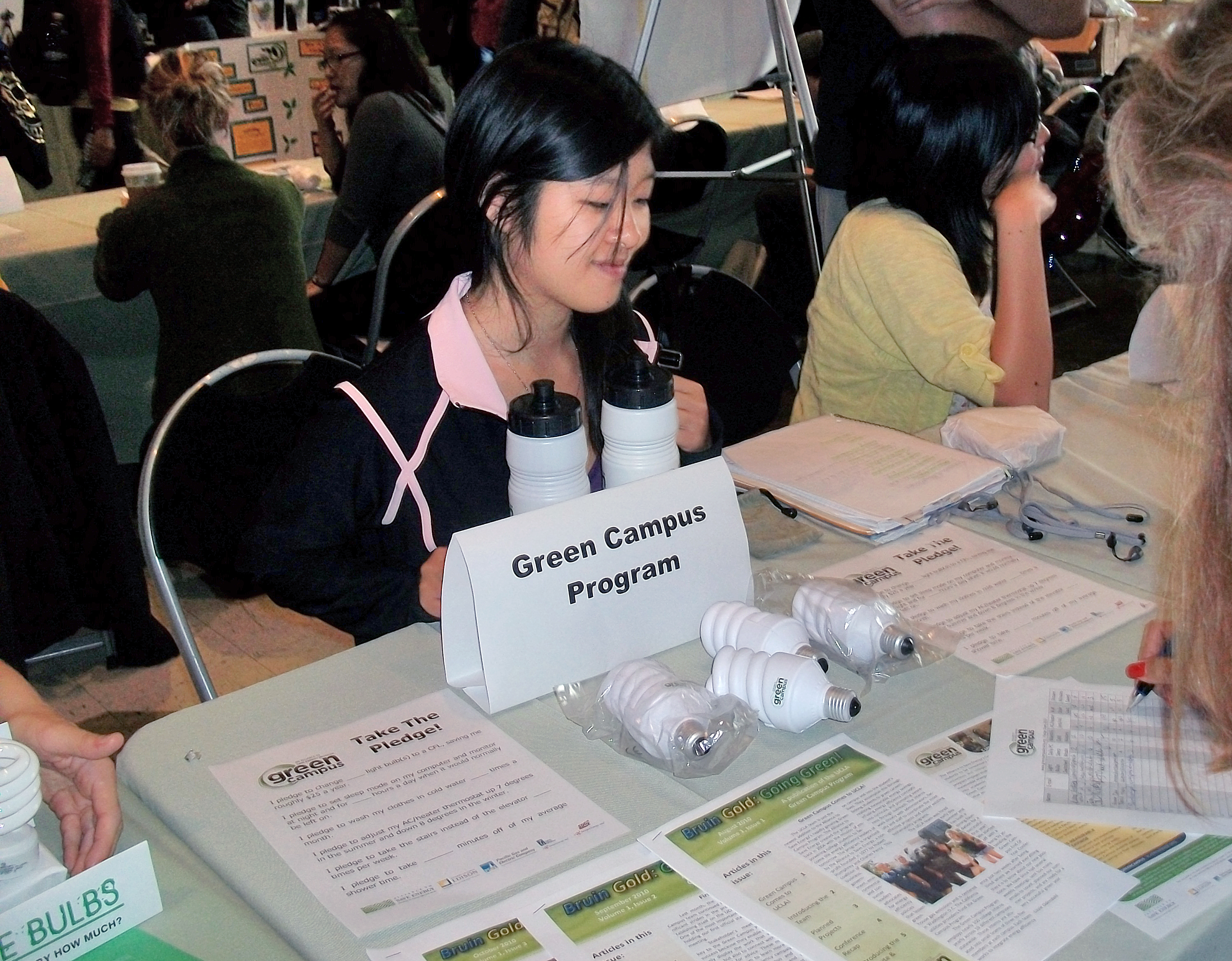
A team of five students discovered illegal tampering of a high-speed nozzle and made recommendations to improve sustainability in dining facilities on the Hill.
Last week, the Green Campus Program interns audited the Hill’s dining halls, restaurants and the De Neve commissary, where they found simple solutions to inefficiency.
In De Neve dining hall, where the staff cleans dishes, someone drilled a hole into a hose nozzle that sprays water near the legal limit of 1.5 gallons. With the tampering, the nozzle sprayed water at a rate of four to five gallons per minute, said Bobby Freidin, one of the interns and fourth-year environmental science student.
Dining Services performs periodic checks of its kitchen facilities, said Robert Gilbert, sustainability manager for UCLA Housing and Hospitality Services. When inspectors find something wrong, such as the tampered nozzle, they fix it.
“If any equipment was drilled into, that wasn’t something we did purposely, at least on a management level,” Gilbert said.
With thousands of students living on the Hill, energy sustainability is a much more demanding task in residential restaurants than in average kitchens.
The University of California has an energy partnership with several utilities that fund the Alliance to Save Energy, a nonprofit that organizes the Green Campus Program in various universities.
The free audit is a useful source for recommendations on saving energy and money, Gilbert said.
Trained by the Food Service Technology Center, the interns mainly observed the real energy hogs in UCLA’s kitchens: fryers, charbroilers, ovens and refrigerators.
The team estimated energy usage by accounting for food preparation time and the amount of food made. They also took note of business hours and the equipment’s age.
Lizzie Odendahl, team manager and a third-year political science student, said the team will calculate its exact results to send out reports to the residential restaurants within two weeks.
For Rendezvous, results include inefficient appliances, a warming cabinet working at four times the energy it should be, and plans to upgrade to a bigger and more energy-consuming charbroiler, Odendahl said. Light bulbs should be changed in De Neve dining hall, where various kitchen equipment also need small adjustments.
Gilbert said since he has not yet seen the numerical results of the audit, he does not know what steps will be taken to improve the kitchens. However, Dining Services would consider replacing certain appliances based on their short-term payback, he said.
Over time, simple improvements can make a real difference, Odendahl said.
The Green Campus Bruins started their work as interns in the fall of 2010. They are funded through the nonprofit organization Alliance to Save Energy with the purpose of reviewing on-campus entities to measure their energy efficiency and make suggestions to save energy and money.
Freidin said the team has worked on other small projects like a competition that encouraged undergraduate chemistry labs to save energy by fully closing fume hoods, which use the same amount of energy per year as three or four residential houses.
The interns also reviewed restaurants on campus and the kitchen in the Ronald Reagan UCLA Medical Center. They plan to examine more buildings for lighting improvements. Sirena Lao, an intern and third-year environmental science student, said they will also examine computer use and hold a fume hood conservation competition for the graduate labs.
“Considering how much energy goes into this campus, the small amounts we save are not substantial,” Freidin said. “But the main goal is to get people thinking.”