This post was updated July 20 at 8:02 p.m.
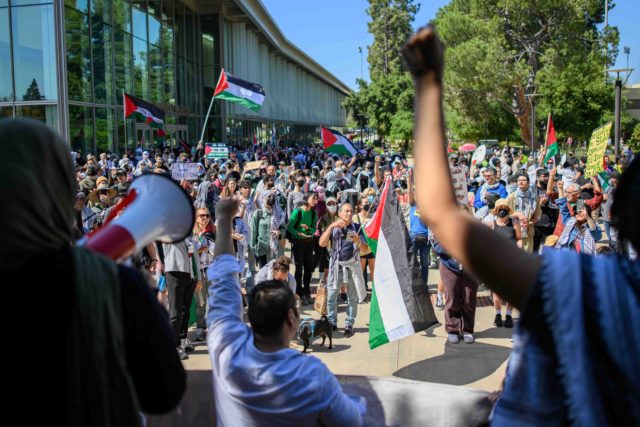
Students and faculty are suing the UC to demand the release of documents relating to the policing of pro-Palestine protests on the UCLA campus.
The lawsuit, filed June 27 in state court, claims the University has withheld documents requested by the Palestine Solidarity PRA Collective, the plaintiff in the suit, about the police response to the first Palestine solidarity encampment at UCLA – including a report by consulting firm 21st Century Policing Solutions – in violation of the California Public Records Act.
The CPRA mandates that government agencies release government records upon request, with some exceptions, such as for documents that the release of would harm the public interest or “constitute an unwarranted invasion of personal privacy.”
“This lawsuit seeks the enforcement of seven specific public records requests, focused on university responses to the Palestine Solidarity Encampment and related demonstrations, alongside the broader trend of increased militarization of police and repression of the Palestine solidarity movement,” Students for Justice in Palestine at UCLA said in a Tuesday press release announcing the lawsuit.
Abenicio Cisneros, the attorney representing the Palestine Solidarity PRA Collective in the lawsuit, said he filed the lawsuit because UCLA has refused to voluntarily release the records the collective has requested.
“It’s not just a matter of delay,” he said. “The university explicitly stated that it would not release the records voluntarily.”
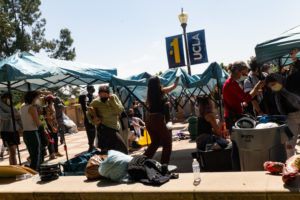
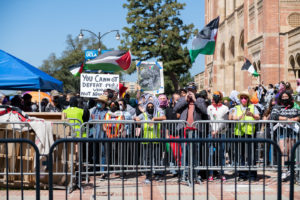
In late April 2024, students at UCLA set up an encampment in Dickson Plaza to demand that UCLA and the UC divest from companies with ties to the Israeli military.
Pro-Israel counter-protesters attacked the encampment April 30 and May 1, 2024, throwing fireworks, a scooter and tear gas into the area. Mary Osako, UCLA’s vice chancellor for strategic communications, said in a statement after midnight on May 1 that law enforcement had been called for immediate support, but police did not intervene until over two hours later.
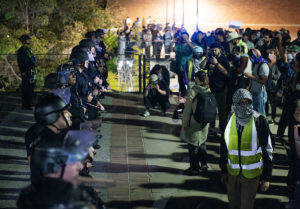
Police swept the encampment in the early hours of May 2, 2024, detaining over 200 pro-Palestine protesters.
[Related: Hundreds of protesters detained after police breach pro-Palestine encampment at UCLA]
The encampment, as well as other protests on the UCLA campus, came amid the Israeli military’s siege of the Gaza Strip, which began after Palestinian political party and militant group Hamas’ Oct. 7, 2023, attack on Israel that left around 1,200 dead. The Israeli military’s offensive in Gaza has killed over 58,000 Palestinians, according to the Associated Press.
Thirty-five pro-Palestine protesters also sued the UC, police forces and counter-protesters in March, alleging that the University violated their civil rights.
[Related: Pro-Palestine protesters file lawsuit against UC, UCLA, police, counter-protesters]
According to the June lawsuit, the University has declined to release 21CP’s report, which was commissioned by the UC Office of the President following the sweep of the first Palestine solidarity encampment.
In November, the University released a list of recommendations – which was separate from the report – created by 21CP following the firm’s investigation into the police response to the encampment. The document said UCLA had developed a “Tiered Response Matrix” before the encampment for how the university should respond to on-campus demonstrations.
The UC has claimed the 21CP report is exempt from CPRA disclosure because of attorney-client privilege, according to the lawsuit, which demands the release of the report and the “Tiered Response Matrix.” Under the CPRA, documents relating to ongoing litigation are exempt from disclosure if the relevant government agency is a party in that litigation.
“UCLA has a much fuller account of how violent Zionists were during the encampment, and how brutal they were,” said Dylan Kupsh, a member of Graduate Students for Justice in Palestine at UCLA. “Through these records requests and others’ records requests, we can finally start unraveling the depth of complicity in our administration.”
The lawsuit also requests the release of the names of staff and faculty on the UCLA Student Conduct Committee. According to an exhibit attached to the lawsuit, Kupsh filed a request for the disclosure of the staff and faculty membership of the committee in January.
“It’s really important for those that are undergoing the student conduct process to know who’s on these committees and who’s staffing these committees,” said Kupsh, a doctoral student in computer science, who said he is going through the student conduct disciplinary process.
The university responded to the request with a list of committee members’ staff positions with all names and some positions redacted, according to an exhibit to the lawsuit. UCLA public records analyst Chelsea Malone said in an emailed response to Kupsh that the names of committee members are exempt from CPRA disclosure, according to the exhibit.
A spokesperson for UCOP declined to comment on the lawsuit, which also demands the release of records relating to the appointment of Acting UCLA Police Chief Scott Scheffler.
Kupsh also said he and others have been waiting on responses for records requests submitted roughly a year ago.
Cisneros said access must be timely for the right to public records to be meaningful.
“An agency could withhold records via delay until they’re no longer salient, until it’s more difficult for them to be actionable,” the San Francisco-based attorney said.
The Daily Bruin has dozens of outstanding public records requests relating to the first Palestine solidarity encampment, some of which were filed more than a year ago.
“The university can’t continue to deny and delay public access to information on UCLA’s active and unlawful support of the ongoing genocide in Gaza and the university’s repression of students advocating for justice in Palestine,” SJP said in the press release.
Contributing reports by Alexandra Crosnoe, News editor.