This post was updated July 20 at 7:30 p.m.
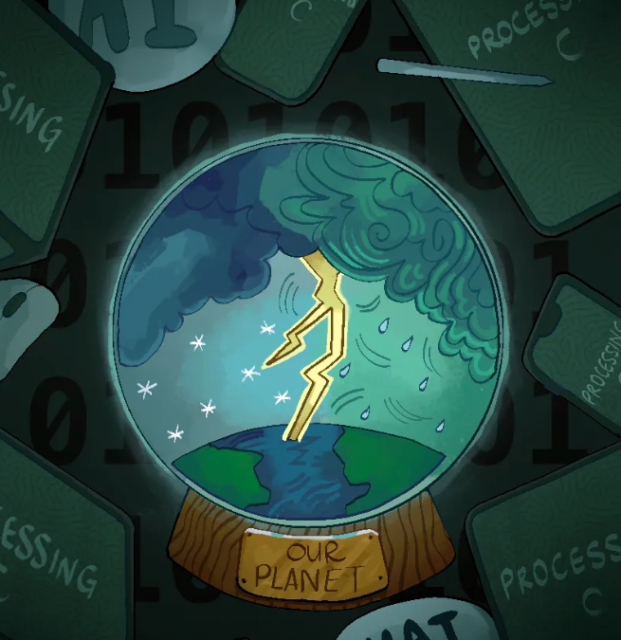
Writing the perfect email or outlining the perfect essay isn’t the end of the world – but climate change is.
Generative artificial intelligence and ChatGPT have drawn lots of attention, as they innovate new ways to make our lives more convenient. Whether it’s writing an email to a professor or summarizing 20-page readings in a pinch, these tools are invaluable to many students.
As fast as these new technologies have raced to fix our most trivial needs, they have distracted us from the existential threat that Earth’s changing climate poses.
Celebrating green technology has become more essential than ever, especially as innovations like AI have gripped public attention. While these consumer-facing technologies may provide instant gratification, they also erode necessary progress toward addressing the climate crisis.
The Massachusetts Institute of Technology found that our embrace of generative AI has limited our capacity to address the climate crisis, in part by shifting political attention away from the sheer necessity of climate policies and the implementation of clean technology.
Sara Graves, a doctoral student in atmospheric and oceanic sciences, said these attitudes originate from a culture that seeks to work against nature, not with it.
“A lot of it goes back to these patriarchal, colonial ideas we have about nature and conquering it,” she said.
Earth has become a resource that exists to serve human interests, and the existential threat of continued ecological damage has been eclipsed by flashy innovations with more immediate benefits.
This has contributed to a culture that prioritizes attention-grabbing innovations but ignores the impacts that such innovations have on climate change.
“On a day-to-day basis, when carbon dioxide is emitted into the atmosphere, you don’t see it. You don’t taste it. It’s not immediately local,” Ann Carlson, the Shirley Shapiro Professor of Environmental Law at the UCLA School of Law, said. “So, it can be kind of easy to shove the effects of climate change out of your mind until you experience them directly.”
Our embrace of immediately gratifying technology has eroded our concern for the things we generally cannot see. And worse, not only are its effects invisible — so are the payoffs of reducing our carbon outputs.
“You can buy an electric vehicle, you can consume less, but you’re not going to see immediate reductions in the problem,” Carlson said. “It takes all of us – many years, changing technology, changing our behavior – to make a difference.”
Putting your neck out to fix a problem you can’t really see can be unattractive. AI, on the other hand, noticeably conveniences our lives with just an internet connection and access to a browser. With such an alluring technology at our fingertips, climate change mitigation can seem even more exhausting.
Political factors in the climate policy arena have also intensified. Politicians continue to understate or deny the implications of human-caused carbon emissions, exacerbating an already weak understanding of the tangible effects of climate change.
Lilie Kulber, a fourth-year bioengineering student and president of the UCLA consulting organization Clean Consulting, said having a president who doesn’t believe in climate change is dangerous and will likely weaken the country’s current progress.
The Trump administration’s anti-climate stance compounds upon preexisting challenges in garnering public support for renewable technology. The president’s heightened hostility toward mitigating climate change is evident in the One Big Beautiful Bill Act, which aims to expand domestic oil and gas production while curtailing many of the Inflation Reduction Act’s clean energy tax credits, among other rollbacks.
However, without a vested public interest in pursuing climate change mitigation, elected officials aren’t incentivized to enact clean energy policies.
“We need every sector of our society working on and focused on climate change. That means political pressure from ordinary folks,” Carlson said.
Politicians must listen to their constituents — the people who ensure their continued political power. Shifting the public conversation toward tackling climate change can have real policy impacts, especially in the implementation of emerging clean technologies.
Capturing and storing carbon currently in the atmosphere is an essential innovation we need to be focusing on, Carlson said. This entails creating negative emissions by storing existing carbon in the ground or in cement. But, she added, it’s costly, new and almost impossible to implement without strong policy backing it.
The energy transition has also long been a focus of climate action. Harnessing clean energy sources like nuclear, solar and wind energy reduces our reliance on fossil fuels altogether. Battery storage has also gained traction, where recent innovations have increased battery capacity and lowered costs to better store renewable energy and power electric vehicles.
Green technologies have the power to impact everyday concerns. Hot-button policy items – like grocery prices, health care and public infrastructure – are all compromised by increased weather extremes and the frequency of ecological disasters. Treating climate change as being embedded into the issues we already care about demonstrates to politicians the benefits of enacting green legislation.
At the end of the day, climate change is a problem that affects us all.
“I don’t fully understand why we seem to be shrugging our collective shoulders about the greatest existential environmental threat the planet has ever faced,” Carlson said. “The sense of urgency needs to come from the public to make politicians pay attention to it.”
It’s time we celebrate green technologies with the same attention we do other high-tech advancements.
After all, ChatGPT can’t write your professor an email if climate change-induced hurricanes are destroying its data centers.




Comments are closed.