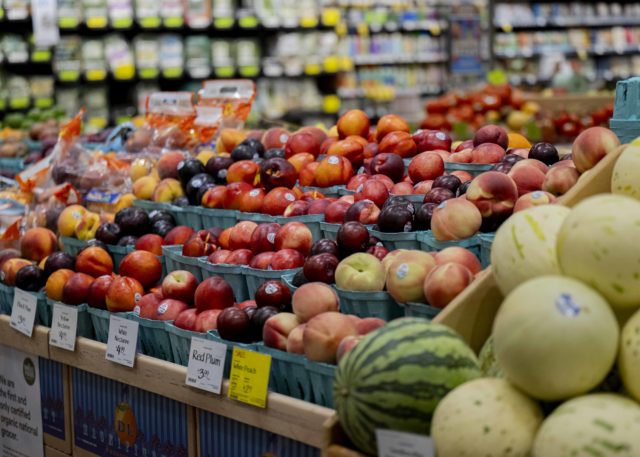
Residents in some neighborhoods of Los Angeles live in food deserts, creating systematic barriers to healthy eating.
The nonprofit organization Food Empowerment Project defines a “food desert” as a geographic area that lacks or has limited access to nutritious and affordable food, often forcing residents to rely on cheap, unhealthy fast food options. These neighborhoods have an average poverty rate of at least 20%, with at least 33% of the population living more than a mile from the nearest grocery store, according to the United States Department of Agriculture.
Jack Bobo, the executive director for the UCLA Rothman Family Institute for Food Studies, said systemic factors such as economic disparities and inadequate public transportation lead to the emergence of food deserts.
“Many of these neighborhoods have limited access to public transportation that makes it difficult for residents to reach stores, so it’s often a long commute on public transportation in order to access a store that has healthy options,” Bobo said.
Bobo added that urban planning, zoning and historical redlining – the discriminatory practice of denying or limiting financial services to residents of specific neighborhoods by race – have played a role in the creation of food deserts. He said zoning policies that prevent supermarkets from opening in lower income areas limit residents’ access to healthy food and groceries.
“There have been practices like redlining that have led to long term socioeconomic disparities that have affected marginalized communities and made it difficult or less likely for businesses to move in,” Bobo said.
Due to food deserts’ historical origins of redlining, these areas are often correlated with neighborhoods of lower income and with more racial minorities, according to the Economic Research Service.
PBS SoCal found that neighborhoods in South LA with a history of redlining, such as Watts and Bunker Hill, experienced economic disinvestment and decreased property value from the late 1930s. According to the nonprofit organization Community Health Councils, the lack of investment from major grocery stores and healthy food retailers in these neighborhoods created a food environment dominated by corner and convenience stores with little nutritious options, eventually turning the areas into food deserts.
In LA, the effects of living in a food desert disproportionately affect Latino and African Americans, who make up a large portion of the population in South LA, according to Data USA. In comparison, wealthier and less racially diverse neighborhoods such as Hancock Park and Westwood were deemed attractive for investments and are considered to have less food deserts, according to the LAist and the USDA.
Samantha Corona, a second-year international development studies student, said she noticed a drastic difference in food options offered in Westwood compared to her hometown near Inglewood.
“Around here there’s Sprouts, and there’s Erewhon and there’s Whole Foods, a lot of organic things,” Corona said. “When I’m home, my sisters, they buy chips, they buy snacks, they buy gummies, they buy candy.” .
As a result of living in a food desert, many residents in South LA do not consume the daily recommended amount of fresh produce for a healthy adult. The LA County Department of Public Health reported that only 12.7% of adults in South LA consume five or more servings of fruits and vegetables a day, the recommended amount by the National Health Service. This percentage is significantly lower than the 22.7% of adults in West LA and the 14.7% of adults in the LA County average.
Furthermore, the Community Health Council’s analysis of store inventories found that, while 90% of all grocery stores in West LA sell fresh fruit and vegetables, this figure is only 75% in South LA.
Stephanie Pincetl, professor at the Institute of the Environment and Sustainability at UCLA, said the issue of limited fresh food is aggravated by the fact that fast food contains processed derivatives of whole foods, removing their nutritional value.
“What you want is a whole food,” Pincelt said. “You do not want some food that’s been fractionated into a gajillion little profitable pieces.”
Limited access to nutritious food has a variety of negative health impacts. According to a 2024 Very Well Health report, residents in a food desert are often deficient in key nutrients such as iron, vitamin A, and iodine. These deficiencies are linked to symptoms of fatigue, depression and a weakened immune system, as well as complications in growth and development, as per the same report. The Food Empowerment Project also found that there is a connection between food deserts and diabetes rates due to the highly processed and caloric food items available to people in these areas.
Bobo said the issue with the food options offered in food deserts goes beyond their high-calorie content.
“It’s not just calories and not just too much sugar but also inadequate micronutrients,” Bobo said. “In addition to that, there’s mental health issues that are related to this – stress, anxiety, food insecurity can all affect health and wellbeing.”
Corona said limited access to healthy food options presented a great challenge when she had to take care of her mother when her mom dealt with health complications.
“I remember when my mom had cancer … the closest Trader Joe’s is two cities away,” Corona said. “It was pretty far, maybe a 30-minute drive with traffic.”
In light of the consequences of living in food deserts, the UCLA Healthy Campus Initiative supports students in accessing healthy food options and provides opportunities for volunteering students to distribute nutritious meals in these affected areas.
To address the issue of inadequate food access during the COVID-19 pandemic, the HCI Center and UCLA Dining collaborated with the Venice Family Clinic to provide more than 500,000 nutritious meals to low-income clinic patients and their families.
Student organizations at UCLA are also committed to addressing the issue of food deserts. Bruin Dine is a student-led organization that works to redistribute leftover food from the dining halls to students and staff in need.
Meghna Bhakta, a second-year civil engineering student and sustainability committee dead for Bruin Dine, said the organization addresses the issues of food deserts through research efforts with UCLA. In May, Bruine Dine hosted an event called Bite Back, where UCLA researchers presented their findings on structural inequalities in food access affecting UC and California State University students, aiming to raise awareness of the issue.
“We’ve definitely been trying to advocate more for those students,” Bhakta said. “We give out the food, and we’re trying to be a resource to people who do live in food deserts.”
However, addressing the issue of food deserts, in LA and elsewhere, has proven difficult due to the complexity of economic and environmental factors. Pincelet said short-term solutions such as building a community garden in a food desert may seem to increase the availability of fresh produce, but factors such as residents’ agricultural and nutritional knowledge, coordination and organization of the garden, and time may limit the efficacy of this solution.
Instead, Pincelt said that the root cause of food deserts, poverty, must be addressed first in order to make substantial change.
“Simply providing more grocery stores does not alleviate the problem of the cost of food, the effects of the kind of agriculture we have and the health of people,” Pincelt said. “If you’re really thinking about sustainability, it’s a complex set of interconnecting kinds of issues.”


Comments are closed.