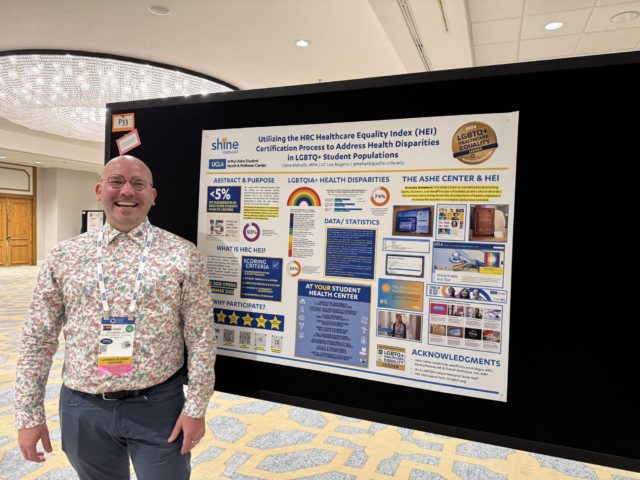
Geno Mehalik of the Arthur Ashe Student Health and Wellness Center spoke with Daily Bruin reporter Catherine Wang about the center’s commitment to inclusive care for LGBTQ+ students.
Mehalik, the Ashe Center’s outreach and professional development manager, presented a poster titled “Utilizing Healthcare Equality Index Certification to Address LGBTQ+ Health Disparities at Your Student Health Center” at the 2025 American College Health Association Annual Meeting in May.
It received an award in the category “Enhancing Access & Belonging in College Health & Well-being.” HEI is a national standard that assesses how well a healthcare facility supports its LGBTQ+ patients and staff.
This interview has been edited for length and clarity.
Daily Bruin: What is the Health Equity Index, and why is it important that the Ashe Center got recognized as a leader in this initiative?
Mehalik: This is something that I took on back in 2015. I am queer myself, and so I found out about this through advocacy work. I found out about the Healthcare Quality Index, and I was like, ‘How can I bring something of myself and my advocacy to the Ashe Center and have something that I manage?’ I found out about this survey, and it was really about bringing training and bringing best practice processes to the frontline staff so that they help to make our LGBTQ+ students feel comfortable in the clinic.
It’s a biannual survey administered by the Human Rights Campaign. Right now, there’s about 2,400 facilities around the country that participate. But the brainchild for this presentation at the American College Health Association was that so few student health centers actually participate. When we started this, it was pretty much us and UC Davis that was doing this work, and maybe a few other ones around the country. So, the idea was ‘Why don’t we promote this Healthcare Quality Index to student health centers around the country so that they can do this work as well?’
Daily Bruin: What does it take to get HEI certified?
Mehalik: There are five sections of criteria. The first one is non-discrimination and staff training. That includes patient non-discrimination, employment non-discrimination and staff training. For criteria two, it’s patient services and support. That’s LGBTQ+ and transgender patient services, patient self-identification. Criteria three is all about employee benefits and policies. Criteria four is patient and community engagement. So, that’s basically ‘Is your organization sponsoring events like the Lavender Graduation on campus?’ The fifth criteria is responsible citizenship. ‘Are you doing anything that’s actually harming the community?’ – if you do these, you’re going to be deducted points.
Daily Bruin: What improvements has the Ashe Center made as a result of working towards the certification?
Mehalik: There are so many LGBTQ+ health disparities that come just by virtue of being part of the population. There’s a lack of data; there’s poverty within the community; there can be risky behaviors. Discrimination with the community, homelessness, lack of access to care, lack of relationship recognition and lack of gender recognition.
This was so many years ago now – and patients take it for granted – but we were one of the first people to do the all-gender restrooms. In the health center, the majority of our restrooms are single-stall restrooms because people have to go in there and do self-swabs and stuff like that. So, we were one of the first places on campus to rebrand all of our single stall restrooms into all-gender restrooms and to be part of that initiative that was started by the LGBTQ Center.
We started a HIV STI PrEP clinic. As a result of this work, we put up lots of patient education from the National LGBTQ Health Training Center and those flyers that they put together and their patient education, we put those up in our exam rooms just to sort of encourage conversations and create visibility within the clinic. The services that they offer – primary care, hormone therapy, referrals for gender affirming surgery and interventions, working with our insurance plan UC SHIP – make sure that students have those referrals as well.
Daily Bruin: What drew you to this work in helping to eliminate health disparities for the LGBTQ+ community?
Mehalik: What brought me to it was having a background in advocacy. I worked with Equality Florida. I am on the board for a nonprofit, and we do scholarships for queer youth. It was started in the aftermath of the Pulse nightclub shooting. It’s called the Dru Project. We lost our friend Drew at the shooting, and so, we do queer youth scholarships in his honor. This kind of work, and supporting the LGBTQ+ community at UCLA is just rewarding on its own.
Daily Bruin: What are examples of inclusive care at the Ashe Center that the student population may not know about?
Mehalik: When they (LGBTQ+ students) hear about the PrEP clinic, they’re always like, ‘Oh, wow, we never heard about this.’ That’s a type of visit that you can schedule through the MyStudentChart. Your primary care doctor can talk to you about STIs and PrEP, but we have actual PrEP visits where students can meet with a registered nurse and talk all about it. It’s a longer-style appointment where you have more time and more quality of that appointment – and being able to get the care that you need.
Daily Bruin: What are areas of improvement for the Ashe Center?
Mehalik: I think outreach always can be improved. I think the way that you communicate with students is through video these days. I can put so much information on the website, but are students going to go there and read the website? We just actually launched an AI chatbot on our website through Student Affairs.
We’re in a downturn right now with funding freezes. I don’t know if things are going to get better in terms of staffing, but I think it’s just a matter of us finding ways to connect more with students, and maybe through our health education work through the Student Health Advisory Committee. I’m just gonna keep plugging along and doing what I do and always trying to find new ways to expose the Bruin community to our services.



Comments are closed.