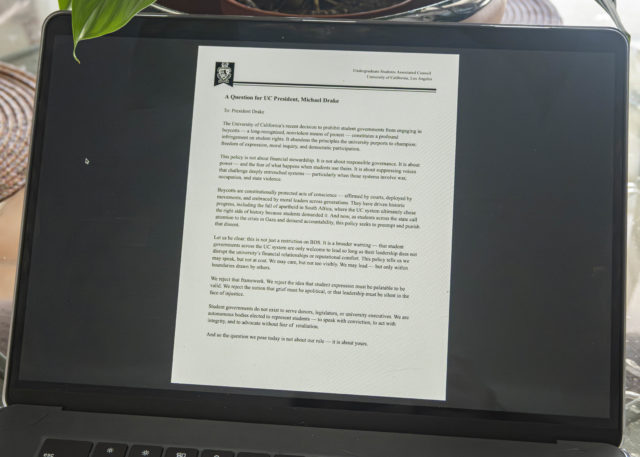
The Undergraduate Students Association Council unanimously approved a letter to UC President Michael Drake criticizing the UC’s ban on student governments’ boycott of countries, including Israel, at an emergency meeting July 15.
Drake announced in a July 2 letter to UC chancellors that boycotts of companies dependent on their affiliation with Israel – or any other country – violate University policy, which requires that student governments use “sound business practices.” Prior to this letter, the UC had not explicitly stated it had any policies specifically banning boycotts.
[Related: Student governments across UC campuses banned from anti-Israel boycotts]
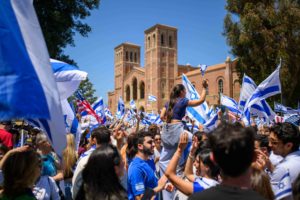
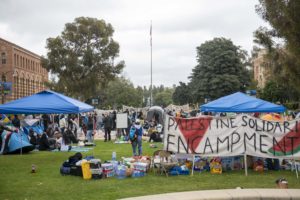
The ban on boycotts comes after UC-wide protests of the Israeli military’s siege of the Gaza Strip, which began after Palestinian political party and militant group Hamas attacked Israel on Oct. 7, 2023 and killed around 1,200 people. The Israeli military has killed over 58,000 Palestinians through its offensive in Gaza, according to the Associated Press.
USAC passed a resolution endorsing the Boycott, Divestment and Sanctions movement against Israel in February 2024, calling on the UC Board of Regents to divest from companies associated with the Israeli military. It claimed in the resolution that Israel is engaged in “apartheid, ethnic cleansing, and genocide.”
[Related: USAC passes resolution endorsing Boycott, Divestment and Sanctions movement]
The council also unanimously voted to amend its bylaws last year to pause the transfer of funds into its endowment until the University agrees to divest from companies that participate “in the violation of human rights.”
[Related: USAC freezes transfer of funds to endowment until UC divests]
Alicia Verdugo, then-USAC Cultural Affairs commissioner, proposed both the resolution and bylaw change. Verdugo resigned in February following allegations that their office refused to hire Jewish students.
The letter, written and presented by Internal Vice President Tommy Contreras, accused the UC of violating student governments’ freedom of expression and blocking students from engaging in political action. Contreras declined to comment about the ban on boycotts and the letter.
The council alleged in the letter that the UC prides itself on diverse discourse – until that discourse is inconvenient to it.
“Let us be clear: this is not just a restriction on BDS,” the letter said. “It is a broader warning – that student governments across the UC system are only welcome to lead so long as their leadership does not disrupt the university’s financial relationships or reputational comfort.”
The council defended the practice of boycotting in the letter and urged the University to stand on the right side of history with regard to the “crisis in Gaza.” It also contrasted the UC’s involvement in the fall of apartheid in South Africa – when more than 2,000 students at UCLA rallied in a USAC-sponsored protest for full divestment from the nation – as an example of how boycotts have historically proven effective within the UC.
The UC Board of Regents voted to divest $3.1 billion from companies associated with South Africa’s apartheid government in July 1986, over a year after protests at UCLA began.
[Related: Examining parallels to 1985 student calls for divestment from South Africa]
“It sums up our dissatisfaction with it and how the banning goes against the values that the UC has claimed historically to support and loves to tout that it’s the birthplace of the free speech movement, and yet we are currently taking steps to limit free speech on our campus,” Contreras said during the meeting.
The council also posed a central question to Drake in the letter, asking if the UC remains a place of free expression.
“President Drake, does the University of California still see itself as a space for critical inquiry and democratic engagement – or has it chosen to become something else?” the letter said.
A coalition of the nine undergraduate UC student body presidents also wrote a statement to the UC Board of Regents, UC chancellors and UC system student body criticizing University administration for the disregard to the financial autonomy and free speech of student governments that they posted on their Instagram pages July 9.
“We, as UC system student body presidents, were first made aware of the public reaffirmation not through our own administrators, but through an article published by the LA Times,” they said. “We are, first and foremost, deeply disheartened by the lack of communication and accountability by our respective administrations, who have chosen to undermine our value as student leaders and discredit the students we represent.”
Stett Holbrook, a spokesperson for the UC Office of the President, said in an emailed statement that the University opposes boycotts of companies associated with any specific country. He added in the statement that financial boycotts are inconsistent with “academic freedom and the free exchange of ideas.”
Transfer Student Representative Hyerim Yoon said she believes that, since USAC is a democratically elected governing body, it has a right and responsibility to serve the needs and interests of its constituents without intervention from administration.
“I stand against any actions that restrict the actions of an elected body, whether it’s this ban specifically or any actions that target freedom of speech overall,” said Yoon, a rising fourth-year English and history student.
They added that they believe boycotting is a nonviolent avenue for marginalized communities within the UCLA community to advocate for themselves and create change.
International Student Representative Keya Tanna said student governments like USAC act as a mediator between students and university administrators and added that she was disheartened to see the UC censoring student governments.
“It does reflect a nationwide issue, especially with everything going on with international students specifically and the political environment,” she added. “We’re seeing a very similar loop of events taking place nationwide.”
Tanna also said she hopes that the letter can convey the student body’s disapproval and hold the administration accountable. She added that, while the letter is a starting point, she believes it will take putting constant pressure on the UC administration to create change.
Tanna said USAC is yet to take tangible steps to end the ban on boycotts but that things are “always in the works.”
Yoon added that she hopes the letter will empower other UC student governments – and student governments across the nation – to also do their part in standing up for students.
“It’s a method for us to fight back,” they said. “We’re living through one historic moment after the other, and, if our history lessons have taught us anything, it’s that student activism is so important, and it consistently matters.”

Comments are closed.