This post was updated July 27 at 8:25 p.m.
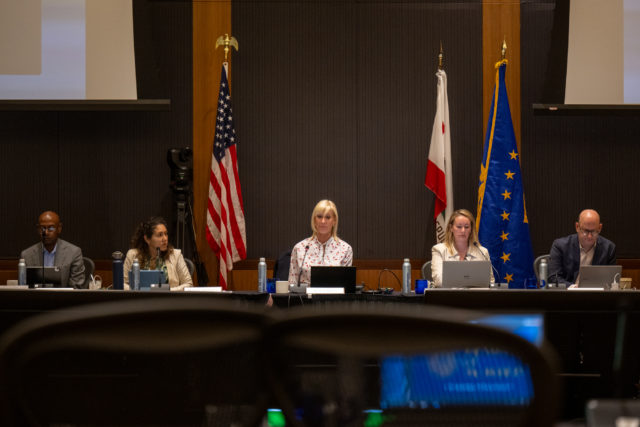
The UC Board of Regents discussed alumni outcomes, considered campus reporting resources for students and introduced the UC Student and Policy Center on July 16.
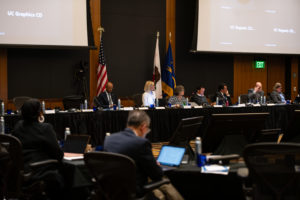
The committee on academic and student affairs listed the University’s top employers as it develops new tools to record alumni careers and examined the success of incident reporting given current campus climates at its July meeting. The board held its bimonthly meeting July 15 to July 17 at UCLA.
Katherine Newman, the UC provost and executive vice president of academic affairs, said amid a national debate about whether the cost of college is still worth it, the data on UC alumni is “unequivocal” in supporting the choice to pursue a degree. Nearly two thirds of alumni graduate without any student debt and graduates experience steady income growth over time, she added.
UC alumni are also more likely to own a home or launch a business than their peers without college degrees, Newman said.
Newman also said she helped develop a labor market forecasting tool, UC alumni career pathways, which analyzes alumni’s top employers, fields of study and marketable skills. The committee acquired its data from Lightcast, a labor market analytics company that provides information on job postings and career profiles, she said.
“We are hoping that we can share this information, and use it as a resource for others,” said Pamela Brown, the UC’s institutional research and academic planning vice president. “We’re hoping that this is a way that we can illustrate UC’s impact to company leaders, policy makers and advocates across the state.”
The platform also aims to provide UC campus career centers and students with a better understanding of current employers and job market demands, Brown said. For example, alumni outcomes can be sorted by regional maps, illustrating the impact the UC has on a regional basis and identifying the most common jobs UC alumni have in that area, she added.
UCLA Chancellor Julio Frenk also said that UCLA is planning an initiative he calls “UCLA for Life,” which encourages students to return for learning opportunities after they graduate.
“Students are graduating into the most dynamic labor market in history,” Frenk said. “Thinking of ourselves as the providers of evolving educational services throughout the entire career path of our students once they graduate and that idea of going from a closed to an open system is pretty profound.”
The committee also discussed the effectiveness of incident reporting resources in instances where students have complaints against faculty and other community members.
If a student has a complaint that is outlined in the campus’ code of conduct, there are several options to submit a complaint, said UC Deputy Provost Amy Lee. To learn how to file a complaint, students may ask a department chair, dean or administrator – or access their campus website, she added.
Once they are ready to file a complaint, they can contact their executive vice chancellor and provost, academic affairs, academic personnel, student affairs or dean of students office, or an academic leader, Lee said. Students can also make a report using the whistleblower hotline.
Audrey Jacobs, student observer of the academic and student affairs committee, said the University must do a better job of ensuring resources for reporting harassment or discrimination in the workplace or classrooms are accessible to all students, regardless of their political affiliation or background and especially for communities that have been marked the most by these issues.
“This especially applies to students of color whose viewpoints may directly contradict the University’s financial interests,” said Jacobs, a third-year Asian American studies and gender, sexuality and women’s studies student at UC Davis.
Jacobs also said the University should be more transparent about which populations of students are using resources and which are not. An anonymous system would also provide insight into which cases are being prioritized in the investigation process, she added.
Jacobs said these reporting systems are meant to be neutral – and that she wants to ensure that no single political agenda or viewpoint affects the outcomes of cases.
Regent Richard Leib said he agreed with Jacobs that the University must ensure reporting resources are accessible to all, and added that one of his main concerns regarding the incident reporting process is the promptness in which complaints are addressed. Complaints are first addressed by a local implementation officer, who determines and oversees temporary services, accommodations or other measures prior to the formal investigation, according to UC discrimination, harassment and affirmative action in the workplace policies.
A new policy will ensure that initial complaints will be responded to by local implementation officers within 30 business days beginning fall 2025, Lee said. However, there is still no timeline for the complaint to be fully adjudicated, despite complaints of cases taking over a full year, said Regent Jay Sures.
The board also introduced the UC Student and Policy Center, which aims to reinvigorate the UC’s presence in Sacramento, at the public engagement and development committee meeting July 16. Catharine Baker, the director of the UC Student and Policy Center, said the center is a concrete way the university can meet its mission of public service.
“We do that by being a hub of engagement – engagement between the University and not just our legislators and the governor’s office and government agencies but the entire policymaking ecosystem in California,” Baker said.
The center will create new ways for UC students and alumni to connect with state leaders and promote civic discussion. Baker said the introduction of the center is especially important now, given that 2026 is an election year.
“It’s wonderful if the University can be the one place, perhaps, in Sacramento, where you’re having good conversations,” Baker said.


Comments are closed.