This post was updated July 28 at 2:43 p.m.
Sarira Namavar, a dual United States and Iranian citizen, said she suspected she would not be able to see her grandparents for at least four years after President Donald Trump began his second term.
Trump’s June 4 proclamation that restricted the entry of foreign nationals into the U.S. confirmed her premonition.
“The travel ban was a stab in the heart,” Namavar said.
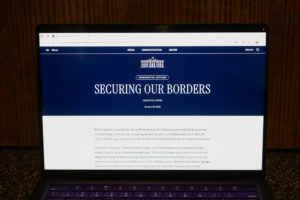
The directive bars foreign nationals from 12 countries, including Iran, from entering the U.S. – and imposes a partial travel suspension on seven other countries, such as Venezuela and Turkmenistan. It claims to target countries that sponsor or promote terrorism, as well as those whose immigrants frequently overstay their visas, effectively precluding 6% of the world from entering the U.S., according to the American Immigration Council.
Namavar, a fourth-year sociology student, said she left the majority of her family behind in Iran when she immigrated to the U.S. as a child. Now, she fears she will face scrutiny from the government when traveling between the two countries, she added.
Trump’s previous travel ban – enacted in 2017 during his first term – also prevented Namavar’s relatives from being present for her graduation and other important moments in her life.
“A lot of moments I could have had with my family got stolen away from me,” Namavar said. “My grandparents, two of them passed away, and I haven’t been able to go to their funeral.”
A series of executive orders passed during Trump’s first term – coined a “Muslim Ban” by critics – blocked citizens of predominantly Muslim countries, such as Iran, Sudan and Yemen, from entering the U.S. The new travel ban, however, is broader – applying to 14 more countries.
Hiroshi Motomura, a professor at the UCLA School of Law, said both Trump’s previous and current travel bans reflect an ongoing agenda of targeting immigrants. He added that he believes the ban conveys that the Trump administration is open to “certain kinds of immigrants” – but only those they deem acceptable.
“It’s really rejecting the idea that America’s a nation of immigrants,” Motomura said.
The latest travel bans, which bar Haitian nationals from entering the U.S., have also prevented U.S. citizen Joanna Gaudet, a rising fourth-year psychology student, from visiting her relatives in Haiti for the summer with her family. She said she was worried her family members who were born in Haiti would face complications upon returning to the U.S.
Haitian citizens, whether immigrants or not, cannot enter the U.S. under the ban, though lawful U.S. nationals or permanent residents are exempt. The Department of State issued a Level 4 “Do Not Travel” advisory to the country July 15.
Gaudet added that she had hoped to meet her goddaughter in person and see the neighborhood where her mom grew up.
“I want to be able to see the country that my family comes from and reconnect with my roots, reconnect with my culture,” Gaudet said. “My Haitian culture is the biggest part of me.”
Along with fears of traveling abroad as a Haitian citizen, Gaudet said her mother took down the cultural bumper stickers and license plate from her car and began carrying her passport around, motivated by worries of U.S. Immigration and Customs Enforcement targeting her because of her Haitian background.
Proposed travel bans also have the potential to impact an educational trip at UCLA, said rising fourth-year political science student Jasmine Aner.
The UCLA Black Male Institute organizes an annual trip to Ghana as part of its mission to create equitable educational opportunities for Black male students, according to the UCLA Center for the Transformation of Schools. But the Ghana trip could be at risk due to a proposed travel ban, said Aner, who is set to go on the trip.
A June 15 diplomatic cable from the State Department threatened 36 nations, including Ghana, with travel bans if they fail to take action against issues like antisemitism, terrorism, anti-American sentiment and their citizens staying in the U.S. illegally, according to Reuters.
“I was just devastated, disappointed,” Aner said. “This is a major step back for all people of color, because it’s 15 Black students going to West Africa for the first time.”
The trip, which is set to happen from Aug. 7 to 14, was still on as of July 26. Aner said she sees the trip as a chance to connect to her Black heritage – and that it felt “meant to be” after tracing her roots to Ghana.
“I may not have that opportunity ever again,” Aner said.
Motomura said the recent provisions are likely to put international students studying at American universities in challenging positions, as they may not travel to their home country during breaks out of fear that they will be unable to enter the U.S. again.
In addition to the travel bans, over 1,800 international college students had their visas revoked by the Trump administration in early April, with at least 19 UCLA students and alumni impacted.
A Department of Justice attorney said in an April hearing that the visas were being restored while U.S. Immigration and Customs Enforcement developed a “framework” for visa revocations. The Daily Bruin was unable to confirm if the UCLA students’ visas were reinstated.
[Related: Trump administration announces restoration of international students’ visas]
Motomura added that he believes international students will increasingly turn to Canada or countries in Europe to further their studies, rather than the U.S.
“The real cost of this over a generation is going to be not having all the international ties that have been the hallmark of U.S. influence,” Motomura said.


Comments are closed.