This post was updated Aug. 3 at 5:33 p.m.
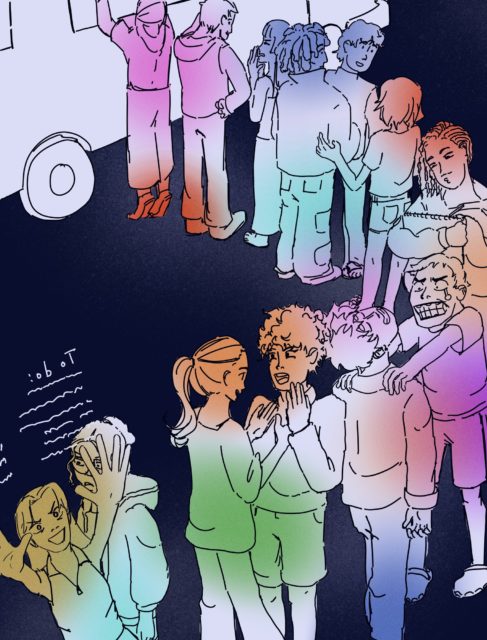
One of my most humbling moments at UCLA was when I waited two minutes in line for a cup of water.
Simultaneously, a strong advantage but annoying disadvantage of attending UCLA is how large the student population is. Undergraduates alone make up over 33,000 students.
Being surrounded by thousands of kind, intelligent, hardworking and ambitious students has been a beyond enriching experience for me. But waiting in long lines is also a persistent frustrating side effect of the large student body.
While the urge to doomscroll in line is strong, students should maximize their waiting time by forming new social connections or studying.
Gluing my eyes to my phone often made me feel guilty, as I knew I could have spent my hour in between class more wisely. So instead, I found ways to optimize such valuable time.
During the first few weeks of the quarter, especially during the fall quarter, I would talk to the people in line either in front of or behind me.
This strategy is how I met my boyfriend and one of my closest friends at UCLA.
I distinctly remember standing in a 30-minute line at Spice Kitchen at Feast for a comforting bowl of pho during week zero of my first year at UCLA.
I was deciding whether to scroll on my phone and shut the world out or try to make new friends.
Then I overheard two men behind me talking about advanced placement government. Assuming they were political science majors, I asked what their majors were.
They both laughed and said they were computer science majors. Computer science majors who were politically informed? I was so excited to talk to them.
We ended up talking for three hours, eating pho and laughing like old friends. I realized that I could have missed out on deep friendships if I had chosen to use my phone while waiting in that line.
Lines are optimal for socializing because everyone is standing in the same place with nothing to do. There is almost a guaranteed commonality of attending the same university. Bruins also tend to be friendly, which makes introducing yourself easier.
Socializing is not the only option Bruins have to make lines valuable. If my social battery was particularly low, especially after a long day at work, I would answer emails, texts and Slack messages to make sure I was in touch with my colleagues, family and friends.
Getting the chance to catch up with people you are close with is not only a great way to pass the time, but also a comforting activity after the rush of attending class or going to work.
If students are feeling more productive, another great alternative is brainstorming and editing essays while waiting in lines.
At first, I tried not to do this. I already spent most of my day studying or working, so thinking about dense topics during periods of just waiting in line felt exhausting.
On more difficult days, I combatted this by giving myself breaks. The first 10 or 15 minutes I would spend scrolling through Instagram memes or listening to music, and the next 10 or 15 minutes I would write out all of my initial thoughts for an essay prompt.
Other days, I spent the entire hour editing essays I had already written and thinking of questions to ask during the professor’s next office hour.
The boredom of waiting in long lines is unexpectedly perfect for brainstorming, as boredom lets you think through your thoughts instead of someone else’s.
Without distractions to pull me away from my own arguments and busy myself with less important issues, I was able to formulate stronger and more creative ideas.
Yet another way to optimize time in line is to listen to recordings of lectures and review slides, especially before finals and other important exams.
Staring far off into the distance, I tested myself on class material. I put away my phone with notes on the material and recalled as much information as I could about the topic. I would later learn that this is a form of active recall, a study technique I failed to learn in high school and community college but practiced at UCLA.
Regardless of what exactly I accomplished during that hour waiting in line at UCLA, I tried to complete at least one or two important tasks.
UCLA students, known for a strong work-hard, play-hard balance, can accomplish even more if they are productive while waiting in lines, whether that be socially or academically.
When I remained productive while waiting in long lines, I used my time in a way future Amy would be appreciative of. I encourage other Bruins to consider doing the same.

Comments are closed.