
This post was updated Aug. 24 at 4:45 p.m.
The California State Legislature passed the California Public Records Act (CPRA) in 1968 to ensure government transparency and accountability.
CPRA, upon request, requires public documents to be disclosed to the public within a 14-day period, unless there is a privacy or public safety issue preventing the agency from doing so.
The state law relies on government agencies to be transparent with their actions. Yet when students searched for answers and demanded access – UCLA stayed silent.
The Daily Bruin has more than 70 outstanding requests, all filed over six months ago. More than 30 requests from The Bruin have waited over 300 days without any indication of exemption.
These requests include information on powerful figures like UC President Michael Drake, then-UCLA Chancellor Gene Block and Administrative Vice Chancellor Michael Beck.
Drake just announced a ban on all student governments from boycotting companies associated with Israel. Under Block’s leadership, UCLA declared the first Palestine solidarity encampment unlawful and watched the same day as students were attacked by counter-protesters. Months later, Beck announced Time, Place and Manner policies that define when, where and how students can express their right to free speech.
“We recognize the importance of adhering to the California Public Records Act in a timely and transparent manner,” a UCLA spokesperson wrote in an emailed statement.
The UCLA mission statement claims the university’s primary purpose is “the creation, dissemination, preservation and application of knowledge for the betterment of our global society.” It claims to value “open access to information.” Yet UCLA is historied with CPRA noncompliance.
UCLA failed in 2018 to release a video of audience members heckling then-United States Secretary of the Treasury Steve Mnuchin at the UCLA Burkle Center for International Relations in a timely manner. The Foundation for Individual Rights and Expression, then known as the Foundation for Individual Rights in Education, sued and won.
This year, the Palestine Solidarity PRA Collective sued the UC for access to seven documents because UCLA refused to fulfill records requests. UCLA cited public interest as being the reason it refused such requests, which is a valid reason under CPRA.
However, public records requests offer a glimmer of truth and transparency, especially when organizations fail to be honest.
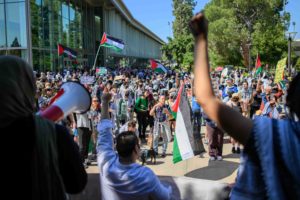
The Los Angeles County Sheriff’s Department claimed it was not involved in the response to the April and May 2024 encampment during a Daily Bruin investigation. After months of evading public records requests, over 30 Daily Bruin photos told a different story. LASD’s acting chief of the special operations division, Thomas Giandomenico, later said the department’s statement was a “misinterpretation.”
These top-down decisions are being made behind closed doors and impacting students greatly. Institutions made to serve their populations are limiting the ability to organize, speak freely and hold individuals accountable. At a taxpayer-funded university, with approximately 79.4% of undergraduate students from California, emails, meeting notes and decision-making documents cannot remain concealed. When pressed on how these policies are crafted and how decisions are made, the administration provides very little clarity. This lack of transparency breeds mistrust.
The UCLA spokesperson responded that the amount of time it takes to process requests is dependent on different factors, and each step in the process is necessary to comply with privacy and confidentiality laws.
Students also depend on the university’s cooperation with CPRA to provide answers on where UCLA spends its approximately $11 billion annual budget.
UCLA wasted at least $213 million on the Ascend Finance Transformation project, a messy IT project that still sits incomplete. The university spent $11,781,917 on security and law enforcement during the Spring 2024 pro-Palestine protests, which included the injury of several students in the April 30 and May 1 counter-protester-led attack and the arrest of over 200 people in a police sweep the following night.
These failures are not just procedural – they directly harm students’ ability to seek truth, understand administrative decision-making and hold leadership accountable.
The UC system must recommit itself to the transparency it so often claims to uphold. Repeated failures to comply with CPRA – from suppressing footage to stonewalling advocacy groups – are not isolated missteps or oversights. They reflect a much deeper institutional parasite that is failing to be accountable. When UC delays, denies or forces legal action to access public documents, it erodes trust and violates the core principles of a public institution.
At a time when campuses’ battlegrounds for free expression and political speech are increasingly volatile, the UC’s refusal to turn over basic documents sends a chilling message: We will act, but we will not answer for those actions. This should concern everyone – not just the students waiting for their CPRA requests to be answered. The system must establish clear, enforceable timelines for fulfilling public records requests, allocate sufficient resources for compliance and publicly commit to upholding oversight. Student journalists and the broader public deserve answers and transparency.
Transparency isn’t just about paperwork. It’s about power. Refusing to release records about protest response, law enforcement presence or outside political influence prevents students from understanding who is really in charge – and whose interests are being served.

Comments are closed.