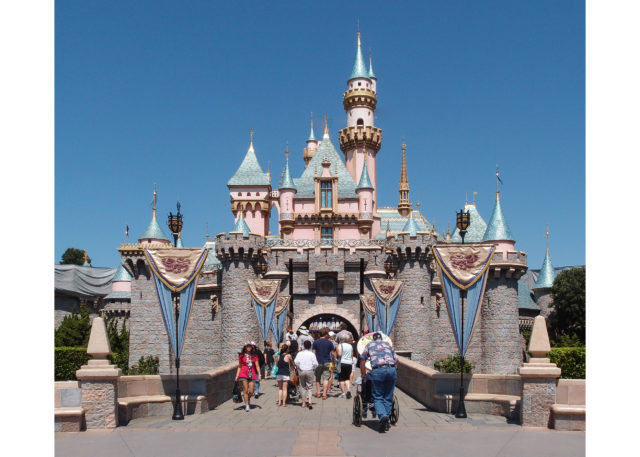
This summer, Disneyland celebrated its 70th anniversary.
The park’s celebrations included the debut of its new attraction “Walt Disney – A Magical Life” and additions to both the Main Street Cinema and “it’s a small world” ride, according to the Walt Disney Company website. Guests also attended a special 70th anniversary parade while collecting souvenir guide maps and anniversary buttons at the park.
Walt Disney modeled the amusement park over seven decades ago after a variety of significant locations in his own life.
Jeff Kurtti, a presidential fellow at Chapman University and Walt Disney historian, said Disney drew inspiration for the amusement park from his childhood in Missouri and watching his daughters play at Griffith Park in Los Angeles. Kurtti added that Disney was also influenced by his travels to world fairs around the country, inspiring his vision to replicate a place where parents and children could have fun together.
“This idea of some sort of destination amusement that sort of brought dimensionally to life the settings of stories, sort of living cinema, was something that kicked around in his mind his whole life, and finally saw its fruition in what we know as Disneyland,” Kurtti said.
Disneyland distinguished itself from popular urban amusement parks like Coney Island USA by incorporating television into the Disney experience, according to business news website, ZDnet. By creating distinct themed areas in the park, the amusement park tried to mimic the experience of physically switching television channels as visitors wandered through the park.
Kelsey Knox, university archivist at UC Santa Cruz and co-author of “The Women Who Made Early Disneyland,” a book recognizing the legacy of women who helped create Disneyland, said Disney is responsible for creating the modern theme park model. She added that Disney’s incorporation of thematic storytelling and offering of more than just rides in the park revolutionized the industry.
Along with manufacturing a studio-set atmosphere, Disneyland was unique in its representation of real places with a strong sense of nostalgia.
For example, the park’s first themed area was Main Street, USA, which was inspired by Kansas Street, a major street in Disney’s hometown in Marceline, Missouri, according to the Smithsonian American Art Museum.
However, Knox said Main Street, USA’s design is nostalgic for many visitors – regardless of where they are from – reminding them of small-town America.
Kurtti said the park-wide nostalgia also served to provide visitors with a sense of cultural normalcy after the devastation of World War II. Through architectural markers of the 1950s like Victorian-style scalloped woodwork, ice cream parlors and sweetheart chairs, Kurtti added that Disney created a physical atmosphere that would reassure visitors that their nation could return to its pre-war image.
Michael Steiner, a retired professor emeritus of American studies at Cal State Fullerton, said Disney wanted the park to feel like an imagined utopia during a time of uncertainty for many Americans.
“He was kind of a platonic idealist. He felt that (Disneyland) was reality, not the ugly sprawl that surrounds,” Steiner said. “He was trying to project what he thought was a positive image of America for people.”
However, Disney’s idealistic vision for Disneyland did not always reflect history with complete accuracy.
According to the Montana Historical Society, the use of Western iconography in Frontierland – Disneyland’s recreation of the 19th-century American frontier – presented a distorted version of Western history by omitting the experiences of people of color, including Mexicans, Indigenous peoples and African Americans.
In 2020, NPR reported that Frontierland’s popular attraction Splash Mountain received criticism for its association with the 1946 Disney film “Song of the South,” which negatively depicted Black Americans post-emancipation.
A petition was created in June of that year to pressure the amusement park to change the ride’s theme from “Song of the South” to the 2009 film “The Princess and the Frog,” which features Princess Tiana, Disney’s first Black princess. According to the non-profit organization Change.org, which initiated the petition, over 21,000 supporters ultimately signed the petition and were in favor of Splash Mountain’s retheming.
Within a month, according to CNN, the Walt Disney Company announced that it would reimagine the attraction at both Disneyland and Walt Disney World in the theme of “The Princess and the Frog.” The renamed attraction, now called Tiana’s Bayou Adventure, opened on Nov. 15, 2024, and brings riders along on Tiana and her friends’ journey to find a band for the upcoming Mardi Gras performance, according to the Disney Experiences website.
According to the Walt Disney Imagineering website, Disney’s philosophy of embracing change inspired Disneyland engineers to renovate the Splash Mountain ride. Engineers specifically chose “The Princess and the Frog” for the redesign to provide a more inclusive representation of Black characters within the Disney universe.
Steiner said Disney’s redesign of Splash Mountain serves as an example of the company’s efforts to represent historical imagery in its rides with greater accuracy and diversity. In the future, he added that Disneyland could recreate the frontier myth – a process that Tiana’s Bayou Adventure has started – by including education of Indigenous and Black history in the park experience.
“You could stress the cultural borrowing that took place in early stages of the frontier … at the same time that you make people aware that there was a lot of darkness there too,” Steiner said.
While Disneyland attempts to offer a more realistic depiction of the past, Knox said the park’s ability to offer an escape from everyday life is a fundamental aspect of its legacy.
“Walt Disney wanted your focus to fully be on the fantasy and what was happening in Disneyland, as opposed to thinking (of) it as part of the outside world,” Knox said.
As Disneyland celebrated its 70th anniversary, Knox added that the park’s displays of fun and happiness are a main reason for the park’s appeal.
“By being in Disneyland, you’re in this fantasy world where nothing bad is happening,” Knox said. “You go to Disneyland to feel joy and to feel enjoyment in the surroundings that you’re in.”


Comments are closed.