This post was updated Aug. 24 at 7:41 p.m.
A court ruled Thursday that UC Regent Jay Sures must pay $150,624 of graduate student Dylan Kupsh’s legal fees after Sures unsuccessfully attempted to file a restraining order against him.
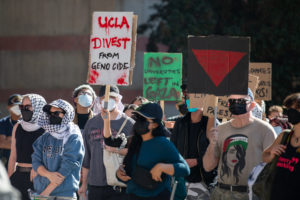
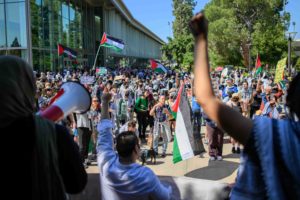
Kupsh – along with around 50 other pro-Palestine protesters – demonstrated outside Sures’ Brentwood home in February, calling him “responsible for protecting UC investments in genocide and weapons manufacturing.” Lawyers representing Sures initially alleged that Kupsh was a “ringleader” among the protesters, but were unable to prove the claim in court.
[Related: Pro-Palestine protesters demonstrate outside UC Regent Jay Sures’ home]
Ben Gharagozli, a lawyer representing Kupsh, said they responded to Sures’ lawsuit with a successful anti-SLAPP motion – a legal process that allows defendants to strike down cases targeting free speech on matters of public concern.
“A lawsuit like this one is essentially challenging someone’s constitutional rights,” Gharagozli added. “The defendant can move to strike the complaint by saying, ‘Hey, wait a minute, this is my constitutional right to protest.’”
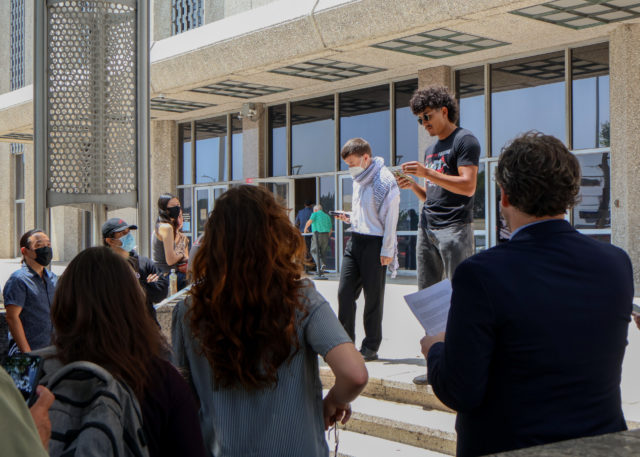
About 30 people gathered outside the Los Angeles Metropolitan Courthouse around 12:40 p.m. to rally in support of Kupsh. Supporters gave speeches before and after the court session and chanted “The students, united, will never be defeated.”
Kupsh said he believes the case was representative of a larger attempt by UCLA to create what he called a “false Zionist narrative” and suppress pro-Palestine activism on campus.
“Part of this case is showing this narrative of known university complicity,” he added. “The university is not listening, and making protests necessary in order to make sure that our voices are heard, and there’s at least some pressure on them to do something.”
The UC Office of the President did not respond in time to a request for comment on the court’s decision.
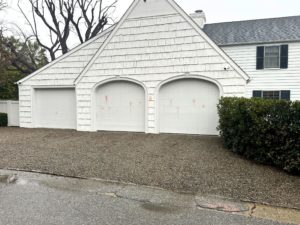
Stephen Fraser, a lawyer representing Sures, said the original lawsuit was an attempt to prevent Kupsh from returning to demonstrate outside Sures’ home. Protesters in February left red handprints on Sures’ garage and caution tape in his yard, and held a banner that read “Jonathan Sures you will pay, until you see your final day.”
UCLA suspended Students for Justice in Palestine at UCLA and Graduate Students for Justice in Palestine at UCLA – two student groups that attended the protest – a week after the incident. Chancellor Julio Frenk said in a campuswide email announcing the suspensions that members of SJP and Graduate SJP harassed Sures, prevented one of his family members from exiting their home and vandalized the area.
[Related: Chancellor Julio Frenk announces suspension of two pro-Palestine student groups]
UCLA’s Office of Student Conduct recommended in March that SJP face an indefinite ban from campus, while Graduate SJP should lose its status as a student organization for four years.
[Related: UCLA recommends indefinite ban for SJP, 4-year suspension for Graduate SJP]
Sures, who is Jewish, is the vice chairman and a managing director of the United Talent Agency, where he represents the Anti-Defamation League – an organization that seeks to combat antisemitism and frequently advocates for Israel.
Sures is also a board member of the LAPD Foundation, which raises money for the LAPD, and serves as chair of the boards of governors for two laboratories that develop and test United States nuclear weapons – the Lawrence Livermore National Laboratory and Los Alamos National Laboratory.
Sures also introduced Item J2 – a policy, initially named Item J1, which prohibits academic departments from making political statements on their website homepages – to the UC Board of Regents in January 2024.
[Related: UC Regents votes to pass Item J2 following months of revision and deferred voting]
While Sures’ co-author, Regent Richard Leib, called the policy “content-neutral,” some UC students and faculty have claimed that it targets pro-Palestine speech in particular. Nine chapters of Faculty for Justice in Palestine across the UC criticized the policy following its July 2024 approval in a joint press release, calling it an “attack on free expression.”
[Related: UC Board of Regents Item J1 elicits mixed reactions from UCLA faculty]
Gharagozli said he hopes the case sets a precedent for other people defending their freedom of speech in court, adding that “those who try to use their wealth and power to silence voices” should worry about anti-SLAPP laws. While Sures has 60 days to pay the required amount, Gharagozli said his team would look into alternative methods – such as garnishing Sures’ wages – in the event that he refused to.
Kupsh said he will continue to advocate for the UC to divest from Israel, adding that he hopes the case’s result will serve as a warning for university administrators who he said have repressed the speech of student activists and organizations.
“I think this hearing really represents the first occasion where real accountability is happening,” Kupsh said. “Hopefully these legal fees represent something more than just one case alone.”