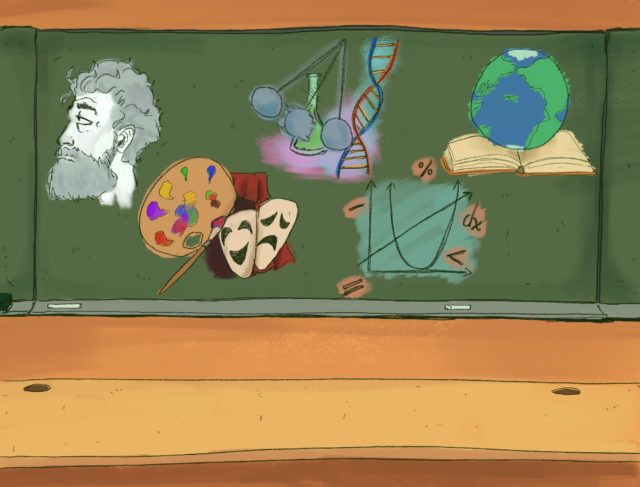
Bruins plan out their academic schedule with a mix of major-related courses and general education requirements ahead of the new school year.
The UCLA Registrar’s Office defines GE courses as introductory classes designed to equip students with essential university-level skills and introduce them to academic subjects in the arts, humanities, social sciences and natural sciences. All undergraduate students are required to take GEs, and they are intended to help students think critically, become better problem solvers and deliver persuasive arguments both orally and in writing.
The GEs are organized into three areas of study: Foundations of the Arts and Humanities, Foundations of Society and Culture, and Foundations of Scientific Inquiry. According to the UCLA Registrar’s Office, students must complete courses from a range of subtopics within each foundation to fulfill their GE requirements, all of which vary depending on their school. For example, the College of Letters and Science requires all students to complete 10 GE courses, while the Henry Samueli School of Engineering and Applied Science only requires students to take five.
Andrew Rice, a second-year aerospace engineering student, said he has already completed two of the five GE courses required for students in the Henry Samueli School of Engineering and Applied Science. He added that his major offers less flexibility in the classes he can take such as being restricted from enrolling in cluster courses, which are yearlong GE courses open only to first-year students.
“I can’t say I love taking the GEs, but I still feel like it’s important. … I still think I’m going to ultimately be benefiting from taking those classes,” Rice said.
According to the UCLA Undergraduate Education Initiatives, GE courses are intended to bridge gaps in shared cultural values and common knowledge. The UCLA Center for Academic Advising in the College adds that GE courses are designed to help students explore subjects beyond their major and understand the connections between various academic disciplines. These requirements also support students in identifying their academic interests while also teaching them new ways of thinking.
In a written statement, Corey Hollis, assistant vice provost and undergraduate academic support executive director for the Center for Academic Advising in the College, said UCLA offers 170 GE courses each quarter. She added that the GE curriculum is integral to a student’s academic journey at UCLA, as they promote well-roundedness in students and allow opportunities for personal and academic growth.
“So even though you may be a history, psychology or biology major, GEs in other areas can give you a different perspective on what you learn in your major,” she said. “In addition, they can also help you narrow down an area or discipline that you might want to major in by giving you a taste of what that discipline is about.”
Columbia University introduced the first model of a general education curriculum in 1919, according to Dordt University. Following the events of World War I, educators at Columbia determined that college education should prepare students for the complexities of contemporary society by balancing in-depth specialization of a major with a broader curriculum spanning the humanities and natural sciences. The university introduced yearlong interdisciplinary classes in these fields, and by the mid-twentieth century, a number of institutions adopted Columbia’s approach to general education by introducing their own curricula.
Dordt University reported that general education underwent a second wave of reform as educators at Harvard University emphasized the importance of general education in promoting democratic ideals and values in the aftermath of World War II. A renewed interest in general education brought about institutional support in strengthening the curriculum across many universities and colleges.
By the start of the Vietnam War, the general education model experienced a third wave of reform, Inside Higher Ed reported. This last reform laid the foundation for the modern curriculum many colleges use to this day, characterized by a wider variety of requirements students must fulfill and offering greater flexibility in the courses students choose to enroll in. By 2018, American University reported that approximately 95% of four-year institutions across the country offered GEs in some capacity.
Dante Simonetti, an associate professor of chemical and biomolecular engineering and vice chair for undergraduate education, said when considering which GEs to take, students must carefully assess which courses peak their interest and decide what they want to get out of their classes. He added that he has found it challenging to motivate students to take courses outside of their comfort zone.
“I think students often want to come in and do what they’re comfortable with,” Simonetti said. “On the flip side, it’s being outside of that comfort zone which helps students sharpen their thinking skills and their communication skills. That’s really a huge benefit that shouldn’t outweigh any small fear of going outside of one’s major discipline,” he added.
Concerns over GE requirements by professors and academic advisors are not new at UCLA.
UCLA professors across various departments created a task force in June to review and redesign the current GE requirements. The current GE program is almost 20 years old, and some say they worry the outdated model does not support the needs of students in a comprehensive manner.
[Related: General education task force seeks to revise program]
Students also said they struggle to understand the main purpose of taking a GE, often concerned more with academic performance rather than the learning experience the requirement is meant to provide.
When enrolling in GE courses, Rice said he looked for classes he thought would be easier, with the goal of boosting his GPA. However, he said he wished he took classes that better aligned with his interests instead.
“There can be a mix of taking something you’re interested in while still trying to maximize the GPA,” Rice said. “There’s so many options, especially at UCLA. Really just find something you actually want to learn about,” he added.
Despite this mindset, according to the UCLA General Catalog, students are encouraged to view GEs as more than just a checklist of required classes. Hollis said GEs are an integral element of a Bruin’s academic journey at UCLA.
“Students should be intentional about their college careers – not just in the choice of major but in the classes they choose and opportunities they engage in,” Hollis said. “This college is the perfect place to develop that narrative of who you are, what you stand for and where you are going, and GEs can be a part of that process.”


Comments are closed.