This post was updated Aug. 31 at 10:08 p.m.
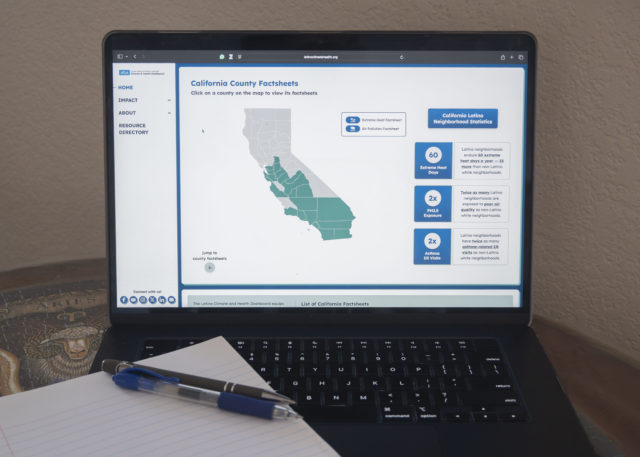
A new technology dashboard created by UCLA researchers highlights climate inequity and air pollution in the Latino community.
The UCLA Latino Policy & Politics Institute’s Climate & Health Dashboard is a resource for the Latino community in California to view data about environmental exposure and public health, said Silvia González, a research director at the UCLA Latino Policy & Politics Institute.
González added that she hopes the dashboard helps bring attention to environmental equity issues, noting that Latino neighborhoods – on average – experience about 25 days of extreme heat annually compared to white neighborhoods, which only experience eight.
The fact sheets available on the dashboard define annual extreme heat days as the average temperature of the day being 90 degrees Fahrenheit or greater.
“There’s this huge disparity about where we live as Latinos and the consequences of that to our health and our well-being,” González said.
Communities of color and low-income communities often live in semi-arid or desert areas because they are more affordable, González said. Latino neighborhoods have an average of 4% of the area covered by trees compared to the average of 9% for white neighborhoods, she added.
According to the U.S. Environmental Protection Agency, trees can help reduce temperatures in areas with higher temperatures than surrounding areas. They can also reduce the amount of energy needed to cool buildings since they provide shade.
However, it can be difficult to add and maintain more trees in neighborhoods because of how expensive they are, González said. She added that homeowners must pay to water the trees, trim them and tend to problems caused by the trees such as damage to the sidewalks.
Due to the high costs, González said low-income communities often have to make the difficult decision to choose between paying the water bill for their house or add another tree for more shade.
Latino communities also have more workers in industries where workers are exposed to heat every day, said Samantha Alejandre, a research assistant at the UCLA Latino Policy & Politics Institute. According to the dashboard, in Los Angeles County, 25% of workers in Latino neighborhoods work in heat-exposed industries compared to 8% of workers in non-Latino white neighborhoods.
Alejandre said some Latinos who do not speak English may struggle to communicate their health concerns at work.
Limited English proficiency can also lead to problems during weather emergencies, said Rosario Majano, a research analyst at the UCLA Latino Policy & Politics Institute.
“In the event of an emergency – whether, again, that’s climate, that’s environmental – there’s no guarantee or there’s no policy in place to make sure that they get language specific warnings or instructions about where to evacuate, how to take care of themselves,” Majano said. “That’s one of the unique challenges facing Latino communities, but also immigrant communities or communities who have high rates of limited English proficiency.”
Albert Kochaphum, a developer at the UCLA Latino Policy & Politics Institute, said he hopes the dashboard empowers policymakers and community members to address the current heat waves.
Since the data is presented at the county level, Kochaphum said policymakers and advocates can use the information about how their communities are impacted by extreme heat and air pollution to attain resources for their constituents such as grant funding.
González added that the data presented in the dashboard can inform future decisions in the context of climate disasters.
“Unfortunately, we, as researchers, know that disasters are going to be more commonplace,” González said. “We hope that, again, thinking in the future, this information will help us make better decisions about how we invest the limited resources that we have.”


Comments are closed.