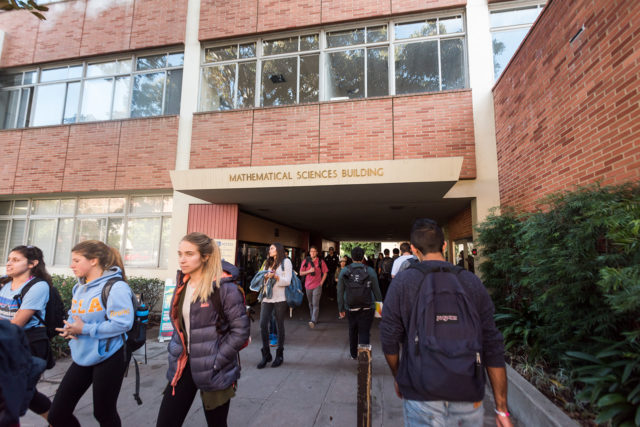
AI learning tools will be introduced to undergraduate physics and math courses this fall.
The Artificial Intelligence and Math Skills program, a two-year project aiming to decrease learning disparities in introductory STEM courses, will be implemented across physical and life science courses to improve student learning experiences, according to the UCLA Center for Education Innovation & Learning in the Sciences website. The program will use supplemental math materials and AI hinting tools to support students who need more support with mathematical skills, according to the website.
The initiative stems from a joint study conducted by UCLA and UCSD faculty members, which found that incentivized supplemental math assignments are associated with improved exam performance.
Alexander Kusenko, a professor of physics and astronomy at UCLA who serves as the primary investigator for the AIMS project, said levels of performance in calculus and physics courses vary for students from different socioeconomic backgrounds. The results of the study showed that supplemental learning methods and Kudu – an AI learning platform that provides restricted AI-generated hints to students needing support – were associated with higher exam scores for students, he added.
This learning model can be applied in many undergraduate STEM courses, said Shanna Shaked, senior associate director of CEILS who serves as a collaborator on the AIMS initiative. She added that she believes one of the most exciting aspects of this model is how it incentivizes supplemental math activities, as the students who score lowest on exams will earn the most points for completing the supplemental resources.
“That makes me very excited, because we have discovered something useful. And it’s working for all the students, but particularly for the students who need most help,” Kusenko said.
Shaked said the AIMS initiative is funded by the Teaching and Learning Center Tier 4 Grant – which supports larger-scale educational innovations that promote student exploration, creativity, engagement, discovery and success, according to the TLC website. The program was awarded a Track 2 Implementation Grant, which can provide up to $100,000 to teams of faculty and students seeking to tackle student needs and challenges through pedagogical transformation, the website said.
K. Supriya, associate director of CEILS who co-authored the study and serves on the AIMS program, said federal funding cuts affected research for this initiative, as researchers submitted an NSF proposal a few days before UCLA’s funding was paused, and have yet to receive feedback.
[Related: Research grant suspension impacts applied mathematics program, collaboration]
Shaked added that the TLC grant was critical to the implementation of the AIMS project because it is not associated with national funding allocations, allowing research to continue.
“Thanks to that grant, we’re able to keep doing some of the work,” Shaked said. “Not nearly in as much depth or with as much evaluation and research as we would like, but certainly able to continue broadening the use of these promising interventions.”
The TLC funds will be used to support graduate students who help develop materials for the program, as well as the instructors and investigators who implement the program, Shaked said. She added that the grant allows researchers to continue working on the AIMS project, but many participating faculty members are also being impacted by the research funding freeze, which makes adequate compensation for their work and time more challenging.
As the program grows, Supriya said the project will expand its implementation of AI learning tools to introductory chemistry courses, such as general chemistry, with the hope of reaching life sciences courses.
If evidence shows that incentivized supplemental assignments are effective in different contexts and settings, these tools could be useful for instructors at all levels and for all kinds of courses, Supriya added.
As AI becomes increasingly integrated into higher educational institutions, Supriya said researchers should explore how initiatives like AIMS can maintain or increase student learning by offering tailored support.
“It’s a helpful tool,” Supriya said. “I only see the use of such things growing over the next five years.”
Contributing reports by Shaun Thomas, science and health editor.

Comments are closed.