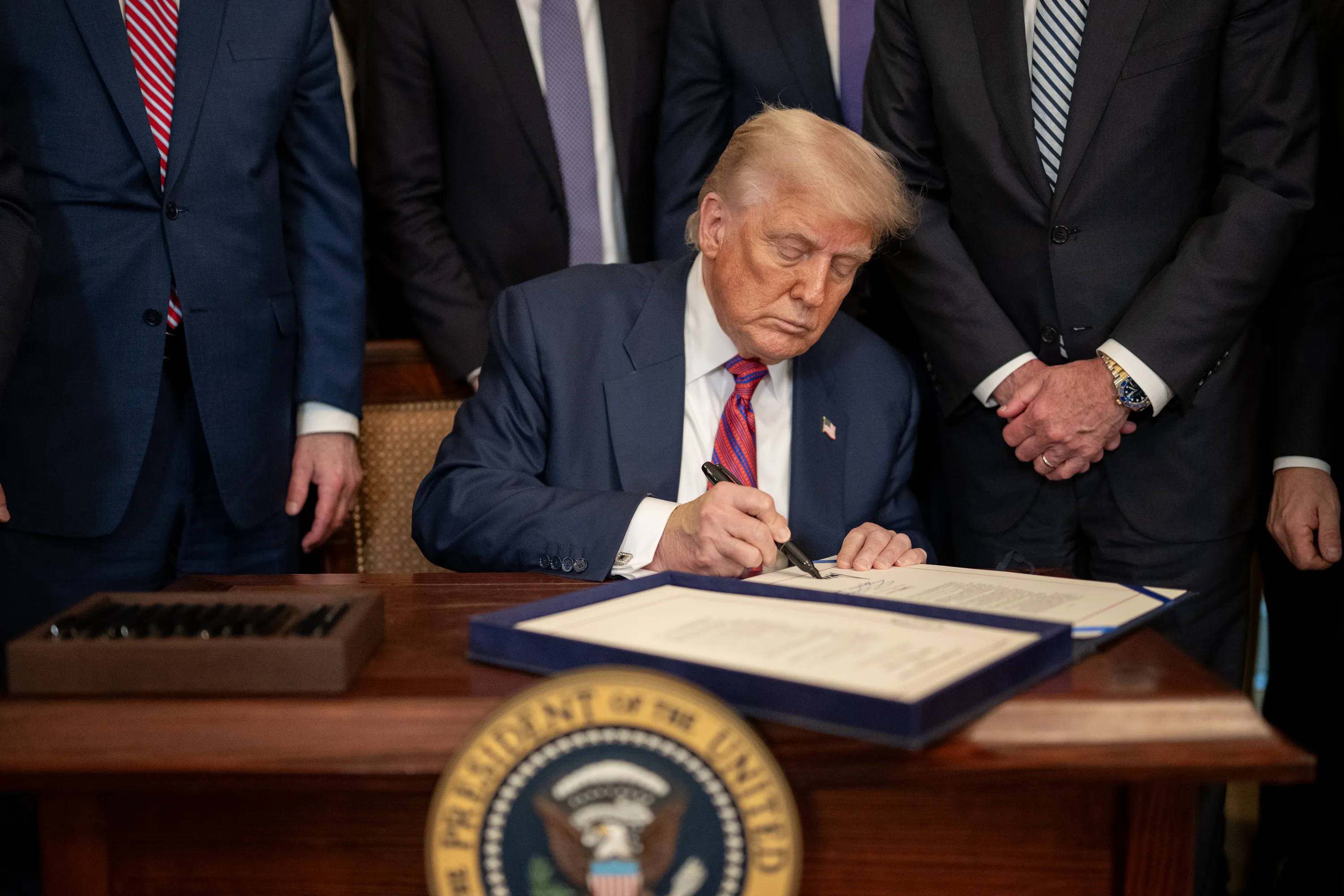
The Trump administration’s executive actions have posed constitutional concerns for legal professionals, institutions and law students.
According to the American Bar Association, within the first three months of taking office, the administration has issued several executive orders targeting the nation’s leading law firms for their work and affiliations. In response, many firms filed lawsuits against the administration, arguing that the orders were unconstitutional and undermined the rule of law, Business Insider reported.
The Administrative Office of the United States Courts define the rule of law as a principle ensuring all individuals, regardless of their position or authority, are held accountable to the same laws. As defined, these laws are publicly announced, enforced equally, adjudicated independently and aligned with the international principles of human rights.
Ariela Gross, a distinguished professor of law and history at the UCLA School of Law, said this principle holds the government to the same laws as the general public.
“In its broadest sense, the rule of law is the idea that we are a government of laws and not men, that we actually follow the laws that are passed by the legislature and that we follow the Constitution as interpreted by the courts,” Gross said.
However, in March and April, according to Reuters, some law firms have been targeted by the administration for their work involving immigration, supporting transgender rights and investigations into the Jan. 6 riots. The administration accused these firms and their cases of undermining U.S. interests.
The American Bar Association reported that the administration’s executive orders, letters and memoranda have subjected these firms to revoked security clearances, hindered access to federal buildings, canceled government contracts and mandated a federal review of their diversity, equity and inclusion programs and policies.
The Center for American Progress, a nonpartisan public policy group, found that, in targeting these firms, the administration exceeded its executive authority and may have violated the firms and their clients’ constitutional rights to free speech, due process and access to legal counsel.
According to the New York Times, these targeted law firms have reacted to the administration’s executive orders in a variety of ways: some have challenged the administration through lawsuits while others have yielded to its demands to avoid further repercussions.
The Associated Press reported that Paul, Weiss, Rifkind, Wharton & Garrison, a multinational American law firm, was the first firm to capitulate to the administration’s demands. In March, Trump signed Executive Order 14237, which alleged the firm had engaged in discrimination and a weakening of the judicial process. As a result of these allegations, the order called for major restrictions on the firm in its relations with the federal government.
Within three months, leaders at Paul, Weiss negotiated with the administration to provide $40 million in “pro bono” work – free services for the public good – in exchange for the lifting of the executive order and its restrictions.
After the Paul, Weiss agreement, the New York Times reported that eight other major firms have taken preventive measures and struck a deal with the administration by promising nearly $1 billion worth of pro-bono work.
As a part of these firm’s negotiations with the administration, ProPublica reported that many of them have also refused to represent clients who have previously opposed Trump or may be targeted by the administration in the future.
Gross said the partnership between these firms and the administration are leading some students to reevaluate and deeply consider the firms they want to work for.
“Seeing so many prominent institutions or individuals bending the knee was really scary,” she said. “We could only imagine our students just looking at the job options might be thinking if this is the legal world they’re going into.”
According to Forbes and ProPublica, some law students worry that joining these targeted firms could limit their ability to take on pro bono work for causes not supported by the administration, including LGBTQ+ rights, environmental conservation, government accountability and political representations.
As a result, Politico found that some law students have increasingly started seeking jobs at firms that have resisted pressure from the administration, citing concerns about moral differences and a desire to uphold the rule of law.
Richard Abel, a professor of law emeritus at the School of Law, said law students have the right to boycott firms that have yielded to pressure from the Trump administration.
“There are plenty of law firms around. I think that’s the kind of principled action that law students can take, and I think they should do that individually and collectively,” he said.
In April, more than 1,200 law students from across the nation signed a letter issued by the American Constitutional Society, a progressive legal non-profit organization, alleging that the executive orders have assaulted the rule of law. This letter urged legal professionals from across the country to resist the pressures from the administration and uphold such principle.
Similarly, Reuters reported that, in the same month, more than 1,100 law students and 51 law student organizations from across the country submitted a brief in support of the law firm Susman Godfrey in their lawsuit against the executive office.
Grace Meng, the executive director of the David J. Epstein Program in Public Interest Law and Policy, said it is the responsibility of lawyers and legal professionals to defend the constitution and uphold the rule of law.
“It’s a statement of faith and in principles that are crucial for what we believe in – in our democracy and our Constitution,” she said. “It is a strong critique of the actions of the Trump administration and a desire to push back against those very real threats.”
Meng is one of more than 100 UCLA School of Law faculty members that signed a letter to their students, condemning the actions of the administration.
Legal educators from other universities across the country have joined Meng in these letters. Many voice concern that the administration’s actions could negatively affect the functioning of society and the future study of law, according to the Yale Daily News.
Gross said it is important for legal educators to continue supporting their students amid an uncertain time in the field of law.
“We stand against these actions. We stand with the people who are fighting back, and I hope that – as our students see us standing up – they feel less afraid to stand up,” Gross said. “There are many people out here who are by your side. So, if we all stand together, we can fight this back.”

Comments are closed.