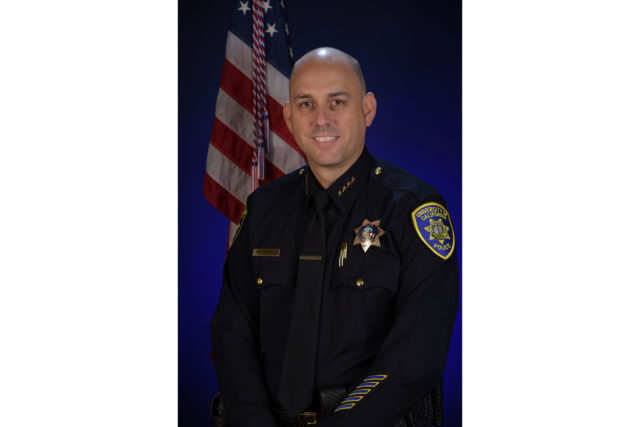
Craig Valenzuela, a UCLA alumnus and former Los Angeles Police Department commander, was appointed UCPD’s chief of police in July. He stepped into the role Sept. 1.
Valenzuela will be the fourth person to lead the department in under two years, after it came under fire for its role in policing campus protests. Former chief John Thomas was “temporarily reassigned” and then left the department in December 2024, after police took over two hours to respond to an attack on the 2024 Palestine solidarity encampment at UCLA and used tear gas, flash bangs and rubber bullets to arrest over 200 encampment participants the next day.
The department has also seen structural changes, with former Chancellor Gene Block creating the office of campus and community safety to oversee policing and public safety at UCLA. Valenzuela’s is the first appointment managed by Associate Vice Chancellor Steve Lurie, himself a former LAPD officer.
Valenzuela spoke with Daily Bruin metro editor Maggie Konecky about his experience, plans and approach to policing on campus.
This interview has been edited for length and clarity.
Daily Bruin: Congratulations on becoming the UCPD Chief of Police. You’re a UCLA alumnus yourself – what does it feel like to be back on campus?
Craig Valenzuela: It’s rather incredible. It’s beyond a dream job, because I don’t even think I ever dreamed of being back here. I love this university and it’s great to be home.
DB: Was there anything in particular that inspired you to apply?
CV: This university. As corny and maybe as simple as that sounds, I was a very happy LAPD employee. Things were going well for me. I was very happy with what I was doing. But this place just is a draw – as I can imagine, anybody who’s ever gone to school here, once they graduate and move on to do other things, they will feel drawn back to the university. That’s largely how I felt, and that’s the one special thing that drew me back here.
DB: You’ve had a long and storied career as an LAPD commander. Is there anything about that experience that’s going to inform your leadership and decision-making here?
CV: Early on in my career with LAPD, I was able to do so many different things in policing – and I specifically say policing and not law enforcement, because I think there’s so much more that we do as police officers than just enforce the law. I’ve been able to do everything, from dealing with vice problems like prostitution, gambling, drinking, to … I was able to work on a mental health response team early in my career. That really informed my outlook on how to solve problems. Arresting people is not always the solving of a problem. It may solve it very briefly, but things like treatment, therapy, help all of those things.
That’s a large way to say I think it’s prepared me to come to a place that clearly is smaller, but has many of the same urban problems that we see everywhere else in Los Angeles. I really feel like I’ve had this opportunity to create this multifaceted view of policing.
DB: When it comes to a community as large and varied as this one, what will be your approach to policing?
CV: First and foremost, I think it’s officers being visible. I don’t mean big, tough guys standing on corners, arms crossed, having this intimidating point of view. I really want to be able to have me or some police officers standing in line at Kerckhoff Hall to grab a cup of coffee and say, ‘Good morning,’ and make eye contact.
My philosophy is, it’s one interaction at a time, it’s one contact at a time, where we build trust. It’s the day-to-day officer who’s riding by on a bicycle and says, ‘Good morning,’ and you just hopefully feel more comfortable having the police around. To me, the police are not here to be anything other than a part of this diverse, safe community where hopefully people feel heard, seen and protected.
DB: Would you say that police have not been visible enough on campus in the past?
CV: Having been in the job eight days, I don’t know that I can tell you that firsthand, but it’s something that I have heard pretty regularly. And look, let’s face it, there is going to be a segment of your readership that doesn’t want to see the police on campus and I hope to change their minds. I hope to work with those people. I hope to work with your readers. I hope to work with this community, faculty, staff, visitors, parents – whoever it is. They may not understand, but at least we have that conversation.
DB: If we count those who had the job on an interim basis, you’re the fourth UCPD chief in around a year-and-a-half –
CV: – and I hope to change that. I hope to be a sense of calm and continuity, both within the police department and because, again – I go back to the community and building relationships and those interactions. People recognize who I am, hopefully recognize that they can come up and talk to me and we can talk about important issues on this campus.
DB: What about your predecessor’s work do you want to build upon, and what do you want to do differently?
CV: I’m really hesitant to look backward. I’m not going to criticize any of my predecessors, whether they were interim chiefs or the previous chiefs. I really want to have a forward-looking view of getting us to a place where people see the police as part of the community.
I really want to build upon my vision of more cops visible on campus, approachable, maybe even so much that you almost don’t notice them – but we’re there when we’re needed.
DB: UCPD has been criticized by many students for its tactics during campus protests, including detaining student activists and deploying less-than-lethal weapons – like batons – on crowds. What will your approach be to handling these difficult situations and will it be different from the leadership tactics used in the past?
CV: I get a sense, and I’ve heard, that groups do not work with us to prepare for when they have protests – which is totally different than when I worked with the LAPD. We would meet with protest groups leading up to … look, I want to be very clear. I cherish, I understand, I remember activism on this campus – and First Amendment activity – when I was a student. I think it is paramount. This place, this university, is an important voice in all of these conversations.
In terms of going forward, I would encourage those groups to work with us. I’ll meet – we’ll meet in a coffee shop. I’ll be in something other than a uniform. I want to have conversations so that their message can get out. I want – without any bias, because we’re non-political – to support their ability within the guardrails of the First Amendment, within the guardrails of the Time, Place and Manner rules. The longer and louder, within the rules, they can have their activism heard, I think is incredibly important. I implore them – all the activists, unions, student groups – to work with us. Let us help you do it the right way, so you can do it louder and longer, and not end in something that is either illegal or violent.
[Related: UCLA set to revise Time, Place and Manner policies, expand public expression areas]
DB: Tell me more about policing being non-political. I’ve always thought – I know you said not to use “law enforcement”, but in the context of “law” – politics are inherent?
CV: I want a police that somebody has no idea who I voted for, no idea what political party I might be in. It’s non-political from the point of view of, “I don’t have a side, except for lawfulness, peace.” People being seen, people feeling protected – if that’s political, then yes, I guess maybe I am political – but to me, from a party view, we’re non-political.
DB: How do you plan to work alongside other departments, like Steve Lurie and the Office of Campus and Community Safety, in situations where student safety may be at risk? What’s the process for deciding which department gets to make the final judgement calls?
CV: One of the reasons why I took this job was because I thought the structure made for very clear reporting and a very clear chain of command. Clearly, AVC (Associate Vice Chancellor) Lurie is my supervisor. Clearly, AVC Lurie has a supervisor above him. I want to work across the board, with student affairs, student life, all of these things that policing on the campus is going to touch. From my point of view, my direction is going to come through AVC Lurie – but having now been to a few meetings with him – a lot of that is also collaborative.
This is not AVC Lurie and Chief Craig Valenzuela putting their hammer down and saying, “This is the way it’s going to be.” Again, going back to my time with the LAPD, that largely doesn’t work. Community policing, partnerships, all of those things take work, and take time and take listening. Oftentimes, it may take meeting in the middle, and that’s really the way I see things going forward.
DB: When it comes to those collaborations, do you think that UCLA was right to reassign former Chief John Thomas after the encampment?
CV: Having little to no information, that would be really unfair for me – and it’s really not my place – to judge. It’s my job to go forward. It’s my job to look forward. Now, don’t get me wrong, I want to learn from the past.
To harken back to my LAPD days, one of the core values of the Los Angeles Police Department is quality through continuous improvement – and we can’t get better if we don’t take those kinds of things and learn from them. So I’m going to do my best to learn and not judge.
[Related: UCLA Police Chief John Thomas ‘temporarily reassigned’ from duties]
DB: Just a few days ago, the Supreme Court ruled that some immigration enforcement activities that were previously on pause in LA are now able to resume. Given UCLA’s large immigrant community and workforce, have you been considering plans for what role UCPD will play in the event that there are immigration enforcement operations in or around Westwood?
CV: California law prohibits law enforcement, police personnel, to take part in immigration activities. Let’s be very clear, UCPD is not going to be walking up and asking anybody’s immigration status. We’re not going to be working with ICE to go and do immigration enforcement. I don’t know how to be any more clear than that, our job is to keep this campus safe and to follow California law.
DB: What would that look like in practice?
CV: Are you giving me an example? If a raid did occur?
DB: I understand UCPD wouldn’t aid in any way – but what would be UCPD’s role in that situation?
CV: We’ve had some conversations, right? If immigration enforcement comes to campus and we get a radio call, we get out there – I’m going to (be) asking our folks to make sure that who they’re seeing are actually federal officers. Then we’re gonna stand back, keep the peace as best we can. We’re not going to aid them in taking folks into custody.
If somebody walks up and attacks a federal officer, UCPD will intervene because now we have an unlawful act. So, we have to differentiate between immigration enforcement and an unlawful act. In an unlawful act, we have an obligation to take action.
DB: What in the future are you looking towards most?
CV: Kind of difficult to answer with having had eight days on the job. It’s really about getting to know everybody here within the department. I’m really looking forward to classes starting. I’m very used to walking up Bruin Walk and feeling like there are thousands of people with backpacks ready to go do and learn great things.
But let’s face it: the World Cup, our place for the Super Bowl and the looming 2028 Olympics. This campus may not be the center of it, but (it’s) pretty darn close to the center of everything. That is both a burden and something that I cannot wait for, and I’m going to work really hard to get our part of the police department ready for the Paralympic and Olympic Games in ‘28.
[Related: LA to host 2028 Summer Olympics, athletes to use UCLA facilities]
DB: What stood out to you most during your first eight days on the job?
CV: At the end of this month, it’s my 29th year anniversary in policing. I finished UCLA on Sept. 13, 1996. Seventeen days later, I started the Academy with the Los Angeles Police Department. That’s a long way to say I really think I know a lot about policing, but I have a lot to learn – from both everybody in this building and a lot from our community, about university and campus policing.
UCLA is quite unique given our urban nature, and the open campus environment, and everybody walking through this place. It really struck me on how much I really have to learn.

Comments are closed.