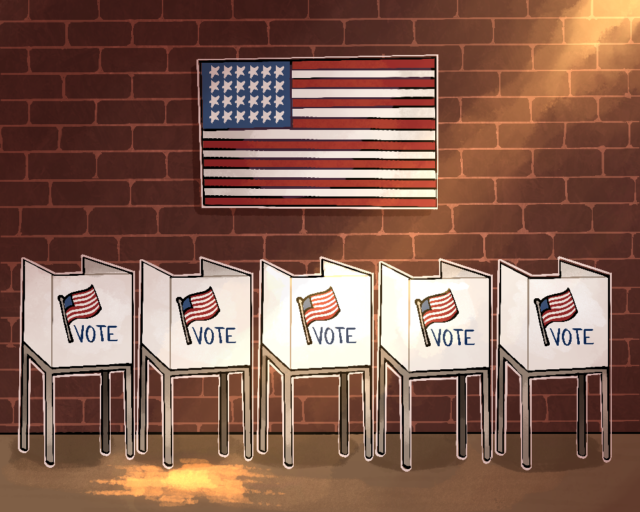
This August marked the 60th anniversary of the 1965 Voting Rights Act – the landmark United States federal law that banned racial discrimination in voting.
But six decades later, many of its protections are at risk as lawmakers and court judges across the country challenge its constitutional provisions. The act, signed into law by then-President Lyndon Johnson, reinstated the country’s commitment to voting equality after the 15th Amendment failed to increase voting rights among African Americans.
Richard Hasen, a professor at UCLA School of Law, said the amendment failed in practice due to poor enforcement.
“Even though the 15th Amendment barred racial discrimination in voting, it was not well enforced,” Hasen said. “At first, Black men did have the ability to elect candidates in the South but then, following a compromise after the disputed 1876 election, the South was allowed to discriminate again against Black voters, and the Supreme Court repeatedly refused to intervene.”
During the Jim Crow era, legislators in the Southern states used a loophole in the 15th Amendment to suppress African Americans’ votes by enacting measures such as poll taxes, literacy tests, all-white primaries and grandfather clauses, according to History Channel.
By the early 1960s, the Civil Rights Movement brought renewed attention to the issue of voting rights.
Johnson, according to Stanford University, introduced and signed the Voting Rights Act in 1965 following pressure from Martin Luther King Jr. after the nation witnessed state troopers violently attacking African American voting rights demonstrators in Selma, Alabama.
According to the Brennan Center for Justice, the Voting Rights Act was regarded as a comprehensive piece of legislation meant to dismantle Jim Crow laws and other discriminatory structures nationwide that had long disenfranchised Black voters, particularly in the South. Following its passage, Congress implemented the law to enforce the 15th Amendment and guarantee that no one would be denied the right to vote on the basis of race.
Section 2 of the act specifically mandated states and local governments to abolish any prerequisites to voting including literacy tests and poll taxes. It also included a provision allowing individuals to sue the government that instituted such laws.
In Section 5 of the act, a system was established requiring jurisdictions with a history of racial discrimination in voting to obtain “preclearance” from the U.S. attorney general or a federal court in the District of Columbia before implementing new voting laws, according to the National Archives.
Bernadette Reyes, senior voting rights counsel for the UCLA Voting Rights Project, said preclearance allowed executive enforcement of the law.
“It was a preventative measure,” Reyes said. “The executive was able to stop discriminatory systems from going into place before they started.”
Registration rates among African Americans saw a significant increase within a year of the Voting Rights Act passing. Between 1956 and 1966, the percentage of registered Black voters in some southern states increased nearly fivefold, according to the nonpartisan voting rights group Public Wise.
Since its enactment, Congress has reauthorized the Voting Rights Act five times between 1965 and 2006 to further expand voting rights for marginalized communities.
Laura Wray-Lake, a social welfare professor at the Luskin School of Public Affairs, said when Congress renewed the act in 1975, they added an important provision requiring oral instruction and assistance to non-native English speakers, further reducing barriers to registration and voting.
However, in recent years, Hansen said the act has seen weaker executive enforcement due to the Supreme Court’s conservative lean, coupled with increased political polarization.
“Until the early 2000s, both Democrats and Republicans were strong supporters of the Voting Rights Act – not seeing it in stark political terms,” Hasen said. “But today, because we’re so polarized and because minority voters – especially Black voters –have tended to favor the Democratic Party and white voters – especially in the south – have tended to favor the Republican Party, it’s very hard to disentangle when something is race discrimination versus when it’s political discrimination.”
Conservative Supreme Court justices today often support a “colorblind” interpretation of the Constitution and resist the Voting Rights Act’s race-conscious provisions, Hansen said. Conversely, he added that liberal justices generally defend these measures as necessary to address ongoing racial disparities.
In 2013, the Supreme Court ruled in Shelby County v. Holder that the formula for determining the areas subjected to preclearance provisions was outdated and unconstitutional. The court’s majority argued that the formula was no longer necessary because disparities in voting by race have decreased since the act was initially signed into law.
Reyes said while the Supreme Court did not rule preclearance itself unconstitutional, the absence of the formula made Section 5 effectively unenforceable. She added that the court’s decision allowed discriminatory voting rights practices to go into effect without prior review and relegated challenges to litigation after the fact.
Without the protection of preclearance, voters must rely on expensive and time-consuming lawsuits to challenge discriminatory voting practices and racially discriminatory maps, according to the Cornell Undergraduate Law and Society Review.
In 2021, the Supreme Court’s ruling in Brnovich v. Democratic National Committee made it even more difficult to challenge discriminatory voting laws in court under Section 2. According to the Harvard Law Review, the court upheld two Arizona state laws that discarded ballots cast outside a voter’s assigned location and prohibited voters from designating another person to deliver mail-in ballots on their behalf.
The Campaign Legal Center reported that over the last decade, states previously following the protective measures mandated by the Voting Rights Act have passed restrictive voting laws including stricter voter ID requirements, purged voter rolls, limited early voting and reduced polling locations.
As of September 2024, at least 31 states have passed 114 restrictive voting laws, according to the Brennan Center for Justice. The Harvard Law Review found that these court decisions and new restrictive voting laws will have a disproportionate effect on voters of color.
In 2021, U.S. Rep. Terri Sewell, a Democrat whose district includes the entirety of Selma, introduced the John R. Lewis Voting Rights Advancement Act legislation that would have restored and strengthened every provision of the original Voting Rights Act. The bill passed the House but was blocked by Senate Republicans, according to Rock the Vote, a nonpartisan voter registration organization.
While legislation aimed at expanding voting access is being blocked, measures that do the opposite – such as the newly introduced Safeguard American Voter Eligibility Act or “SAVE” Act – are advancing, framing new barriers to voting under the guise of preventing election fraud, according to the California Secretary of State.
This bill, which has passed the House and is pending Senate approval, would require anyone registering or updating their voter registration to present documentary proof of U.S. citizenship in person – typically a passport or birth certificate – effectively eliminating online and mail-in options, voter registration drives and automatic registration systems.
According to the Center for American Progress, driver’s licenses, REAL IDs and even military or tribal IDs do not satisfy the bill’s requirements, leaving an estimated 146 million Americans – many of them working-class and low-income – without the required documents for voter registration.
Amid uncertainty over the future of voting rights, Wray-Lake said preserving the protections of the Voting Rights Act is still of critical importance today because it allows citizens to participate in our democracy.
“In a democracy, basically – by definition – all people deserve a say in what’s happening,” Wray-Lake said. “In our country, voting is a big part of how people have a say, and so as a democracy, we must make it as easy as possible and as equal as possible for all voices to be heard in that process.”

Comments are closed.