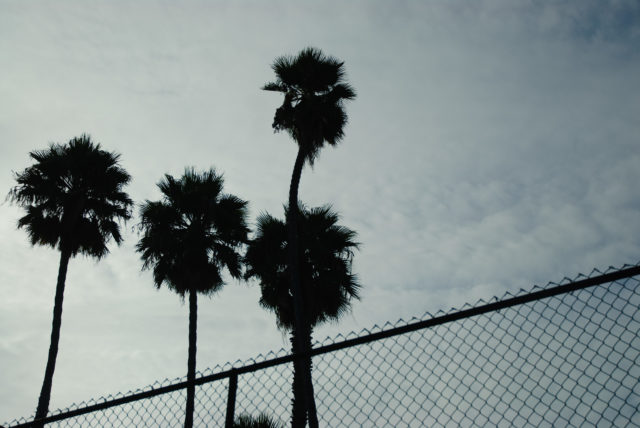
A group of UCLA researchers is using an air quality monitoring system across the Westside of Los Angeles to better understand contamination following the Palisades fire.
The system, Community Action Project Los Angeles Air, seeks to update the community on air quality as reconstruction continues in areas burned by the Palisades fire, according to CAP LA website. CAP LA has 20 sensors that monitor the air quality around the Pacific Palisades area.
Residents can access the information through the air quality dashboard on CAP LA’s website, which allows users to sign up for air quality alerts.
Researchers from the California Institute of Technology set up air quality monitors in the Eaton fire zone, which inspired UCLA to do the same for the Palisades fire, said Yifang Zhu, a professor of environmental health sciences at UCLA who led the project.
Both groups of researchers use sensors that provide information on the amount of coarse particles in an area – generated by debris removal and construction – that can be harmful to human health, Zhu said. These sensors detect pollutants by measuring the light scattered by the particles, Zhu added.
Zhu said she encountered several challenges that came from completing this project, including operating without power.
“Most of the homes don’t have power, so I have solar panels and batteries to power those sensors,” Zhu said.
Qiao Yu, a postdoctoral researcher in the Fielding School of Public Health, said he believes wildfires are going to become more frequent in the future due to climate change and hopes these projects can serve as an example for how academics should interact with local communities.
“We are trying to build a blueprint for … what is the best practices of doing those fire remediations,” Yu said. “There are other, more abstract goals like increasing awareness of people and having more communication between the higher education research institutes with the community members.”
Zhu added that CAP LA’s online portal, which anyone can access, seeks to make information about air quality more accessible.
“We make sure our data dashboard is very community, user-friendly because the quant EQ backend and data visualization is more for researchers,” Zhu said. “Our network is really trying to provide information guidance to the community.”
Yu also said the Trump administration’s recent funding cuts to UCLA have been hard on researchers in general – although this lab is funded by California alone – and this project is also financed by private foundations. However, researchers often have to wait to access funds as the donation goes through administrative processes, he added.
The Trump administration froze around 800 of UCLA’s research grants in late July, totaling $584 million in funding. The administration proposed a settlement that sought $1 billion from UCLA along with several policy changes to regain its funding, which UC President James Milliken said would “completely devastate” the UC.
[Related: Proposed UCLA settlement from federal government seeks $1 billion, policy changes]
Yu said he has collected more than 200 items such as pillows or t-shirts from the town’s volunteers so researchers can sample items for leftover pollutants.
“People will say, ‘Oh, soft materials, pillows – you just throw it away and get a new one, right?’” Yu said. “A lot of this stuff – like some of the clothes, some of the plush – have emotional values. People just don’t want to discard it. We hear all these kinds of stories from community members.”
The project is being independently funded by the R&S Kayne Foundation and the Danhakl Family Foundation. According to their respective websites, the R&S Kayne Foundation invests in communities to promote positive change, and the Danhakl Family Foundation collaborates with grassroots organizations to promote youth development and provide support for disadvantaged communities.
Dr. Victoria Danhakl, a trustee of the Danhakl Family Foundation, said her personal connection to the Palisades inspired her to contribute to the project.
“Our family is from the Palisades. My husband grew up there as a child,” Danhakl said. “The community has always been important to us, and, after the fires, we felt it was important – especially for people moving back – to know that the air they were breathing was okay and free of debris.”
Yu said he feels fulfilled by the project, adding that he believes he is making a tangible difference in people’s lives. He added that climate policy is sometimes vague, but this project is working to address the impact of climate change in a real way.
“Sometimes when you do research or academia like a researcher, you’re in an ivory tower,” Yu said. “I can see my research is making a real world impact, and that’s the part that makes our whole lab very excited.

Comments are closed.