This post was updated Sept. 24 at 11:04 p.m.
UCLA finalized its Time, Place and Manner policies Friday following a formal review and approval process, replacing interim policies that were in effect since September 2024.
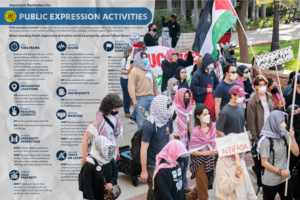
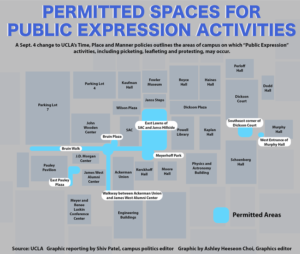
The finalized policies expand the university’s designated areas for free expression – where people can demonstrate without prior approval – to include the northwest corner of Le Conte Boulevard and Westwood Boulevard and the area of Bruin Walk stretching from the ASUCLA information kiosk to Meyerhoff Park, the grassy area east of Kerckhoff Steps.
They also officially ban public expression activities, even in areas designated for free expression, from occurring between midnight and 6 a.m – a policy previously outlined in the interim guidelines. Public expression activities may occur between 6 a.m. and midnight, but if an activity disrupts a scheduled event, participants may be asked to move or face disciplinary or legal action, according to the guidelines.
The new policies allow the use of amplified sound when marching or in designated free expression areas without prior permission, given that sound remains below 85 decibels and does not disrupt campus operations. Previous guidelines banned the use of amplified sound during marches, unless approved beforehand.
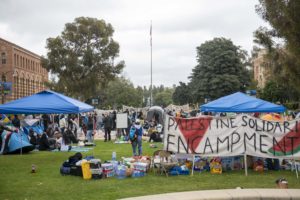
The finalized policies ban temporary structures or encampments on UCLA property – unless the temporary structure is in conjunction with “appropriate campus activities” and receives approval from the UCLA Events Office – and overnight camping.
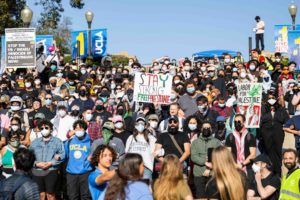
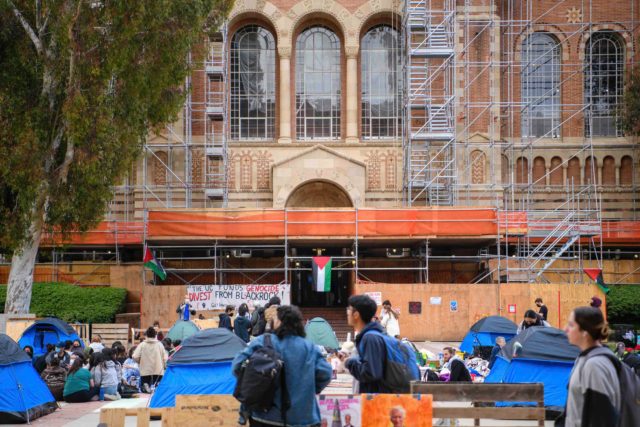
UCLA’s interim TPM policies followed a series of pro-Palestine protests in spring 2024, in which demonstrators set up multiple encampments demanding that the UC divest from companies associated with the Israeli military. The first Palestine solidarity encampment – which was set up in Dickson Plaza and swept May 2, 2024, resulting in the arrests of over 200 protesters – and an encampment erected May 23, 2024 on Kerckhoff patio both occurred in areas where protests are now banned by TPM guidelines.
[Related: USAC passes resolution criticizing UCLA’s revised Time, Place and Manner policies]
UCLA is currently navigating a federal funding freeze, with the Trump administration suspending over $500 million of the university’s research grants July 30 and July 31. A federal judge, who temporarily restored UCLA’s frozen National Science Foundation grants in August, said Thursday that she was “inclined” to restore the university’s National Institutes of Health grants after hearing arguments from U.S. Department of Justice attorneys and UC researchers who sued the federal government because of previous grant cuts.
A draft settlement proposal acquired by the Los Angeles Times revealed that the Trump administration is demanding that UCLA tighten its protest guidelines in exchange for the university’s suspended research funding. The settlement asked UCLA to prohibit demonstrations that occur overnight or in Dickson Plaza and Royce Quad – policies which were introduced in the interim guidelines and finalized in Friday’s guidelines.
[Related: Trump administration makes demands for UCLA policy changes in exchange for funding]
The Trump administration also asked UCLA in the settlement to stop protesters from wearing masks to shield their identity while breaking university policy. The finalized TPM guidelines ban people concealing their identity when violating the law or UCLA policy – but clarified that face coverings and masks are allowed if they are used in compliance with UCLA guidelines.
The university clarified in the guidelines that TPM policies also apply to all union employees. The American Federation of State, County and Municipal Employees Local 3299 and the University Professional and Technical Employees-Communication Workers of America 9119 led several strikes during the 2024-25 school year – where some employees disrupted traffic, used amplified sound and marched around buildings.
[Related: UPTE-CWA 9119, AFSCME Local 3299 negotiations with UC remains ongoing]
“Throughout the review and approval process, we received and carefully considered public comments from members of the UCLA community, which played a meaningful role in shaping these final policies,” UCLA administrators said in a Friday email announcing the policies. “We recognize that not everyone will agree with every element of all of the policies; our efforts focused on balancing the collective interest of the entire campus community.”