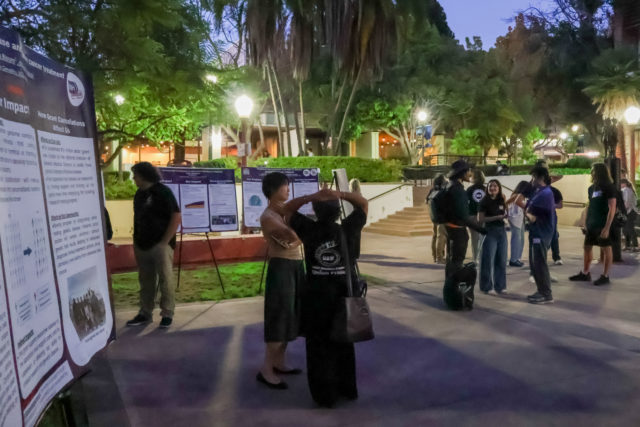
Hundreds of researchers, faculty and students attended a two-part science fair for suspended research projects Sept. 10 and 11.
The UCLA Faculty Association and the UCLA Brain Research Institute led the first day of the fair at the northwest corner of Westwood Boulevard and Le Conte Avenue. The United Auto Workers Local 4811 – which represents academic student employees, graduate student researchers and academic and postdoctoral researchers – hosted the second day of the fair.
The fair’s primary goal was to highlight how suspended federal funding has disrupted research across UCLA, said Carrie Bearden, a professor in psychiatry, biobehavioral sciences and psychology.
The research showcase came in response to the Trump administration’s July suspension of nearly $600 million in research funding to UCLA. The freeze stalled projects in labs across multiple disciplines, with faculty warning that prolonged uncertainty and withheld grants could jeopardize ongoing discoveries.
While 300 grants from the National Science Foundation were restored after a federal court ruling in August, about 500 grants from the National Institutes of Health remain suspended, affecting research in brain cancer, concussion recovery, gut microbiomes and more. A federal judge, though, said Thursday that she was “inclined” to restore the frozen NIH grants.
“This is really critical life saving research that’s going on,” said Bearden, who co-organized the event. “We really wanted to make the public aware of what’s happening, and also just give people, in general, more of an appreciation of both the work that’s happening at UCLA … and how it’s being impacted.”
[Related: District court judge to hear arguments on restoring suspended NIH grants to UCLA]
Researchers lined the sidewalk along Le Conte Avenue and the courtyard of Rolfe Hall with posters of their research which the federal funding freeze halted or left unpublished.
Handing out coloring pages, Maya Weissman presented her lab’s research, which looked into the link between gut microbiome evolution and human health. When the cuts were announced in July, Weissman – a postdoctoral researcher in ecology and evolutionary biology – lost not only her lab’s funding but also her income, leaving her “fighting for her job.”
“Science impacts everyone. The research that we do here at UCLA saves lives. It impacts our ability to conserve the environment, but it also gives back to the economy,” Weissman said. “So our research, our jobs here, are important to UCLA, to California, to the entire world, and it’s really important that even if you’re not a scientist, you come out, you support us and you help us fight.”
Weissman said she hopes UCLA provides interim funding for researchers to continue research progress and ensure that people do not lose their jobs.
Dr. Sinifunanya Nwaobi, a child neurologist and clinical instructor in the UCLA Department of Neurology, said the freeze has forced her to spend valuable time applying for new grants instead of advancing her lab’s research.
“There’s instability in terms of knowing, ‘How long is this going to last? How long will the funds that I have support not only this important work that I’m doing, but the people that get the work done?’” Nwaobi said. “There’s questions of, ‘What does this look like for us researchers moving forward?’”
Before her grant from the National Institute of Neurological Disorders and Stroke was suspended, Nwaobi investigated treatments that could reduce pain and sleep disturbances in patients with migraines.
Mayumi Prins, director of the UCLA Brain Injury Research Center, said while her department’s research used to score adequately on NIH scoring guidelines, she has had a difficult time securing new funding since the NIH deprioritized traumatic brain injury research and cut grants.
Before her grants were frozen, Prins researched concussion and severe traumatic brain injury recovery for children, athletes and veterans. Her research sought to understand the mechanisms of injury recovery by measuring glucose metabolic activity, Prins added.
“It does make a really big difference in the quality of people’s lives. At some point they’re going to look around and say, ‘Why don’t we have our treatments for this?’” Prins said.
Sunlan Lu, a fourth-year computational and systems biology student and an undergraduate research assistant for the Kornblum Lab, said the freeze has raised concerns for undergraduate students that work in labs.
Lu added that the freeze impacted one of her lab’s brain tumor research grants. The federal government also required the lab to eliminate diversity, equity, and inclusion related language from its proposals, despite their glioblastoma work being unrelated to DEI.
“I also have a lot of friends … who were originally supposed to work in the lab but with the recent events, our lab may not be able to support them,” Lu added. “Everything’s kind of in jeopardy right now. This is some groundbreaking work surrounding brain cancer.”
Michael Chwe, a professor of political science and member of the UCLA FA executive board, said the freeze represents a wider challenge to higher education.
“This is going to really affect the whole finance of the university and really mess up many different things,” Chwe said. “This is probably just one of the first of many attacks on universities, and they’re just using this as a way to extract whatever they want from our university.”
Chwe added that, as the first public university to face this scale of a funding freeze, UCLA’s actions could shape how other universities respond to similar attacks
[Related: UCLA professors voice concern over public, political implications of funding cuts]
While the UC has indicated that it is negotiating with the federal government, UC employee groups filed a lawsuit against the Trump administration Tuesday, arguing that the funding cuts and $1 billion settlement demand violate their rights to due process and free speech.
“It’s really a matter of standing up and saying, ‘We’re independent, we have our own values, we believe in education, we believe in the truth, we believe in research,’” Chwe said. “And you can’t just extort that out of us.”

Comments are closed.