This post was updated Sept. 28 at 7:09 p.m.
How to land a post-grad job 101: go to school, join the right clubs, get the relevant experience, work hard and then land the job.
That’s how it was always thought to be done.
Until now.
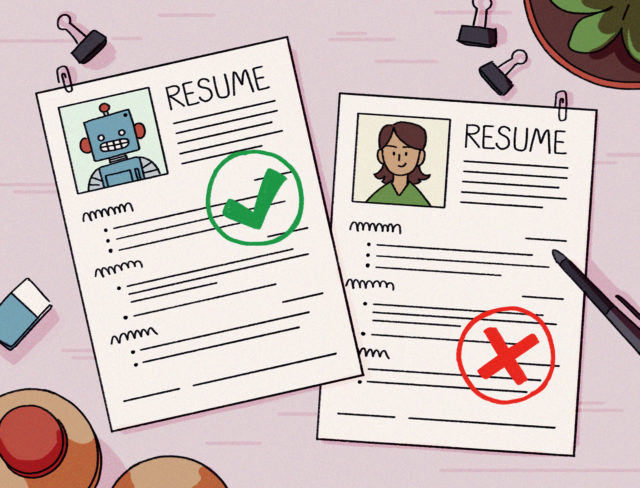
As artificial intelligence becomes increasingly integrated into the workplace, where does that leave students in search of entry-level jobs?
Some argue AI will take our entry-level jobs.
But this sentiment is only half correct.
AI is not only displacing the traditional entry-level job, but also redefining the role. Amid this period of societal transition, UCLA has a responsibility to prepare its students for an AI-driven world.
A recent study done at Revelio Labs found the use of AI systems in the workplace has contributed to a 35% decline in entry-level postings since January 2023.
AI systems encompass a wide range of abilities, including computer vision, image generation, medical image analysis and social media recommendation systems.
Entry-level jobs, meanwhile, generally provide fresh graduates experience in their respective fields and introduce young professionals to the work setting.
Tao Gao, an associate professor in the departments of communication and statistics and data science, said entry-level jobs usually center around office work and completing tasks in front of the computer screen – jobs AI systems do well.
Thus, it unfortunately comes as no surprise when students hear AI will take entry-level jobs first. It is, after all, low-hanging fruit for an AI system to grab.
Society will always need jobs for post-graduates. Those aren’t going anywhere. What is changing is what is required of graduates.
Yet, the way UCLA teaches us remains unchanged; despite what kind of adaptation is required of us, many of our course curriculums largely stay the same. While some course offerings on AI exist, they do not provide enough domain-specific knowledge to bridge the gap for students.
For instance, as of July 2025, GitHub Copilot – an AI coding assistant – has reached over 20 million users. With AI-powered tools such as GitHub Copilot becoming more prominent in the workforce, UCLA should prepare students to know how to use these platforms effectively.
The solution to this problem needs to be a two-pronged approach: teach students how to use AI systems effectively and in a practical way.
UCLA outlines a generative AI policy restricting the use of such AI tools for plagiarism and cheating. This makes sense – the point of assignments is to build your own understanding – but AI can also be used to enhance students’ learning experience.
AI can function as an on-demand teacher’s assistant and break down difficult concepts in a more digestible manner. However, not many classes teach students how to use the domain-specific skills needed in order to use AI tools effectively.
“AI won’t take jobs, but people that use AI will take jobs from those that don’t use AI,” said Terry Kramer, an adjunct professor and faculty director of the Eastern Technology Management Center at the UCLA Anderson School of Management.
To prepare students for an AI-driven workforce, UCLA administrators and professors need to collaborate with industry leaders while integrating lessons on using AI systems for specific tasks. AI should not just be seen as a cheating device, but rather an essential tool that students must learn in order to solve real-world problems.
Students should also have the opportunity to apply these AI skills in a practical, real-world setting during their undergraduate career.
Whether that be a final consulting project or senior capstone, these experiences not only give students the chance to practice their AI skills but also exercise their interpersonal skills in a professional setting.
“We are going to see a coming back of in-person communication. The only way you can trust someone is to talk to that person, read it from their eyes, make sure there’s no AI getting involved. That’s the best way to assess the authenticity of the conversation,” Gao said.
This combination of practicing AI and interpersonal skills will also give students an edge when it comes to applying for entry-level jobs.
“Not only are employers expecting students to possess knowledge based on their academic degree field, but employers are increasingly looking for students and recent graduates to demonstrate proficiency in skills that are difficult to teach,” Kimberly Terrill, associate director for career education and engagement at the UCLA Career Center, said in an emailed statement.
If learning to use tools like GitHub Copilot in a computer science class or Kensho LLM-ready API in a business economics course gives students a career edge, UCLA has a responsibility to integrate these domain-specific AI skills into its classes.
With the rapid development of AI systems, it’s hard to say what entry-level jobs will look like in ten, five or even two years. Just a year ago, this article would have been written very differently.
But one thing is for certain: the traditional formula for landing an entry-level job is obsolete.
We need UCLA’s help to rewrite it.





Comments are closed.