

This post was updated Sept. 30 at 9:59 p.m.
Warning: Spoilers ahead.
It is no battle to enjoy “One Battle After Another.”
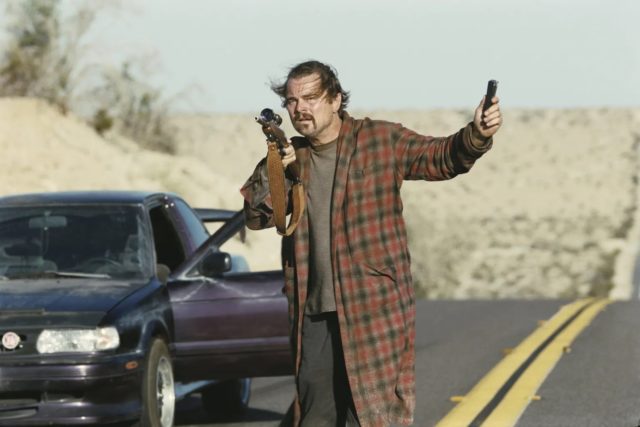
Partially inspired by Thomas Pynchon’s 1990 novel “Vineland,” the tenth film from writer-director Paul Thomas Anderson punched into theaters Friday. An ambitious action thriller that is starkly different from any of the 11-time Oscar nominee’s past work, “One Battle After Another” follows the surviving members of a vigilante group called the French 75 as they work together to protect 16-year-old Willa Ferguson (Chase Infiniti) from a vengeful military officer (Sean Penn). Although the film’s pacing struggles in its final act and some key character development falls short, “One Battle After Another” still emerges as a rousing success through the integrity of its performances and by trusting its instinct to be politically charged from beginning to end.
Anchoring the 161-minute epic is Teyana Taylor, who delivers the film’s strongest performance as proud, confident vigilante Perfidia Beverly Hills. Taylor commands every scene she appears in with a blend of bravado and concealed fragility, displaying a woman who is ferocious and empowered, yet simultaneously vulnerable, uncertain and desperate to maintain agency from her lover Bob Ferguson (Leonardo DiCaprio). Despite disappearing from the screen after the first half hour, Taylor’s presence is felt in every frame that follows – not only because her betrayal of her fellow French 75 members sets the film’s plot into motion, but also since Perfidia is the most lived-in character in the cast.
An equally dynamic figure is Penn as the menacing Col. Steven J. Lockjaw, who prefers to forget a morally ambiguous dalliance with Perfidia and will stop at nothing to capture her daughter Willa – who audiences later learn is Lockjaw’s child, not Bob’s. The narrative would fall apart without a convincing antagonist, and Penn adds another twisted villain to Anderson’s filmography as Lockjaw traverses riotous streets and dusty country roads in his relentless pursuit of Willa. The expressiveness of Penn’s face is particularly commendable, vividly capturing Lockjaw’s internal conflict between his carnal desires and his anxious indecisiveness.
[Related: Theater review: ‘West Side Story’ hits right notes as timeless tragedy with contemporary topics]
Of course, DiCaprio’s acting is reliably solid, with his best scenes arriving during the film’s middle hour in a series of humorous scenarios where he forgets a French 75 codeword to help direct him to Willa’s location. In her first major film role, Infiniti certainly holds her own in scenes opposite the Oscar-winning DiCaprio and Penn, giving Willa the gumption a compelling protagonist needs. The subtle ways that Anderson establishes parallels between Perfidia and Willa – such as framing both firing automatic rifles against barren landscapes – help add to Willa’s complexity as a character whose story cannot be separated from her mother’s absence.
The talents of a few of the top-billed cast members are underutilized, such as Benicio del Toro, who occupies a comedy-driven supporting role as Willa’s sensei who fails to do more than move DiCaprio from one location to the next. The biggest missed opportunity is the nonexistent exploration of French 75 member Deandra (Regina Hall), who could have offered even deeper insight into Willa’s past.
On a technical level, “One Battle After Another” demonstrates that its massive budget – estimated to be north of $130 million – has been put to good use. As an action movie, “One Battle After Another” provides consistently excellent stunt work in a variety of gripping car chases. Likewise, cinematographer Michael Bauman brilliantly captures the characters by closely following each movement through a room or by casting shots wide over a panoramic view of the empty desert terrain. The foreboding score from Jonny Greenwood is also top-notch, especially in contemplative moments set to the tune of a classical guitar.
From a writing standpoint, the screenplay is at its most acerbic and striking in sequences featuring the Christmas Adventurers Club – an ultra-exclusive white supremacist group even more nefarious than Lockjaw. The colonel is blindly eager to join their ranks and eliminate Willa as the surviving evidence of his interracial affair with Perfidia, so much so that he meets his tragic demise by being gassed and incinerated in a Christmas Adventurers Club office. Thanks to Penn’s adept portrayal of Lockjaw’s naivety, it is impossible not to feel some empathy for the officer, as his futile attempts to be accepted by the Christmas Adventurers Club are inevitably in vain.
Anderson seems especially intentional in how he juxtaposes the warm camaraderie of the French 75 with the cold villainy of the Christmas Adventurers Club. The former is an accepting, lower-class mixed-race group that sings around a campfire and abounds in enthusiastic teamwork. The latter features a set of socially polite, classically handsome white men in fashionable Lacoste and Patagonia outfits that would not look out of place on a golf course. One possible interpretation of this depiction could be that political and racial violence in our society also stems from behind the closed doors of people who appear to be civil on the surface.
[Related: Album Review: Laufey’s “A Matter of Time” explores new styles, anxieties of love]
Another curious thematic element of “One Battle After Another” is its exploration of dysfunctional father-daughter relationships, when the most profound emotional components of the story are actually found in the absence of Perfidia from Willa’s life. While questions of Willa’s paternity are integral to the plot, the reunion of Bob and Willa in the film’s big finale falls flat, and a much more cathartic wallop arrives when Willa reads a letter from her mother in the closing scene. The film is at its most moving in quieter moments when audiences are exposed to the unspoken similarities between Perfidia and Willa. As Willa learns that her mother was not the hero she had envisioned, she also realizes how she can forge a path of her own.
After the first viewing, “One Battle After Another” does not immediately match the cinematic perfection of Anderson’s best work, as the film is missing the depth of character delivered in “There Will Be Blood” and the breakneck pacing of “Boogie Nights.” This project is also far from the finest output of DiCaprio’s filmography, and fans of the actor may realize that he falls into the background often in this story. Regardless, the conviction and nuanced interplay of Taylor, Penn and Infiniti’s performances – combined with such a prescient screenplay – catapults the film automatically into conversation with the upper echelon of Anderson’s motion pictures.
Even more powerfully, the chilling poignancy of such a current, relevant tale means that “One Battle After Another” is sure to generate the same level of passionate dissection that Anderson’s past films have inspired. For the film to be released now – particularly amid the political volatility Americans have encountered so far in 2025 – only enhances the gravity this piece holds. This is not a film that can be expected to heal its audiences, but its insightful revelations about our society’s flaws are too profound to ignore.
“One Battle After Another” might not be a traditional action thriller, but its many possible thematic interpretations make it a must-watch.





Comments are closed.