This post was updated Oct. 5 at 9:32 p.m.
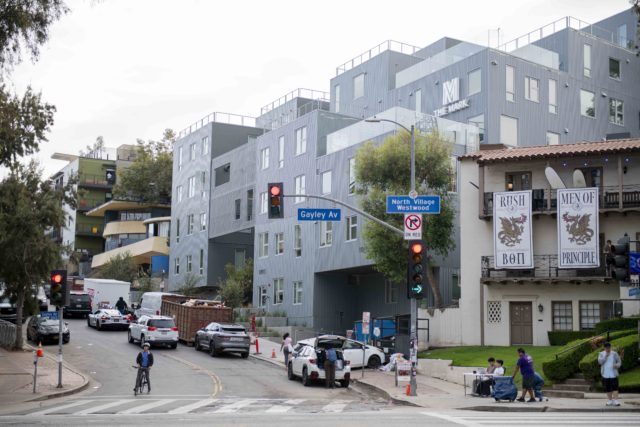
Construction on the sidewalks of Strathmore Drive and Gayley Avenue has forced pedestrians to walk in the street and caused accessibility issues for over a year.
The sidewalk on the northwest side of the Gayley Avenue and Strathmore Drive intersection will be closed until April 2027, according to a sign on the fenced-off area. The construction of an apartment complex called The Mark – owned by Landmark Properties, a real estate firm specializing in university student housing – also consistently blocked sidewalk access on the southwest portion of the intersection until Sept. 22.
No one occupying or controlling a lot can obstruct the free passage of pedestrians and vehicles adjacent to the lot, according to both the City of Los Angeles’ municipal code and the Americans with Disabilities Act of 1990. Any alternative routes or temporary detours must be clearly marked, safe and accessible, said Yonit Kovnator, UCLA’s ADA/Section 504 compliance officer, in an emailed statement.
“Something that may seem like a minor obstacle to an able-bodied person, such as a small sign that can easily be stepped around, can make a pathway significantly more hazardous or impassable for a person with a disability,” Kovnator said in the statement. “These types of barriers can make everyday travel an unsafe experience.”
As of Sept. 29, there were no permits or authorizations to obstruct the public right of way in either location available on the LA Department of Building and Safety website. There is no route marked as an alternative to the sidewalk on the northwest side of the intersection.
Connor Webb, chair of the transportation, environment and public space committee and at-large board member on the North Westwood Neighborhood Council, said in an emailed statement that maintaining safe pedestrian access amid construction work is especially important to Westwood Village, where many residents walk to school or work.
Obstructions at this intersection make it difficult to access fraternity houses and the Hill on a daily basis, said Carson De Filippo, a second-year business economics student. De Filippo added that he believes most students prefer to walk on the street along the construction site rather than crossing to the unobstructed sidewalk.
Blockages can force people with limited mobility to take longer and less direct travel routes, Kovnator added.
“It’s one of those things where it’s a lot of mild inconveniences,” De Filippo said. “Of course, they’re mild, but when they add up, it becomes more of an effect.”
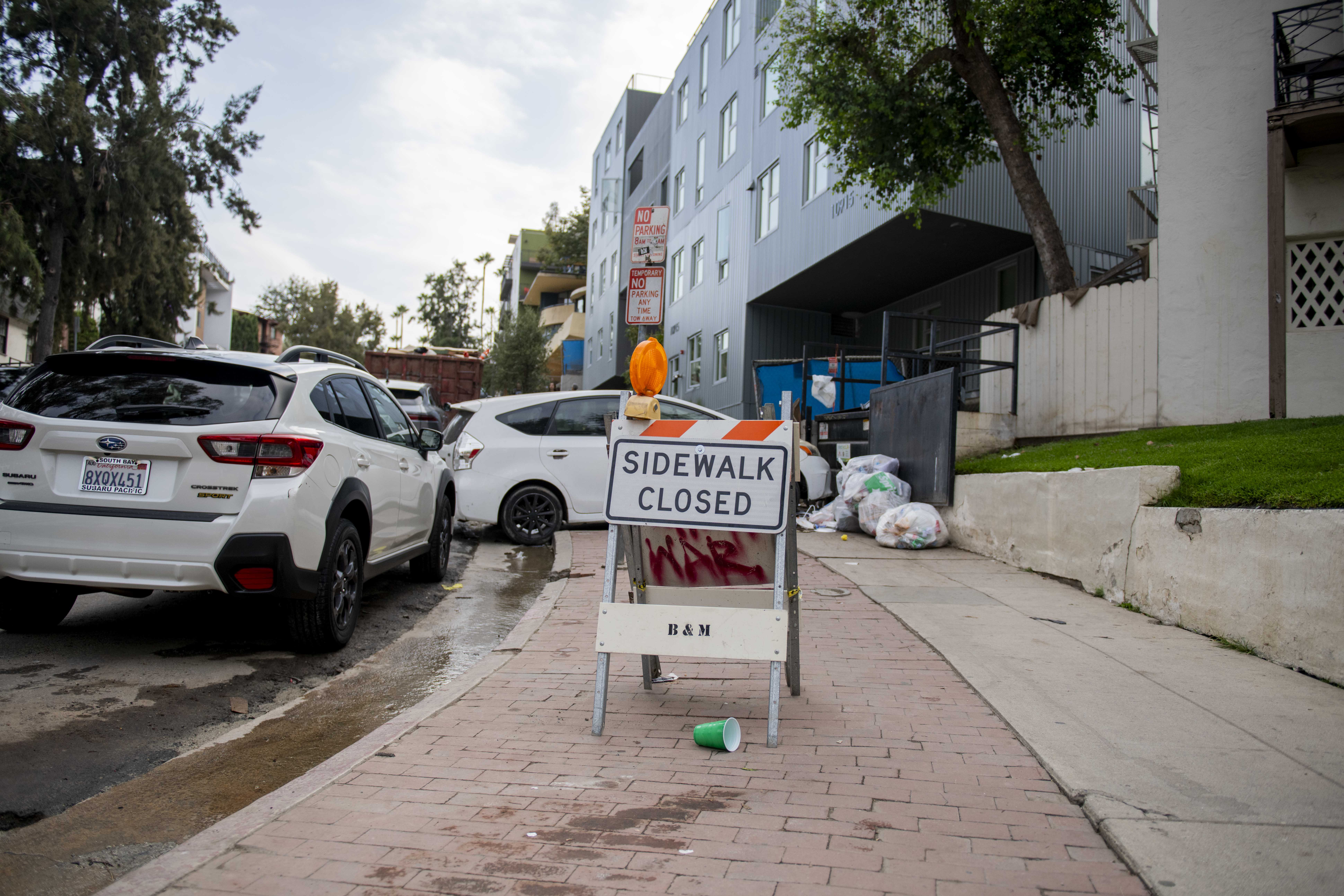
Cars travelling along the blocked roads must also navigate around pedestrians in the street, said Ben Wilson, the president of UCLA’s chapter of Lambda Chi Alpha – the house of which is located on Strathmore Drive, directly across from The Mark.
The Mark’s construction personnel sometimes direct traffic to ensure pedestrian safety on Strathmore Avenue, Wilson said, adding that workers have paused construction when asked and offered to remove bulky items discarded on the sidewalks.
“The sooner they do what they got to do, the sooner the building can be done,” said Wilson, a fourth-year economics student. “I’ve actually had the chance to meet a lot of the crew and build a relationship with some of them, and they’ve been nothing but friendly.”
Landmark Properties said in a statement over text message that The Mark is currently under construction but did not provide answers to other questions. The company’s Strathmore Drive apartments include 37 multi-bedroom units, a fitness center and a pool deck, according to the apartment website.
The sidewalk in front of Landmark Properties’ development was open as of Sept. 22, with planters and newly paved and lit concrete. The newly paved sidewalks are a “less obvious benefit” of the new development, Webb said.
In other parts of the Village, however, Webb said some sidewalks are in a “dire state,” missing curb ramps and containing uplifted cracks. Not only are these conditions uncomfortable and inconvenient for able-bodied people, Kovnator said, they can create “serious barriers” for people with mobility limitations.
“There are sidewalks that don’t meet accessibility standards, essentially restricting independence and making it harder, or sometimes impossible, for people with disabilities to get where they need to go safely and with dignity,” Kovnator added.
While property owners are responsible for maintaining sidewalks in front of their property, the responsibility is often unenforced, Webb said in the statement, leaving the City of LA paying tens of millions of dollars yearly in liability claims for accidents that may occur on the sidewalks.
“It is a longstanding failure of the city to adequately address sidewalks and curb ramps everywhere,” Webb said. “Inaccessibility and pedestrian indignity is abundant, especially in areas with majority renters and low-resource areas.”


Comments are closed.