This post was updated Oct. 3 at 12:23 a.m.
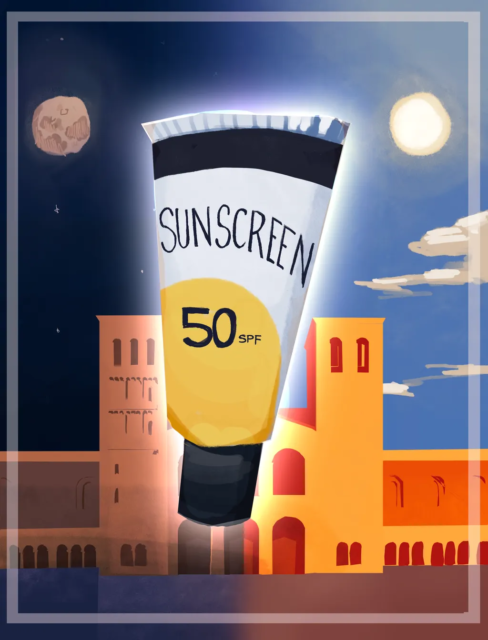
The start of the fall quarter marks shorter and cooler days with less sunlight, but UCLA dermatologists recommend applying sunscreen daily, regardless of the season.
Ultraviolet light is a concern during the key hours between 10 a.m. and 2 p.m., even during cloudy days, said Dr. Soraya Azzawi, a dermatologist at UCLA Health. Ultraviolet light – a form of invisible light emitted by the sun – is associated with photoaging, which is when sun damage causes visible signs of premature aging on the skin, including dark spots and wrinkles, she added.
Azzawi said the ideal sunscreen should be a tinted physical or organic sunscreen with Sun Protection Factor 30 or higher. These protect against both ultraviolet and visible light, such as blue light emitted from screens, she added.
“Having melanin in the skin, being tanner, just ethnically, can be protective to a limited extent, but you’re still exposing yourself to ultraviolet radiation that can induce DNA damage and eventually lead to the development of skin cancer,” she said. “With the depletion of the ozone layer, it’s thought that being outside for a shorter period of time results in a higher risk of developing that skin cancer.”
Dr. Michael Nguyen, another dermatologist at UCLA Health, said finding a product that best suits an individual’s skin tends to be a process of trial and error.
“Living in Southern California, we are exposed to high levels of UV exposure year-round – even in wintertime, we still get a moderate to high level of UV exposure,” he said. “Sun protection isn’t just about protecting your skin when it’s during the bright, summer, intense days, but it’s about developing healthy habits over time, regardless of season, to be mindful of how much sun you’re getting and practicing healthy sun habits with sunscreen.”
Grace Kim and Meagan Kimbrell, two UCLA alumni still involved in Dermatological at UCLA, a student organization whose goal is to help bridge the skin health literacy gap, partnered with Dr. Chaitali Mukherjee – the executive director of the UCLA Arthur Ashe Student Health and Wellness Center – to get UCLA certified as a Skin Smart Campus, a campus committed to promoting skin cancer prevention policies and education. The National Council on Skin Cancer Prevention awarded UCLA two free sunscreen dispensers and a year’s worth of sunscreen as part of this certification.
Kimbrell, who was the president of Dermatological last year when she was an undergraduate student, said she first became interested in dermatology when struggling with acne in middle school and spearheaded the sunscreen initiative to address the lack of accessibility to skincare.
Kim said her interest in dermatology started with personal experiences with acne, eczema and a lack of access to health care. Some common myths – such as that people with “enough melanin” don’t need sunscreen – can act as both an educational and psychological barrier, she added.
“Sunscreen can be very expensive, and with so many different options of sunscreen out there in the media, reaching from low prices to very high-end prices, you don’t know what’s best for yourself and it just takes a lot of trial and error at the same time, which can be really expensive,” Kim said.
Mia Carter, a fourth-year biochemistry student and the current president of Dermatological, said her experience with a skin misdiagnosis and desire to fight for equity for Black dermatologists fueled her interest in skin conditions and diseases. Although she has been applying sunscreen since high school, Dermatological instilled in her the importance of sunscreen, she added.
Carter added that she looks forward to seeing the initiative’s impact.
“Just taking the extra step to put on sunscreen every day is super, super helpful for students because if they’re out in the sun a lot and they put it on, they don’t have to think about it for a couple of hours,” Carter said.
Kimbrell also said she and Kim are looking to expand their initiative across California by installing extra sunscreen dispensers in underserved areas and schools, adding that the pair is setting up a crowdfunding campaign to support the initiative.
Kimbrell also said in a written statement that the group was able to acquire five more dispensers they plan to install in Los Angeles and other cities by Sept. 28.
“I just want this to serve as daily reminders to put on sunscreen,” Kim said. “Don’t wait until it’s too late. Anyone can get skin cancer, it’s not limited to any race or ethnicity (or) skin type.”
Contributing reports from Shaun Thomas, science and health editor




Comments are closed.