This post was updated Oct. 5 at 7:50 p.m.
As Americans, we must take heed of death. Life is listed preeminently among the inalienable rights enshrined in our Declaration of Independence.
Death is not to be celebrated.
It is unfortunate that this claim is contentious to fellow citizens of the United States of America, as fabrics of freedoms are woven together to create our high-flying flag.
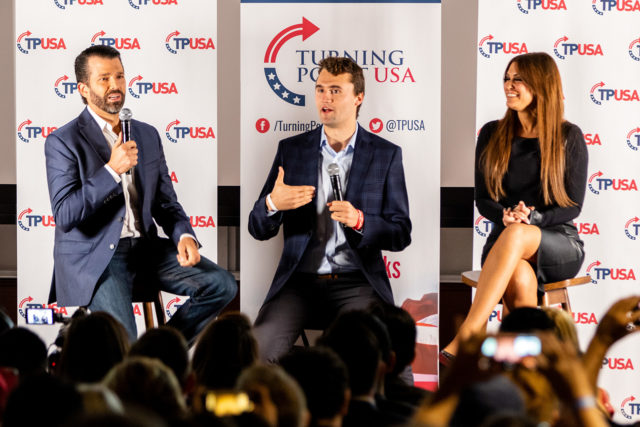
Charlie Kirk, a right-wing political activist and commentator, was shot dead in the land of the free Sept. 10 at Utah Valley University. He was exercising his First Amendment right to freedom of speech. Graphic videos of the shooting were shared across digital platforms, displaying his bloody murder to the world.
Our nation’s reaction directly reflected the state of our country – divided.
Some celebrated, sharing they believed he had it coming. Many were upset by this reaction. Polarized views strengthened. The rift both deepened and widened as the utter inability to understand other perspectives culminated in a finger-pointing battle of hypocrisy.
Charlie Kirk – once just a name to many – became a symbol representing drastically different things to all.
But one thing we could agree on amid this chaos is what a poor state our homeland, a nation in gridlock, is in today – unable to come to peace over even the most basic moral issue of life and death.
Fourth-year political science student Abygale Kim, who aligns with politics that are further left than the Democratic Party, said she personally believes Kirk should not have been subjected to such violence. Kim added that others say Kirk simply received what he believed other people deserve.
“I don’t think it’s uncouth to say that Charlie Kirk did a lot of things to also spread hate and violence towards marginalized communities,” Kim said. “They’re not really happy that he specifically is dead – maybe some people are, but they’re happy that this force of pain in their life doesn’t exist anymore.”
Some conservatives and supporters of Kirk, such as third-year political science student Joshua Park, said they do not feel Kirk was causing harm.
“The biggest and most integral part of his mission was setting up a table and creating a space for dialogue and intellectual discourse,” Park said in an emailed statement. “In a society where so many people are afraid to challenge prevailing and popular orthodoxies, Charlie never hesitated to speak boldly. He gave people – especially young conservatives – a voice.”
This matter transcends political party lines. The fact that Charlie Kirk, a law-abiding citizen, was publicly executed in broad daylight is more than a celebrity death. It’s an attack on our collective freedom.
Those who justify their gladness that Kirk was murdered must realize they relinquish their own prospective freedom by rejoicing in the stripping of his.
His speech could be interpreted as hateful, but violent is not quite accurate. Violence is violent. Shooting someone in the neck is violent. Speech is not. Speech is expression.
An overlooked perspective is that of Ansh Purohit, a fourth-year mathematics/economics student from India, said violent outbreaks such as these are downplayed in this country and are worrisome to his family halfway across the world.
Sadly, Americans are desensitized to gun violence. In fact, gun laws surrounding the Second Amendment were a topic of debate that Kirk voiced his strong opinions on, adding more area for dissent regarding his death. For this, many pointed out the inconsistency between empathy to him and the victims of school shootings around the country.
John Chung, a third-year mechanical engineering student, said those on the left called Kirk’s death a form of political justice – Kirk, who held adamant views on gun control, was killed by what appears to be a lack thereof.
“If you’re going to be celebrating this act of gun violence, I don’t know how you can also be mourning other gun violence,” Chung, who has progressive views, said.
Amid the discourse, a particular sentiment rang a bit louder than others – we must at the very least see eye to eye on what is wrong and what is right.
“Regardless of any party lines or any political opinions, there’s a few things that we can all and should all agree on,” Chung said. “And one of those things is murder is wrong.”
As students in higher education who have come to this place to become open-minded, well-informed and contributing members of society, we have a duty to uphold the values of free thought and speech in order to foster a better tomorrow.
“If we as students, faculty, and staff can foster an environment where disagreement is not demonized and peaceful discourse replaces censorship, I think that is where change begins,” Park said in an emailed statement.
Privilege is invisible to those who possess it. Purohit said he appreciates that we can exercise the right to freedom of speech without persecution in our nation – something we often take for granted.
“If there’s anything most people outside the U.S. acknowledge about the U.S., it is that it is the only country that really guarantees free speech in the world,” Purohit said.
This tragedy has revealed that this freedom can be taken from us in the shot of a second if we do not safeguard it with intentionality and morality. Our inalienable rights can somehow become negotiable given the circumstances of one’s political beliefs.
United we stand, divided we fall. So together we must stand up for our freedom – which includes defending the rights of others to practice it as well.


Comments are closed.