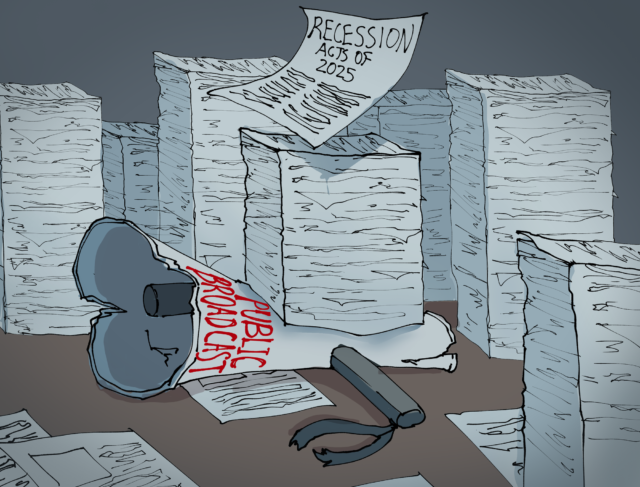
Cuts to public broadcasting funding have strained California’s ability to provide news and education to its residents.
Oct. 1 marked public media’s first day without federal funding in over 50 years. The Rescissions Act of 2025, which was signed into law in July, removed $1.1 billion of funding for public broadcasting. Local news stations that depend heavily on federal funding to sustain their operations are likely to face significant challenges in continuing to provide free public broadcasting to audiences nationwide, according to CBS News.
Republican Rep. Steve Scalise first introduced the act in June with the aim to further the Trump administration’s goals of reducing government spending on services they deemed “non-essential.” Federal services affected include foreign aid and news broadcasting programs.
Kim Thelwell, the vice president of policy and communications at The Borgen Project, a nonprofit organization, said she is worried about the funding priorities of the current administration.
“It’s just very concerning to see that occurring because these, again, were previously approved by Congress, and it just kind of sets a dangerous precedent,” Thelwell said.
The White House did not respond in time to a request for comment about the potential effects of the Rescissions Act of 2025.
As a result of the new law, federal funding for the Corporation for Public Broadcasting (CPB) was removed for the 2026-27 fiscal year. The corporation provides direct grant support to the National Public Radio, Public Broadcasting Service and over 1,500 local stations.
Both PBS and NPR remain popular programs, as they amass millions of listeners and viewers every year.
According to the Pew Research Center, in 2022, an average of 23 million Americans listened to NPR every week. In 2024, PBS reported that 58% of all United States television households – which totals more than 130 million people – watched its network.
Edison Research found that rural communities are expected to be more heavily affected by these funding cuts than the general population because they make up a greater percentage of radio listeners. Rural stations also rely on a greater percentage of their revenue from the federal government, putting them at higher risk of potentially stopping coverage.
Community Television of Southern California’s KCET-TV – also known as Channel 28 – was founded over 60 years ago in 1964 as the first public television station in Southern California. In 2011, it was the largest public television station in the country before merging with another Southern California television station based in Orange County in 2018 to form the organization PBS SoCal.
KCET-TV Channel 28, now operating as a PBS-affiliated television channel, provides educational and informative content including news, documentaries and children’s programming.
Andrew Russell, the president and chief executive officer of PBS SoCal, said funding cuts for public broadcasting laid out in the Rescissions Act will impact Southern California stations’ ability to highlight local and regional stories, with PBS SoCal losing $4.3 million dollars due to the funding cuts.
PBS SoCal stations highlight relevant local stories in their content, something other stations fail to cover in the same capacity. For example, Lost LA is a locally produced documentary series on the PBS website covering California’s history and influence on American history.
The Rescissions Act’s funding cuts will also impact other local stations in the Los Angeles area.
The LAist also operates their own local public media station, LAist 89.3, which is the LA area’s largest NPR affiliate, offering news and cultural programming for listeners in Southern California.
Megan Garvey, senior vice president news and editor in chief of LAist, said the federal funding cuts will lead to a loss of $1.7 million in funding.
“It is a significant impact,” Garvey said. “That’s about 4 to 5% of our annual budget. It represents about 12 or so positions in our nonprofit organization,”
Russell said the reduction in grants and funding from the CPB impacts local Southern California stations’ ability to provide stories focused on local residents such as a reduction in station’s ability to conduct community outreach, in-person events and children’s programming.
“The funds are there really to tell those stories that commercial media or other media sources are not telling,” Russell said.
He added that funding cuts will disproportionately impact low-income communities, especially children relying on the PBS Ready to Learn Initiative that provides free educational content.
PBS SoCal relied on the federal government’s Ready to Learn grant, which provided funding to create educational content for children. The Rescissions Act canceled this grant, which totaled $23 million, along with many other pre-approved funding packages.
Russell said this program is a particularly important community resource.
“Our service – designed as ready to learn – was really to provide education, especially for kids who are not able to go to preschools or those early learning schools, and our focus is about how to help kids get ready for success.” Russell said.
Russell added that despite these budget cuts, the 19 million people watching PBS SoCal will not lose coverage. However, he said stations in Northern California such as those in Reading and Eureka, which get over 40% of their funding from the federal government, may not be able to continue serving their communities.
Amid pressures from the federal government, community members have voiced their support for these public broadcast services.
A campaign called Protect My Public Media has mobilized supporters to urge Congress to restore CPB funding, and donations to NPR and PBS stations have surged following the announcement of the Rescissions Act, according to the New York Times.
Garvey said individual donations are crucial to funding the organization’s operations.
“The majority of our funding comes from regular people who are able to give $20 a month, $50 a month to support local journalism, and so that is the biggest source of donations for us, and I think that will continue to be true.” Garvey said.
While cuts to public broadcasting will have lasting impact on public broadcasting services, Russell said he remains optimistic about the future.
“The federal partnership and the role it’s played over our more than 50 years has been essential, so we’re making the case that some reestablishment of that would be really important to public broadcasting’s future and to our service to our local communities,” Russell said.





Comments are closed.