


This post was updated Oct. 16 at 7:40 p.m.
Editor’s note: This article contains mentions of sexual violence and assault that some readers may find disturbing.
Warning: Spoilers ahead.
In “After the Hunt,” the relentless pursuit of answers is often more entertaining than the answers themselves.
The latest film from Oscar-nominated director Luca Guadagnino launched in theaters Oct. 10 after premiering at the 82nd Venice International Film Festival in August. The 139-minute psychological drama written by Nora Garrett follows two Yale University philosophy professors – Alma Imhoff (Julia Roberts) and Hank Gibson (Andrew Garfield) – as they compete for tenure amid allegations of sexual misconduct from graduate student Maggie Resnick (Ayo Edebiri). Despite some pacing issues and a screenplay overflowing with unfulfilled tangents left to be explored, “After the Hunt” mostly succeeds because of its convincing performances and the relevant questions it asks of audiences in wake of the #MeToo movement.
Undoubtedly the strongest performance in the film is Roberts’ portrayal of Alma – a brooding, secretive woman who is motivated solely by expanding her own power and status. As a well-respected member of the university’s philosophy department, Alma moves through her lectures and hushed conversations at high-society dinner parties with an alluring combination of charm and hunger, as if her discontented desire for more influence could boil over at any moment. Alma’s morality is immediately called into question by the way she flirts heavily with Hank in her husband’s presence and in how she exploits Maggie’s sapphic affection for her, unashamedly basking in the adulation that comes with being Maggie’s idol.
While Roberts strikes a balance between likable professional charisma and cold Machiavellian strategy, Edebiri’s convincing performance as Maggie is consistently untrustworthy and childlike. Each conflict that opposes Maggie plays out like a schoolyard scuffle, emphasizing her coddled upbringing as the daughter of wealthy Yale donors. In addition to her unrequited obsession with her professor, Maggie snoops around Alma’s home and struggles to carry an argument persuasively, hinting at the looming accusations of plagiarism within her dissertation. Soon, two versions of events emerge after an evening party at Alma’s. Upon returning to Maggie’s apartment for a drink, Hank claims he confronted Maggie about her copied work. Maggie claims Hank sexually assaulted her.
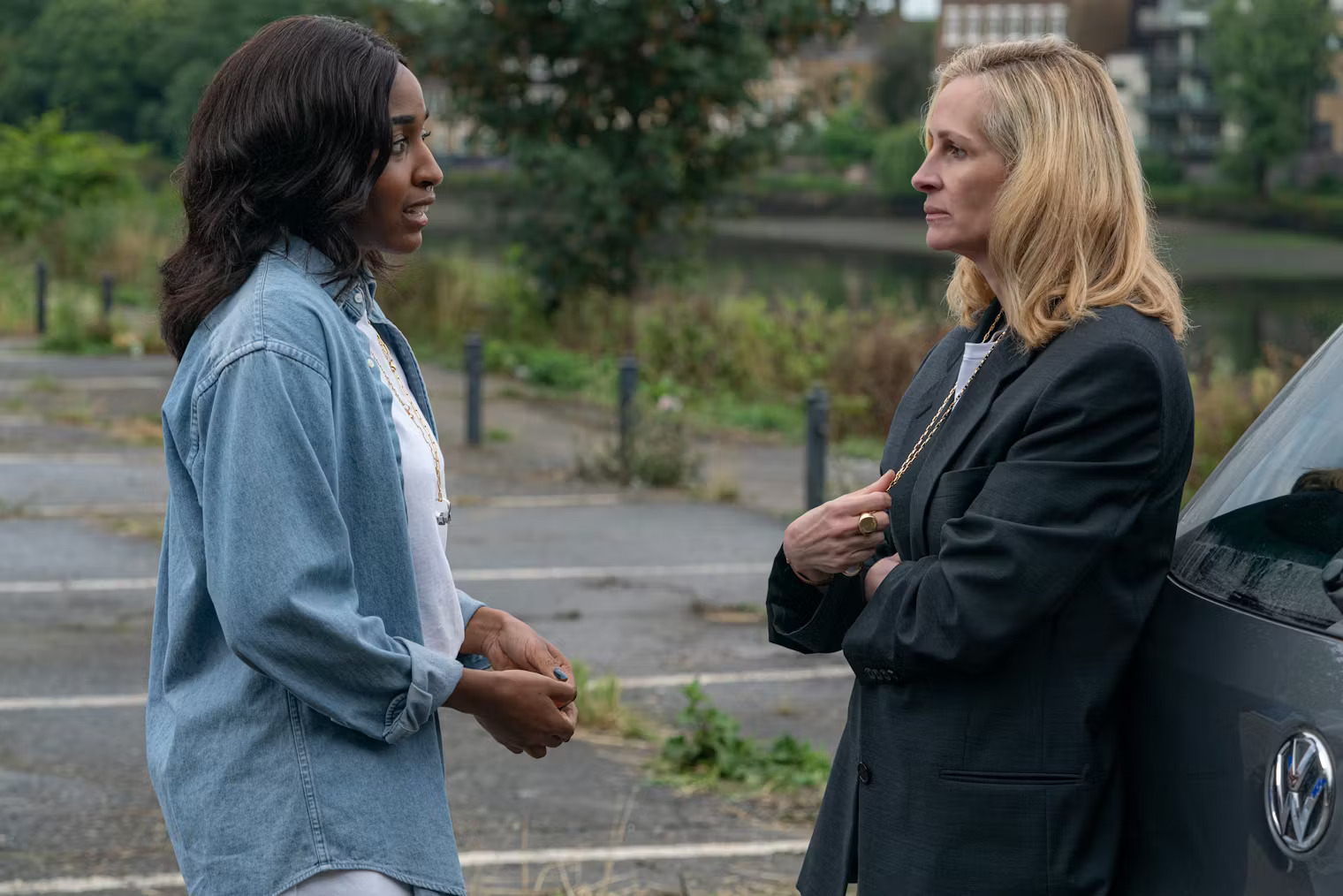
What follows is an uncomfortable but thought-provoking analysis into the formulaic responses to sexual violence that our society has adopted since the #MeToo movement. Rather than admit her knowledge of Maggie’s plagiarism, Alma’s ferocious self-preservation becomes clearer as she turns her back on Hank and allows her competition to be dismissed from the university. Hank then takes a backseat in the plot as the focus shifts toward Maggie, who presses charges against him and shares her account with a journalist. The audience is never told for certain if Hank sexually assaulted Maggie, but it is implied that she is not telling the truth. Regardless, Maggie cogently points out that Alma, Hank and their colleagues all find ways of making her allegations about themselves rather than prioritizing the well-being of a possible victim.
[Related: Film review: Pick your battles, including this one – ‘One Battle After Another’ is a lively romp]
One of the most striking visual motifs throughout the film is the camera’s close shots of key characters’ hands, especially in scenes where a character is sharing a revelatory piece of information. The interplay between Alma and Maggie drives the entire film, and Roberts and Edebiri are superbly paired in a variety of one-on-one conversations ranging from a chat in Alma’s kitchen to a confrontation in a parking lot to a heated argument in an outdoor quad. Every time they appear on screen together, the tension carried through the movement of their hands capitalizes on the discomfort, skepticism and deceit weaved into their dysfunctional professor-student relationship – to the point that Maggie’s nail polish mimics Alma’s.
Despite the spellbinding intensity of the scenes between Alma and Maggie, a few characters were dramatically underused who could have provided a more consistent foil for Alma. One is Michael Stuhlbarg as Alma’s psychiatrist husband Frederik, a loyal partner who intuitively picks up on the falsities in Maggie’s version of events and repeatedly challenges Alma’s biased perception. Likewise, Chloë Sevigny – who stars as a Yale psychotherapist named Kim – juggles the difficult task of being Maggie’s confidant while maintaining her friendship with Alma. She also could have been given more screen time to push Alma’s self-evaluation even farther.

Admittedly, even with an excellent cast and gripping material, there are some fundamental flaws with “After the Hunt.” For most of the movie, substantial time is dedicated to a few unexplained subplots that are not clarified until the film’s final half hour, often without much finesse. For one, Alma spends many scenes spasming in pain or vomiting, but it is not revealed until after she collapses and is hospitalized that she has an addiction to prescription painkillers because of perforated ulcers. Alma’s substance abuse ultimately results in her losing her shot at tenure.
While confined to her hospital bed, Alma finally explains another large chunk of her backstory to her concerned husband: As a teenager, she fell in love with her father’s best friend but later claimed that she was sexually abused by him because of her jealousy that he had taken a different partner. Even though she reneged on her accusation, her former lover had already committed suicide. This was certainly a revelation for Alma to share with Frederik. However, her admission that she had lied about being sexually abused comes too late in the story to add gravity to Maggie’s plight.
[Related: Theater review: A meditation on Alzheimer’s, ‘Am I Roxie?’ finds its footing where memory fails]
Another area where the film suffers is its overly simplistic depiction of racial politics, which are not explored in as much detail or with the same level of nuance as the sexual and gender issues woven throughout the story. On the one hand, Maggie’s positioning as a young, queer Black woman lacking agency in an environment controlled primarily by white educators is sadly realistic despite her repeated statements about having a right to Yale’s exclusive places.
On the other hand, it is a disservice to Maggie’s story that her Blackness is relegated to being a fleeting talking point and not a more well-developed piece of her character. The film is at its most reductive by portraying Maggie – the only person of color in the main cast – as the sole character who is conniving and unscrupulous in every scene. Without a redeeming character arc or tragic flaw, Maggie’s allegations carry less narrative weight. Moreover, the film makes the harmfully dangerous implication that she is more one-dimensional than her white counterparts.
The film might have been immensely better if one or two variables in its overstuffed plot – perhaps the Alma-centric subplots, including a messy third-act romance with Hank – had been cut out entirely to give the rest of the screenplay’s equally challenging ideas more space to breathe. However, one of the film’s greatest strengths is its pervasive moral ambiguity, which increases its cinematic value tenfold as audiences must remain engaged in order to unpack the morally gray actions of Alma, Maggie and Hank. “After the Hunt” is not a masterpiece, but its willingness to reckon with the flaws embedded in contemporary discussions of gender and sexual politics makes it a movie worth pondering long after leaving the theater.
While “After the Hunt” might not always pin down its thematic prey, the chase between Roberts and Edebiri is worth a watch.





Comments are closed.