
This post was updated Oct. 16 at 11:05 p.m.
Amphibian conservation in Australia, sustainable fashion in Indonesia and human-elephant coexistence in India were among the projects nominated for a UCLA award recognizing emerging environmentalists.
The UCLA Institute of the Environment and Sustainability oversees the Pritzker Emerging Environmental Genius Award – the first major United States prize recognizing “next-generation environmental leaders,” according to the IoES website. The institute hosted a “Lunch and Learn” event with the finalists Oct. 8, which included a panel discussion and a Q&A with the three finalists who spoke about how their work contributes to creating a more sustainable and resilient world.
Winner Denica Riadini-Flesch was unable to travel to the event because of her pregnancy, and was represented by her husband, Bertram Flesch. Riadini-Flesch was nominated for her social enterprise SukkhaCitta, which works with rural women to produce eco-friendly fashion using a “farm to closet” approach – part of a wider movement creating local supply chains for sustainable textiles.
“It (The Pritzker) creates awareness and it creates exposure, which then hopefully translates into more people being given permission to actually follow what makes them different, follow what they’re passionate about, and then to set up their own thing or find their own field of research,” said Flesch, the Chief Operating Officer of SukkhaCitta.
One finalist, Seema Lokhandwala was nominated for her work leading the Elephant Acoustics Project in northeast India, which prevents human-elephant clashes by using acoustic detection systems to alert villages and redirect herds. Earning the Pritzker Award gave her project a public platform, Lokhandwala said.
“I come from a very small town in India … nobody cared about the kind of work that I did,” Lokhandwala said. “Everybody in the town knows about my work now, and it is having a really positive impact in the next generation that’s coming in.”
Lokhandwala added that she believes the Pritzker prize could impact younger people who previously thought conservation was too remote of a field to go into.
Anthony Waddle, another finalist, was nominated for his work helping Australia’s green and golden bell frog bounce back from the brink of extinction after once being decimated by the chytrid fungus – the disease that has caused the most documented extinctions globally. Waddle said the exposure offered by the Pritzker Award has benefited him greatly.
“Although I really love what I do, there seems to be a lot of movement against science, … and we have to fight just to be able to do the work,” Waddle said. “Things like the Pritzker … (are) a great reminder that people still do care about what we’re doing, and they want to see us celebrated and our work celebrated.”
Nurit Katz, UCLA’s Chief Sustainability Officer who also moderated the “Lunch and Learn” panel, said she hopes students recognize that there are ways to contribute to sustainability based on their individual passions.
“If you look at the full list of nominees, you’ll see so much diversity in terms of the challenges they’re tackling, and then also the approaches and their backgrounds,” Katz said. “I hope that students will find that inspiring and realize that they can approach this from any major or any perspective.”
Grace Miller, a fourth-year environmental science student who attended the event, said she previously heard of chytrid fungus – which Waddle’s project focused on counteracting – and has done bioacoustics work, like Lokhandwala. Miller added that it was inspiring to see environmentalists pave a path forward in areas she is interested in researching herself.
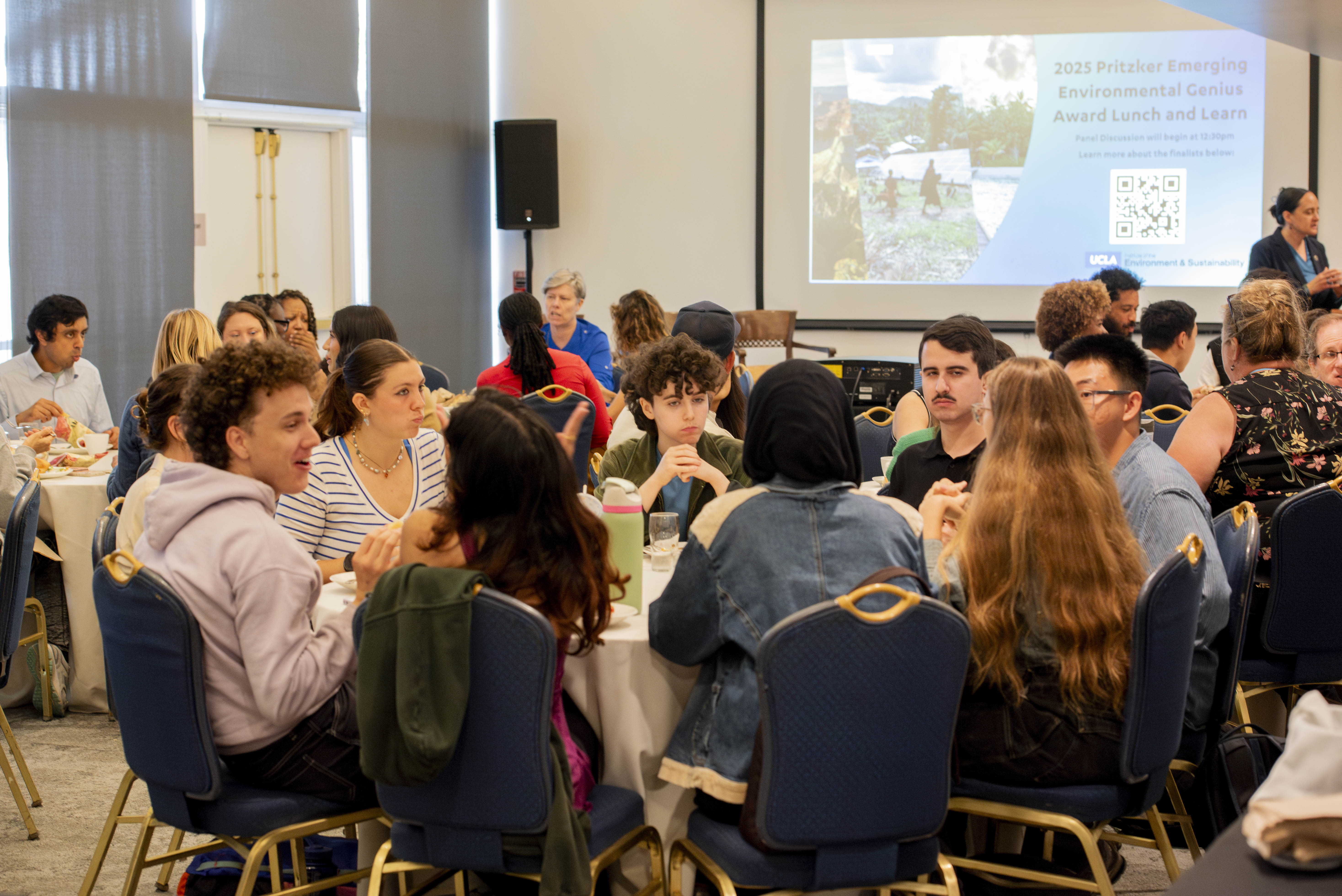
Jolie Rice, another fourth-year environmental science student who attended the event, said she had not heard about the environmentalists’ research before, but still found the panel inspiring.
“I’ve always been really passionate about sustainability,” Rice said. “Coming to these events and seeing people that are successful in these fields and are passionate, it’s really great, because it’s so easy to get cynical and pessimistic.”
Alvaro Villarreal, a fourth-year environmental science student, said he was especially motivated by the panel discussion as someone who is currently applying to graduate school and considering what to make of his future.
“It’s incredibly inspiring to know there is larger things to do beyond us, to help people, to help our world,” Villarreal said.
The finalists were personable about their research and why they pursued it, said Jiaxiang E, also a fourth-year environmental science student. He added that he appreciated how the panel touched on working in the environmental field without a doctoral degree, as neither Pritzker winner Riadini-Flesch nor her husband have doctoral degrees.
“You just have to care for it (the environment),” E said. “And if you care for it, you’re going to do pretty good work.”
Waddle said his nomination for the Pritzker Award has opened doors to meeting different groups of people, including possible funders. Lokhandwala also said the Pritzker has helped her raise funding, adding that financial shortfalls are one of the major obstacles that those in wildlife and conservation are facing.
“At the end of the day, we have to develop the science and implement it,” Waddle said. “If they (funders) can hear what I have to say, I feel like I can convince them that what I’m doing is worthwhile.”


Comments are closed.