This post was updated Oct. 20 at 10:08 a.m.
For one former Bruin, compositions created at UCLA are reaching listeners’ ears for the first time.
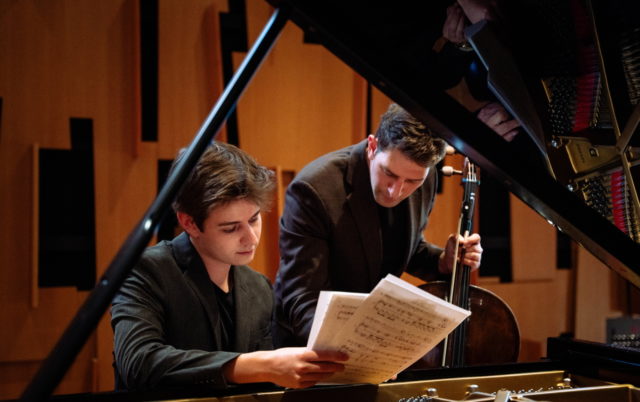
Alumnus Aidan Vass, who graduated with a degree in music composition earlier this year, released the 12-minute recording “Cello Sonata” on Sept. 26. The piece – which was recorded at UCLA – is an original composition by Vass, who played piano on the track alongside musician Daniel Lelchuk on the cello. Vass said he hopes listeners are able to feel the drama of the composition and its musical expansion, even if they are unfamiliar with classical music.
“Changes in expansion are related to this feeling of drama, and I think that drama is something that is intuitively accessible to people regardless of their background,” Vass said. “Somebody who has never heard a classical piece in their life, I think they can intuitively sense this concept of drama and darkness and lightness.”
Vass said he was exposed to music from an early age because his mother is a classical singer, but he did not begin to take music more seriously until he was about 12 years old and playing instruments such as trumpet and guitar. He added that he began composing and writing music at age 13 before he became a composer fellow with the Los Angeles Philharmonic about two years later. The experience at the LA Phil helped Vass elevate his music from a hobby to a a career, and he said learning with distinguished faculty at UCLA strengthened his artistic voice.
Studying music at UCLA is like a buffet, Vass said, because faculty members have different artistic approaches and philosophies that expose students to many ways of thinking about music. Vass added that this variety of perspectives means that students have to think more critically about why they are writing music. Some of the most impactful experiences of his Bruin education were participating in UCLA Philharmonia and recording projects in UCLA’s studios, he said.
[Related: School of Music appoints Michael Beckerman as new dean, plans for more unity]
Vass said he had met Lelchuk a couple years ago, but it was not until spring 2024 that the East Coast musician suggested collaborating. After Lelchuk asked him to write a composition, Vass added that he spent about two months writing and revising “Cello Sonata” through multiple drafts. Rather than attempt to evoke specific imagery or convey a particular narrative about his life, Vass said he strove to create music that was less literal and more focused on Lelchuk’s instrumentation.
“I really wanted to lean into color and some more abstract concepts in music,” Vass said. “I really wanted to write something that was the most adventurous work that I had written before in terms of the amount of musical color that’s in the piece.”
Lelchuk, a sales and media executive at Carriage House Violins in Boston, said he gave Vass creative freedom in the development of the piece. Lelchuk added that he believes the alumnus is one of the leading composers of his generation. It was Vass’ idea to integrate piano into the composition, and Lelchuk said he finds the end of “Cello Sonata” unsettling because of its ambiguity, which lacks a decisively triumphant or tragic ending, and instead leaves the listener to ruminate about the piece. Listening to the piece at different times can also give different perspectives on the music, Lelchuk added, saying hopes listeners will revisit “Cello Sonata” multiple times.
While some parts of “Cello Sonata” are soft and quiet, Vass said other portions are more energetic as Lelchuk delivers powerful strokes on the cello and Vass offers runs on the piano. It was more than a year after it was written, that the duo recorded the piece in May 2025, Vass said. Waiting to record the piece until Vass and Lelchuk could meet in the studio was essential, Vass said, because the interplay between the pianist and the cellist is best executed with eye contact for the performance exchange to work. “Cello Sonata” somewhat resembles an object launching from the ground, in terms of the visuals he associates with the piece, Vass added.
“The primary concept underlying the gestures in ‘Cello Sonata’ is this concept of musical expansion, vertical expansion,” Vass said. “The phrase is sort of small and together, and then they grow really fast, and there’s a virtuosity to that.”
[Related: Garden Party draws influence from jazz to bring positive energy with music]
Melody Vass, Aidan Vass’ wife, said she has seen her husband’s analytical approach and passion for his music throughout the entirety of their five-year-long relationship. She added that her husband is not only kept busy by his work as a composer, but also as the co-founder of the music social media app Musotic and the founder of the generative spa music service Meristream.
“Cello Sonata” is one of Melody Vass’ favorites of her husband’s pieces – she said the composition balances pretty sounds with grittiness. She added that her favorite of Aidan Vass’ pieces is the string quartet composition he wrote during his time at UCLA and performed at a recital earlier this year, because she was able to see the heart and soul he brought to the music, which also moved the audience. With all of her husband’s pieces, Melody Vass said there is a story being told and ample sonic complexity.
“It’s not like there’s a piece that’s just purely happy or a piece that’s just purely dark,” Melody Vass said. “He is very good at capturing the truth and the reality of the world, and ultimately all of his music signifies hope in some way.”
When it comes to the future direction of his music, Aidan Vass said the process of developing “Cello Sonata” has raised his standard for the level of detail to bring to every second of a composition. Rather than cluttering the music, the composer added that he wants to be deliberate with each second of a record. Additionally, he said he wants to continue to create music that encourages collaboration in a live setting, giving each musician the ability to communicate while making the recording process more meaningful.
“If I’m writing music that’s too straightforward, then I don’t want the performers to feel like they’re doing a mechanical task,” Aidan Vass said. “That’s not artistically fulfilling … If I can write music that gives the players more of an opportunity to talk to each other musically, I think that’s really special.”



Comments are closed.