This post was updated Oct. 21 at 3:20 p.m.
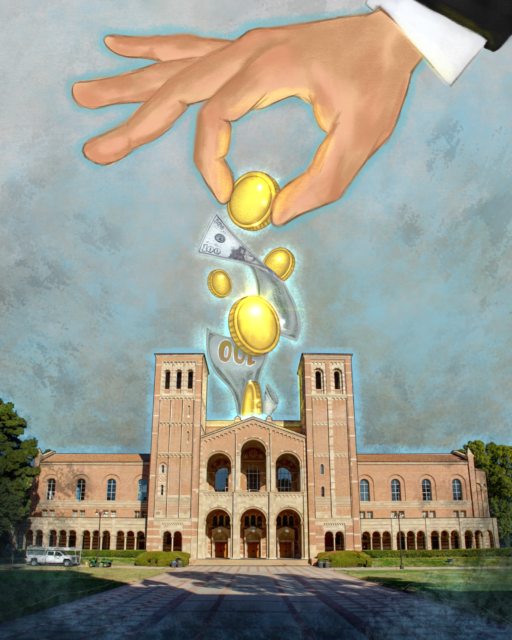
UCLA and the Trump Administration have been at odds over federal funding for months.
In July, The Trump administration suspended an estimated $584 million of research funding to UCLA, alleging that the university failed to protect Jewish and Israeli students from antisemitism, implemented affirmative action in their admission practices and allegedly allowed “men to participate in women’s sports.”
While a federal judge ordered the restoration of most of the funding, the struggle breaks a long tradition of cooperation between university institutions and the federal government in research development.
The White House did not respond in time to a request for comment on the federal funding cuts.
[Related: FEDERAL FUNDING CUTS TO UCLA]
Monique Trinh, the program manager of Pathology and Laboratory Medicine at the David Geffen School of Medicine, said these research funding cuts will have widespread impact on a variety of communities at UCLA.
“These cuts are more than just numbers,” Trinh said. “It ripples into our classrooms, our clinics and our communities and the economy.”
In the 2023 fiscal year, the federal government provided roughly $60 billion of research and development funding through grants and contracts for schools according to USA Facts, a non-profit civic data group. Research in life sciences and engineering programs received the most funding, with life sciences receiving over half of all funding – $33.9 billion – and engineering amassing $10.9 billion.
The main sources of federal funding are the National Institutes of Health, the National Science Foundation and the Department of Defense.
The NIH was first created in the 1880s, but did not receive approval from Congress to award grants until 1946 with the passage of the 1944 Public Health Service Act. Since then, the NIH has become the world’s leading provider of medical research funding and oversees 27 instiutues and centers, including the National Cancer Institute and the National Institute of Mental Health.
The federal government then created the NSF during the 1950s when the rise of the military and defense industry during the Cold War fueled a demand for more comprehensive research in science.
The DOD started funding basic and applied research in 1947. The DOD oversees multiple organizations, including the Departments of Air Force, Army and Navy, as well as many other defense agencies. Defense-related research covers a wide range of fields and disciplines, with spending totaling roughly $9 billion in 2023.
Most university research programs acquire federal funding by putting together and submitting a funding proposal to the government.
A UCLA spokesperson said in an emailed statement that university units identify funding opportunities through federal agency websites then write a proposal outlining the project’s objectives, methodology, expected outcomes and expected costs.
The federal government accepts unsolicited funding proposals on a rolling basis throughout the year.
For new areas of research or more time sensitive projects, a federal agency may also sometimes issue a program announcement – or request proposals and applications – from researchers by a particular deadline.
Aradhna Tripati, the director and founder of the Center for Developing Leadership in Science, said in an emailed statement that she has around $10 million grants dependent on the government. Tripati said that when she applies for grants, she often has multiple goals.
“I will look for programs that are ones that will support the training of students that will support addressing research questions that we have,” Tripati said. “I look for programs that will support, work with community partners that are centered on this project.
Tripati, a professor in the departments of atmospheric and oceanic sciences and earth, planetary and space sciences, said some funding proposals require months to develop. Many of them are comprehensive reports averaging to around 50 to 100 pages each, she said.
Applications for research funding are also highly competitive. For example, the National Cancer Institute had an acceptance rate of 14% for research project grants last year, according to the organization’s website.
“Usually, only the top one or 2% of proposals will get selected,” Tripati said. “The proposals go through peer review, so they get reviewed independently by anywhere from five to 10 specialists in the field who will address … the criteria of intellectual merit and the broader public good, the broader impacts of the proposal and the impacts of the field’s bias and technology infrastructure.”
[Related: Science fair for suspended research aims to show impact of federal funding freeze]
At UCLA, faculty researchers must first secure approval from their department’s chairs or deans. The proposal is then submitted to UCLA’s Office of Contract and Grant Administration, which verifies compliance with both federal regulations and institutional policies, according to the office’s website.
Once approved, the OCGA formally submits the proposal to the federal agency, where it undergoes peer review and internal evaluation.
If successful, the agency issues a Notice of Award to UCLA, officially authorizing the project and releasing funds. After funding is awarded, a principal investigator – the lead researcher – assumes leadership by overseeing the research project.
While university researchers and faculty members are all a part of the research process, the PI’s responsibilities include supervising the design, proposal, execution and management of the research grants.
According to the Association of American Universities, PIs generally use the funds to hire graduate research assistants. The remaining resources are used to fund laboratory supplies, equipment, travel and computational resources.
Trinh said bringing on researchers is a key step in ensuring the success of their treatment studies.
“It’s about access, and that there are real people tied to this and that it starts with these training grants, but what they develop becomes the treatments that people … get,” Trinh said.
Students training under research labs affected by the funding freeze face uncertainty, with many labs currently offering less positions and opportunities, according to the Association of American Medical Colleges. The Los Angeles Times reported that the stressful environment may lead to many early-career researchers seeking employment elsewhere, leading to a potential “brain drain” in the future.
Many UCLA researchers and faculty have pushed back against political pressures affecting their work. Across UC campuses, research faculty filed multiple lawsuits against the administration following the funding freezes in an effort to restore their grants.
Federal judges have since ordered the Trump administration to restore around $500 million of UCLA’s NIH research grants, as well as unfreeze around roughly 300 grants from the NSF.
[Related: Federal judge orders Trump administration to restore $500M of UCLA research grants]
Tripati said researchers and faculties’ resistance is an important testament to keeping partisan politics out of science and research.
“While we successfully fought to get UCLA’s grants restored, federal funding for public good research has become a political football – and it shouldn’t be,” Tripati said in an emailed statement. “Research is a public good – and also does underpin progress – and the economy – that in turn affects everyone’s life – and our individual and collective futures.”


Comments are closed.