This post was updated Oct. 19 at 11:48 p.m.
Former policymakers and political analysts gathered Tuesday to discuss bipartisanship in the United States’ polarized political climate.
The discussion was hosted by the UCLA Luskin School of Public Affairs in partnership with the UCLA Burkle Center for International Relations and the Los Angeles World Affairs Council.
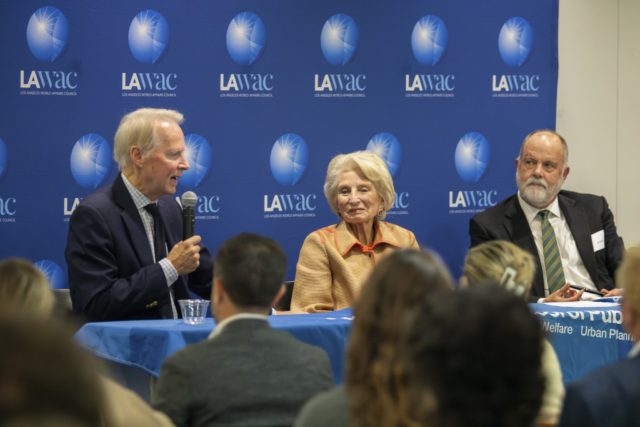
Jane Harman, a Democrat and the former U.S. Representative for California’s 36th congressional district, and David Dreier, a Republican who previously served as a U.S. Representative for several California districts, discussed their experiences in Congress along with the difficulties in achieving – and benefits of – bipartisanship. The conversation was mediated by Jim Newton, a lecturer in public policy and veteran journalist.
Anastasia Loukaitou-Sideris, the interim dean of the Luskin School, started the conversation by introducing the topic, the two panelists and their mediator.
“As we’re all well aware, our country is currently experiencing an era of extreme polarization,” Loukaitou-Sideris said. “Engaging in respectful and insightful discourse is essential to maintaining bipartisanship.”
The event was held on the 14th federal day of the government shutdown, as Congress has yet to come to an agreement on a budget dispute.
Julian Gold, a board member of the LA World Affairs Council and the former mayor of Beverly Hills, called it “imperative” to facilitate “thoughtful, polite, collegial” dialogue to understand those with differences and come to well-informed conclusions.
Harman, who served nine terms in Congress before working in global affairs and national defense, and Dreier, who served 16 terms in Congress before working in foreign affairs policy, spoke about their years collaborating in Congress despite being on opposite sides of the aisle.
One such attempt came as Dreier asked Harman to support the North American Free Trade Agreement, which Harman rejected, Dreier said. NAFTA was a pact between Canada, Mexico and the U.S. that created a free-trade zone between the North American countries. It was implemented in 1994 and was in effect until the passage of the U.S.-Mexico-Canada-agreement in 2020, according to the U.S. Customs and Border Patrol website.
“Here we were, trying to encourage the development of democratic institutions, political pluralism, the rule of law in a very, very bipartisan way,” Dreier said. “Needless to say, it has been a struggle.”
Although they sometimes held opposing views, Dreier and Harman remained on good terms, Harman said. Dreier spoke about how small actions to further goodwill make an impact, citing a time where he sat between Harman and Congresswoman Maxine Waters on the Democratic side of the floor during President Barack Obama’s 2011 State of the Union message, instead of sitting with Republican leadership.
“I went over there because I said there are little, tiny things like that can be done,” Dreier said.
The panelists also discussed their views on how candidates and current representatives in Congress have changed over the past few years – with Harman alleging that many elected officials are more focused on getting re-elected than solving problems.
Although the primary system of elections has remained the same, the division between the two parties has become more extreme, Newton said. There are more extreme candidates at the forefront now than ever before, he added.
Social media has made it so people who are performative and have extreme views “sell” better than those who might be serious and focused, she added.
As a congresswoman, Harman said she tried to understand policies rather than “making noise.” Those who “scream and yell,” however, now often win primaries and carry those mannerisms into their time in Congress, she added.
The two congresspeople had varying answers on whether bipartisanship was dead.
“No,” Harman said. “But in many respects, it’s on life support.”
People with extreme views have been elected at the congressional level in both parties, Harman said, furthering standstills as leaders are pushed away from the opposite party.
Dreier had a different take, saying that bipartisanship has shown up in recent policy outcomes. President Donald Trump has opted not to challenge Medicaid despite how Republicans have previously sought to make changes, and he enjoys the support of union organizations, who have traditionally sided with Democrats, he added.
“If you look at some of these issues, there actually is bipartisanship,” Dreier said. “It is alive and well.”
The key part of working with Harman on topics such as national security and foreign policy was trust, Dreier said.
“We would go and debate on television regularly on these programs and Sunday mornings,” Dreier said. “We’ll always have trust in each other, and that is so vitally important.”
Getting engaged with local and federal initiatives by pursuing internships and other work opportunities is a key step for students to get involved in politics, Dreier said, citing his own experience as an intern in the early days of his career.
Registering to vote, running for office and engaging in conversations with those who hold different opinions are other opportunities to make a difference, Harman said.
“Talk to people who have different views from you,” Harman said. “Listen to them, because guess what, you might learn something, and guess what else – they might learn something.”




Comments are closed.