This post was updated Oct. 23 at 11:23 a.m.
Around 10 student leaders and elected officials held a rally in support of creating a UCLA stop for the future Sepulveda Transit Corridor on Oct. 10 at Bruin Plaza.
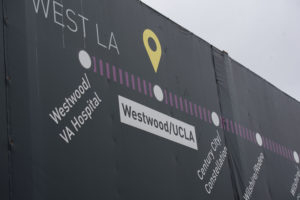
The Sepulveda line will stretch from the San Fernando Valley to the Metro E Line at Sepulveda and Expo or Bundy and Expo. It is expected to be completed in 12-15 years.
With chants of “4 or 5, not the 405,” – a reference to project alternatives four and five, which would include a UCLA stop – multiple people gave speeches to a crowd about the necessity of high-quality transit for UCLA students.
Commuting to UCLA can be time-consuming, unreliable and costly, sometimes taking more than 2 hours per day, said Jack Feng, the vice president of external affairs of the Graduate Students Association, in his speech.
“That amount of time could be saved to advance research, support our undergraduate students or simply resting or recharging,” he said in an interview with the Daily Bruin. “For many of us, this issue is not abstract. It’s very deeply personal.”
Feng added that he endorsed alternatives four and five for the Sepulveda Transit Corridor, which use automated heavy rail technology and include an on-campus station, citing higher potential ridership numbers, environmental benefits and the “greatest social return” per public dollar in his speech.
Feng said he has spoken at press conferences, submitted public comment and attended public hearings to advocate for graduate students.
LA Metro released a Draft Environmental Impact Review for the STC in June with public comment open until August and will next select a locally preferred alternative to recommend to the Metro Board of Directors, according to the STC project website.
There are currently five options for the STC – two monorail and three heavy rail options, with alternative 1 lacking a UCLA station, instead opting for a bus connection from the Wilshire Boulevard station.
According to estimates from LA Metro, alternatives 4 and 5 would serve around 120,000 riders per day, compared to between 82,000 and 107,000 for the other alternatives that reach UCLA. In every proposal, UCLA would be the network’s most trafficked non-transfer station.
[Related: Upcoming Metro projects set to improve UCLA commute times, curb Westwood traffic]
Imelda Padilla – the council member for the Los Angeles City Council’s sixth district – said in her speech that the STC would be a “generational investment” for the San Fernando Valley, Westside and Los Angeles County as a whole. As the sister of a former Bruin, she said she is familiar with the burdens of transportation and housing costs that students and other community members face.
As one of 13 voting members of the LA Metro Board, Padilla has not yet endorsed a specific route, but said in an interview with the Daily Bruin that she is “not overly excited” about the monorail alternatives.
Freddy Puza, the vice mayor of Culver City, said the project would benefit his constituents by reducing traffic and making transit more equitable, as well as benefit the entire region by strengthening the economy and reducing pollution.
Although the current proposals for the STC do not have a station in Culver City, the adjacent E Line does, and multiple alternatives end at Sepulveda Avenue, north of Culver City – with future extensions south to LAX – according to project proposals by LA Metro.
While he did not support a specific alternative, Puza said he would ultimately consider time and cost when endorsing a route. He added that the project’s biggest obstacle is the lack of awareness about it from constituents.
“The number one issue right now is lack of education around it, or lack of knowledge around it,” Puza said. “Once you get people aware of it, I think they’ll have a better investment and then talking about the advantages and disadvantages of the options.”
Padilla said it is important to mobilize UCLA students to support this project, calling them the “future leaders” and “future workers” who would be impacted the most by the project.
“It’s very important for future generations that are going to be using it and taking advantage of it to stay engaged,” Padilla said. “As long as the community and those that are going to be its main stakeholders don’t lose sight of it, everything else flows.”

Comments are closed.