This post was updated Oct. 23 at 7:24 p.m.
I helped organize a protest in response to the murder of George Floyd in 2020.
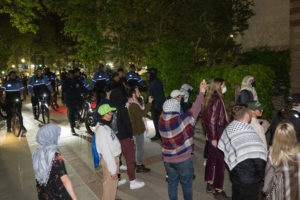
Years later, students filled Dickson Plaza, once again calling for justice. When tents covered the grass during recent campus protests, signs demanding “ceasefire” and “justice” mirrored the same urgency I saw on the streets of Vallejo, California. From Vallejo to Westwood, the demand remains the same: respect for life over silence.
What I once thought of as just “freedom of speech” became something much deeper – the right to demand justice out loud, together.
In recent years, people in the United States have risen up collectively to confront systemic injustice and combat violence against Black and Latino communities.
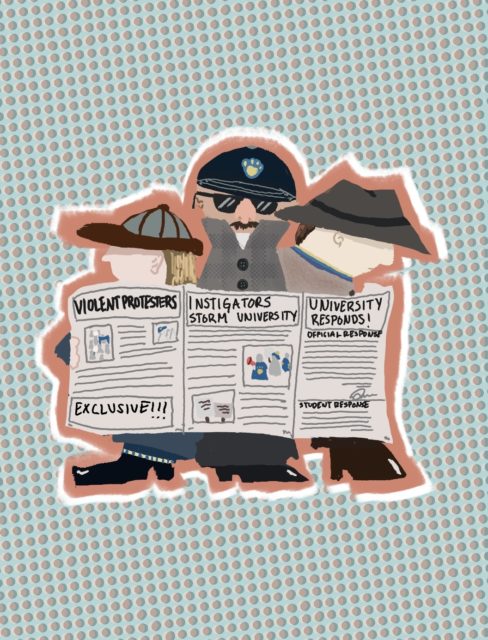
Yet public discourse has become increasingly preoccupied with what constitutes a “proper” protest. Media narratives insist demonstrations must be polite, permitted and orderly to be legitimate – that chaos undermines the message protesters are trying to convey and alienates potential allies.
This framing ignores how the state decides whose safety matters. “Order” itself has long been maintained through the very violence protesters rise up against.
I remember police motorcycles cutting through the crowd, engines roaring as helicopters circled overhead. Even in the noise, we refused to stop chanting.
Why must protesters respect a system that beats, kills and drives them from their homes?
History makes one truth undeniable: Real change has never come by asking nicely. Justice is demanded, not requested.
Many movements that were condemned as “disruptive” are now recognized as monumental to social progress. Civil Rights Movement marches, which at the time were looked at as too “radical” and “disruptive,” are celebrated as vital acts of social courage today.
Defining a “proper” protest is less about safety or civility and more about control. To label some forms of dissent as acceptable and others as dangerous is to decide whose voices deserves to be heard and whose can be silenced.
Maybe that’s what “order” really means – keeping protests tidy enough so those in power can ignore them.
Uprising against police brutality and U.S. Immigration and Customs Enforcement raids this summer made that tension clear. Communities demanded humanity and accountability from systems that continued to criminalize and harm them.
The Youth Justice Coalition is a Los Angeles-based organization that works to unite young people, families and system-impacted people to end mass incarceration and state violence through education, advocacy and direct action.
“I don’t use the phrase ‘peaceful protest,’” said Emilio Zapién, the media and communications director at the Youth Justice Coalition.
Zapién said when people of color gather in public, they are already confronting a system that harms them psychologically, economically and physically.
“There’s an inherently violent nature of law enforcement that shows up to police people that are exercising their First Amendment rights,” he said.
Leah Nelson, the internal public relations coordinator for the Afrikan Student Union, said the conversation about “proper” protest carries racial and systemic weight.
“It’s hard to be polite and orderly in a system that you feel doesn’t respect you or doesn’t deem you as human,” said Nelson, a second-year political science student.
She added that the very standards of “politeness” are rarely applied equally across communities.
“Polite and orderly oftentimes means white, and that’s just the unfortunate reality,” Nelson said.
Zapién agreed and said saying the rhetoric used to demand “polite” protests often works to uphold white supremacy itself.
That pattern is not limited to public demonstrations. It also appears within universities themselves.
Douglas Barrera, a senior associate director at UCLA’s Center for Community Engagement, said he has witnessed similar dynamics between institutions and activists. He said universities, like other systems of power, often tolerate protest only to the extent that it remains orderly and nondisruptive.
“They expect everything to be permitted (apply for and receive a permit),” Barrera said. “They expect everything to happen within the rules. And I think part of that is because they don’t really want those rules to be challenged.”
In other words, institutions draw lines not to protect protest, but to contain it.
Barrera said calls for “politeness” during protests are not neutral expectations, but subtle ways of enforcing conformity and preserving existing systems of power.
By creating expectations that oppressed people must protest politely, even when the system they are confronting has never shown them that same respect, we perpetuate the injustice they are fighting to end.
As Barrera put it, conformity is the very thing protesters resist. And as Zapién and Nelson remind us, politeness has long been a privilege denied to those most harmed by injustice.
To protest is to demand humanity in a system that withholds it, to make visible what power wants hidden.
Justice, as history shows, is achieved through persistence, not permission.

Comments are closed.