This post was updated Oct. 26 at 7:23 p.m.
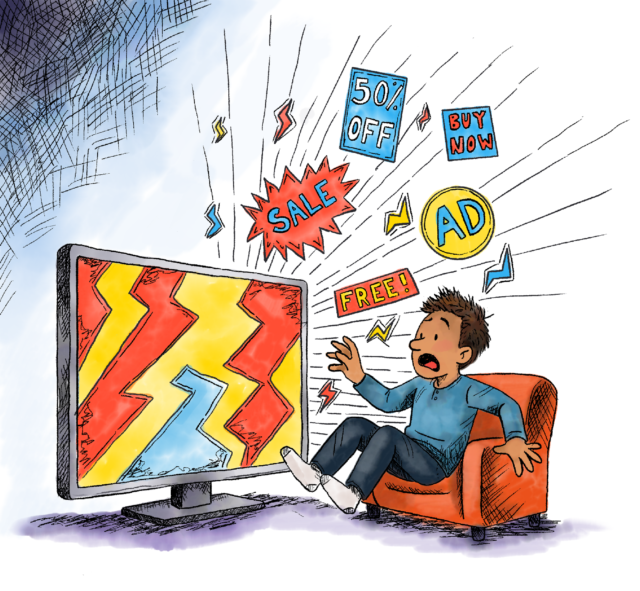
You can barely hear the show, but suddenly an advertisement rings louder than anything you’ve heard. No, it’s not all in your head.
I never thought twice about streaming movies with my finger comfortably near the volume button. When my household was nestled in their beds for the night, I always made sure to quickly lower the volume during a commercial break. It was a reflex.
A law signed by Gov. Gavin Newsom on Oct. 6 officially banned excessively loud ads on streaming services, including Netflix, Amazon Prime Video and Hulu. The law requires streaming services to have ads play at the same volume level as other content.
Hearing about this bill passing felt like a form of validation I didn’t know I needed. Ads being loud always felt like a fact of life.
Since 2023, both YouTube and its other platform, YouTube TV, have been displaying unskippable ads.
Yet on such services made for leisure, incorporating loud ads that appear every second only serves to irritate.
Jade Kariuki, a second-year economics student, said loud and sudden ads intrude upon the relaxation she seeks whenever she’s streaming something.
“Ninety-nine percent of the time, the ad isn’t useful to me or isn’t of use to me, so that just being louder – I don’t need that,” Kariuki said.
Contemplating the volume of ads reveals that the issue is only the tip of the iceberg. Although ads follow me in every aspect of my life – both online and offline – the law led me to stop and think about the sudden ubiquity of ads today.
Kalea Luna, a fourth-year psychology student, said although ads exist on every platform, she’s learned to tune them out. However, she still noticed them in places they weren’t on before, such as on social media.
“I’ve had Snapchat since I was in middle school,” Luna said. “One random day, there just happened to be ads when I was scrolling through stories, and I was like, ‘What is going on?’”
Persistent ads on streaming services and websites point to companies using strong marketing tactics. But when ads cross the line of simple nuisances to becoming sudden, loud and overwhelming, they breed frustration and dissatisfaction with the platform itself. It is more of an issue of principle.
“Everything is an ad now,” said Hayley Dunkel, a first-year public affairs student. “I’ve noticed a lot of platforms now have ads at the beginning so you can watch the rest ad-free, which seems like they’re doing you a favor, but there wasn’t even ads in the beginning (when Dunkel first used the platforms). So it’s kind of confusing.”
Newsom’s recent legislation hands a victory to the consumer, demonstrating that our enjoyment should not come with the price of excessive disturbances.
“I’m glad that this policy passed because it shows that we’re actually taking action to fight back against all these ads,” Dunkel said.
Advertising culture never settles; if anything, it grows over time.
Yet part of the blame also lies with us, such as when we click on an ad for a pair of cute boots and decide to order them from that website.
“I think the ads are more of a product of increasing demand and increasing consumerism,” Kariuki said.
Perhaps one of the most detrimental barriers to pushing back against ads is welcoming them into our pop culture. One of the most pertinent examples is the famous GrubHub “Delivery Dance” ad that became an internet phenomenon in 2021. It was quoted, edited and pinned as a meme.
While ads are unavoidable, we have the choice to leave them as exactly that: Ads.
We don’t have to click on what seems to be a good deal or discuss it with other people. Neither should we need to integrate ads into our pop culture or internet references. Having an ad blocker gives me tranquility, and it is a feature I recommend for users seeking an internet experience less cluttered by ads.
When we cut off the ties that advertisers try to make with the general public, we give ourselves more power than we realize – including the new experience of quieter ads.




Comments are closed.