This post was updated Oct. 26 at 10:36 p.m.
UCLA professors said a new state law allowing higher-density housing near major transit stops – including in Westwood – could make housing more affordable overall.
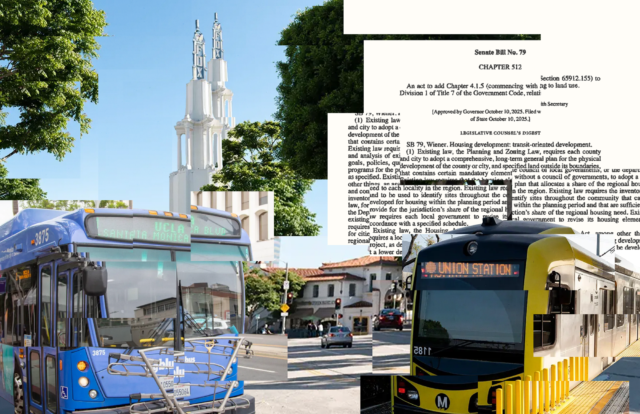
Gov. Gavin Newsom signed Senate Bill 79 – the Abundant & Affordable Homes Near Transit Act – into law Oct. 10, updating zoning laws to permit multi-story low-income housing near major transit stops. State Senator Scott Wiener said he authored the bill due to the state’s critical housing shortage, which has contributed to California’s unaffordable cost of living.
The bill, set to go into effect July 1, 2026, sets rules for developers, such as minimum building heights and required shares of units for low-income residents. Under the new law, compliant projects within one-half mile of a transit-oriented development stop can be exempt from the zoning limits if there is no walking path less than one mile from that location to the transit-oriented development stop, or if the area has at least 15 transit-oriented development stops.
The current dominance of single-family homes near these transit stops means that not enough Californians are leveraging valuable employment commutes, said Michael Lens, a professor of urban planning and public policy at the Luskin School of Public Affairs.
Lens added that these commutes are made accessible by offerings such as the multimillion-dollar Westwood/Rancho Park metro station – where few people can currently afford housing.
UCLA students face some of the highest rents across UC campuses, according to the UC Office of the President.
[Related: Op-ed: UCLA must further address housing affordability to increase educational equity]
Lens said the large sizes of single-family properties contribute to a “really bad land use pattern,” with residents occupying big spaces at high prices, generating a small amount of total units available for living.
“There’s just not that many homes that a diversity of people can live in.” Lens said. “It’s a kind of double-edged problem of scarcity.”
Los Angeles permitted over 17,200 homes for construction last year, according to LAist. This is far from the estimated 57,000 annual homes needed for yearly building to meet its goal of creating 456,643 new homes by 2029, according to Los Angeles City Planning. Approximately 72% of LA residential land is zoned for single-family housing, according to LA City Planning.
Local governments will maintain control over transit-oriented development under the legislation, provided they adhere to guidelines from the state and the Department of Housing and Community Development. The law may also shorten approval and construction timelines for housing developments that meet SB 79 criteria, according to Wiener’s office.
The bill could promote housing affordability near transit areas through a “chains of moves” phenomenon, said Paavo Monkkonen, a professor of urban planning and public policy at the Luskin School of Public Affairs. He added that upscale properties constructed near transit could encourage high-income renters to pursue expensive properties, as opposed to competing with shoppers of lower income for the same units.
“The landlords are able to increase their rents a lot because of the competition, because the demand is so high,” he said. “By having even expensive buildings, you make all housing relatively less expensive.”
SB 79 is unlikely to impact LA outside of major transit stop areas, Monkkonen said. He added, however, that academic analysis can inform predictions on the influence of the bill.
Monkkonen said he believes existing homeowner resistance to new developments led the City of LA to maintain unchanged housing limits when it updated neighborhood plans near the LA Metro station. He added that this prevents new developments suitable for future university students from residing near the publicly-funded transit infrastructure.
[Related: LA Metro plans to open new stations in Westwood, considers metro stop at UCLA ]
SB 79 will help families of all incomes afford housing near quality transit, said Jacob Wasserman, a research program manager at the UCLA Institute of Transportation Studies. While the Cap-and-Trade Program – which creates allowances for permissible emissions, according to the California Air Resources Board – has been effective, transportation is still a major source of greenhouse gas emissions, he added.
Wasserman said addressing land use and transportation issues in tandem is a necessary approach.
“The ultimate goal, that we should try to align our housing policy with our transportation policy, is a good one,” he said. “Anything that gets us to support that goal is worth pursuing.”



Comments are closed.