This post was updated Oct. 26 at 10:30 p.m.
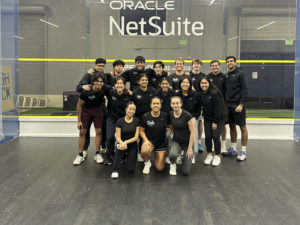
UCLA Squash finished the 2024-25 academic year with a membership count twice as high as last year’s and a second-place trophy for its newly-formed women’s team.
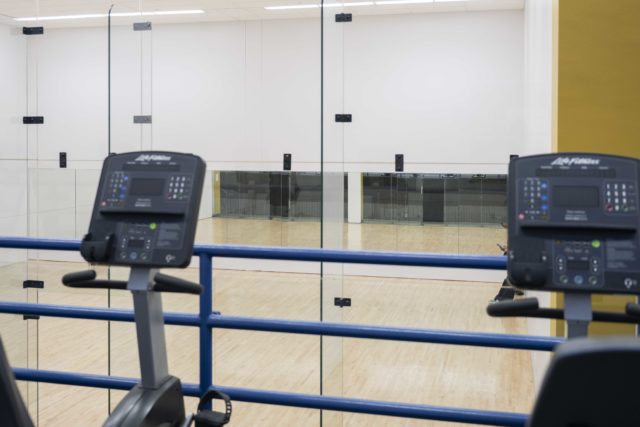
But upon returning to practice at the John Wooden Center this fall, the team learned two of their courts had been removed – leaving them with just one squash court for practices.
UCLA Recreation replaced three racquetball courts and two squash courts on the first floor of the Wooden Center with a new fitness zone and a dance and fitness studio as part of the John Wooden Center Improvement Project, according to its website. The project began fall 2024 and is projected for completion in winter 2027, according to the website.
The squash courts on the first floor were the only ones on campus, according to an emailed statement from UCLA Recreation.
Aadi Bhandari, the president of UCLA Squash, said that prior to the renovation, the team used the courts to train for nine hours a week, play individually and host teams for round-robin competitions. Because of the court closures, the team reduced their on-court time by 30 minutes per session – and began supplementing lost practice with off-court fitness and conditioning, said Bhandari, a fourth-year economics student.
Training around 24 team members in the two squash courts available before the renovations was logistically challenging, Bhandari said. It cost $100 per player for membership and squash court time at TRIFIT health club, where UCLA Squash relocated in winter 2025 while the Wooden Center’s squash courts were closed, said Micah Kim, one of the founders of UCLA Squash.
Bhandari added that other universities in California – including the University of Southern California and UC Berkeley – have at least three squash courts on campus.
“From the perspective of having competitive players who’ve got the motivation to perform well, I don’t think we lack in that aspect at all,” he said. “But what we do lack in is the support from our university to keep deepening the passion for the sport on the West Coast.”
UCLA Recreation said in the emailed statement that it is supporting UCLA Squash by prioritizing their court reservations, increasing the amount of time they can practice in the courts and assessing future options for squash court expansion.
“Given the relatively small size of the campus, space constraints affect nearly all club teams,” UCLA Recreation said in the statement. “Despite these challenges, UCLA Recreation continues to support the clubs in a myriad of ways through space scheduling, athletic training, event hosting, arranging travel, licensed apparel ordering, and managing the club sports’ financial infrastructure.”
Limited court availability also poses challenges for non-team members who played recreationally at the courts, Bhandari said.
One such player is Paulo Alves, an assistant professor in the physics and astronomy department. Alves, who visited the courts weekly, said he fell in love with the sound of the squash ball when introduced to the sport as a child. Alves added that he prefers playing with UCLA Squash team members, because they are more competitive than those who play at private fitness clubs.
Bhandari said 30 to 40 students who did not make it on the UCLA Squash team also play the sport regularly. Alves added that playing squash at the Wooden Center was ideal because it was more cost-effective and convenient than private clubs.
“I’m afraid that we’re going to go through another period where … the squash community is going to fragment, and we’re going to lose that community,” Alves said.
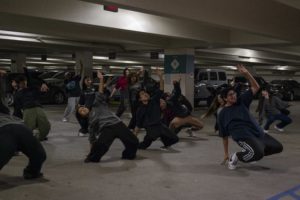
UCLA Recreation said in the emailed statement that it converted the first-floor courts into a dance studio to create a “mitigation space” when two studios on the second floor of the Wooden Center will close in 2026. The space is available to many groups on campus – including dance groups, cultural clubs, athletic teams and wellness classes, it added in the statement.
Catherine Xu – a second-year psychobiology student and co-president of the VibeCheck dance club – said in a written statement that securing a room for practice is challenging, due to the multitude of dance organizations on campus – even with the addition of the new dance studio.
Viviana Romo, the public relations executive for Girl Gains UCLA – a weightlifting club for women – said they believe the new fitness zone contains exercise equipment from the advanced circuit zone, which is closed through January 2026. Romo, a fourth-year international development studies student, added that they find the new space to be “cramped.”
The Wooden Center Improvement Project is set to end before the 2028 Los Angeles Olympics, said UCLA Recreation Executive Director Erinn McMahan at an August 2024 Undergraduate Students Association Council meeting. UCLA’s campus is set to serve as the Olympic Village for the quadrennial games.
The upcoming Olympics will feature squash for the first time, which Bhandari said reinforces UCLA’s need to add more courts – and demonstrates that the game is growing nationally.
“Given the fact that we are so committed – and we’re motivated to see the sport grow on a national level, especially on the western coast – to then be hampered by the loss of courts is definitely disappointing,” he said.

Comments are closed.