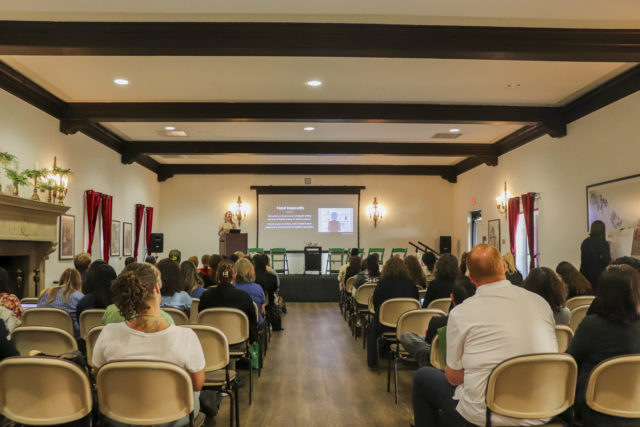
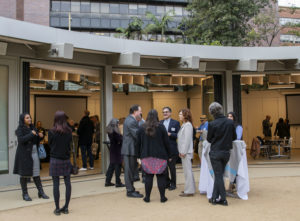
Sustainability experts gathered in Hershey Hall on Oct. 17 to discuss food recovery solutions.
The UCLA Rothman Family Institute for Food Studies and local organizations Los Angeles Food Policy Council, FoodCycle and End Hunger LA presented the event titled “Closing the Circle 2025: From Excess to Access,” which focused on improving food recovery systems. The conference included several panels, followed by breakout sessions and working groups that attendees could participate in.
One morning breakout session, titled “Harvesting Solutions” and hosted by Lisa Johnson from the United States Department of Agriculture and Kristen Johnson from a Southern California gleaning organization called Food Forward, tackled the agriculture industry’s role in food recovery.
An issue with gleaning – the practice of collecting leftover crops after harvest – is that farmers do not have any incentive to donate their produce, as they incur a net loss because of packing and transportation costs, Kristen Johnson said during the panel. She added that refunds or tax credits could be an easy way to incentivize more farmers to donate their produce.
“I think one of the biggest takeaways today should be that we produce enough food to feed everyone in the United States,” Kristen Johnson said.
Olivia Fales, who attended the session and previously worked in urban agriculture, said she appreciated the panelists’ unique perspectives on food recovery, including what the process can look like from home backyards to the national sector.
Kayla de la Haye, an associate professor of psychology and spatial sciences at the University of Southern California, hosted a midday presentation discussing the use of food systems data in addressing food surpluses and community food needs. De la Haye – who is set to join UCLA’s faculty in January – spoke about her current work at USC on tracking food insecurity rates and showed examples of “systems maps” her team created depicting local drivers of food insecurity.
“What this map helps us collectively understand is that there’s no simple cause of food and nutrition insecurity, and there’s not going to be a silver bullet solution,” de la Haye said in the panel. “We really need to think about coordinating how the things of the system are working together to change the events that we’re observing.”
Arianna Roberts, a third-year mathematics/economics student who attended the presentation, said she found it impactful to see how data could reveal the geographic gaps in food access across LA.
“It’s really important to me that we’re using data in positive ways and in ways that benefit people,” Roberts said. “I think this was a really good demonstration of that and how you can use these mathematical, supposedly objective tools to make sure you’re creating social good.”
Another attendee, UCLA alumnus Tanisha Gunby, also said she found the event enjoyable because of its ties to her personal passions. Gunby, who is interested in the health field, added that finding ways to combat food insecurity is compelling to her because of how the issue is tied to many chronic health conditions.
Alba Velasquez, the executive director of the LA Food Policy Council and a UCLA alumnus, said the food systems sector is a small space but has a lot of opportunity. There are several ways to be involved in food systems, she added, including through environmental sustainability, economic development, business or public health.
Elias Jabbe, a conference organizer and a recent fellow at the UCLA Center for Developing Leadership in Science, said he recommends students who are interested in food systems keep attending conferences and building relationships with organizations they may want to work with in the future.
“The purpose of this conference is to connect people who are doing this work so that we’re not working in silos and that we’re actually sharing best practices, building relationships and creating collaborations,” Jabbe added. “That’s the mission. It’s collaboration, partnerships and conversations.”
Leon Lavong, a fourth-year physiological science student, said he chose to volunteer at “Closing the Circle” to become more involved with UCLA’s food initiatives. Lavong added that the conference taught him about food waste in his personal life while also influencing his professional pursuits as a pre-medical student hoping to work in the intersection of food and medicine.
Lumina Chan, another volunteer and an intern with the Rothman Family Institute for Food Studies, said she is passionate about food and nutrition and intends to pursue a career in the field. She added that the event was a meaningful experience for connecting with professors and other professionals in the field.
“I’m just really grateful to see how we’re all here together just to talk about our passion to our food and try to make it a better food system,” said Chan, a fourth-year physiological science student.
Erica Lee, the assistant director for the Rothman Family Institute for Food Studies, said speakers at the event emphasized collaboration as a way to improve food recovery systems. The goal of the event was for attendees to connect with others in the field and to “plant a seed” that will lead to future food recovery solutions, Lee added.
Lee also said there are several ways for students to stay connected with food initiatives on campus, including participating in student-run food recovery groups such as Bruin Dine.
“There are definitely some opportunities for students at UCLA,” Lee said. “You’ll hopefully be able to find something that’s really meaningful.”

Comments are closed.