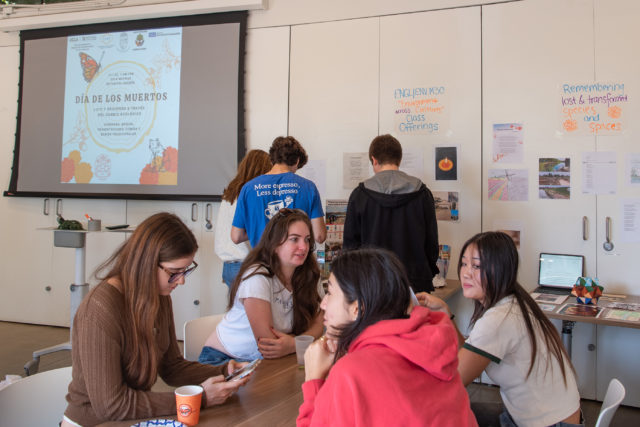
A Día de los Muertos event mourned environmental destruction.
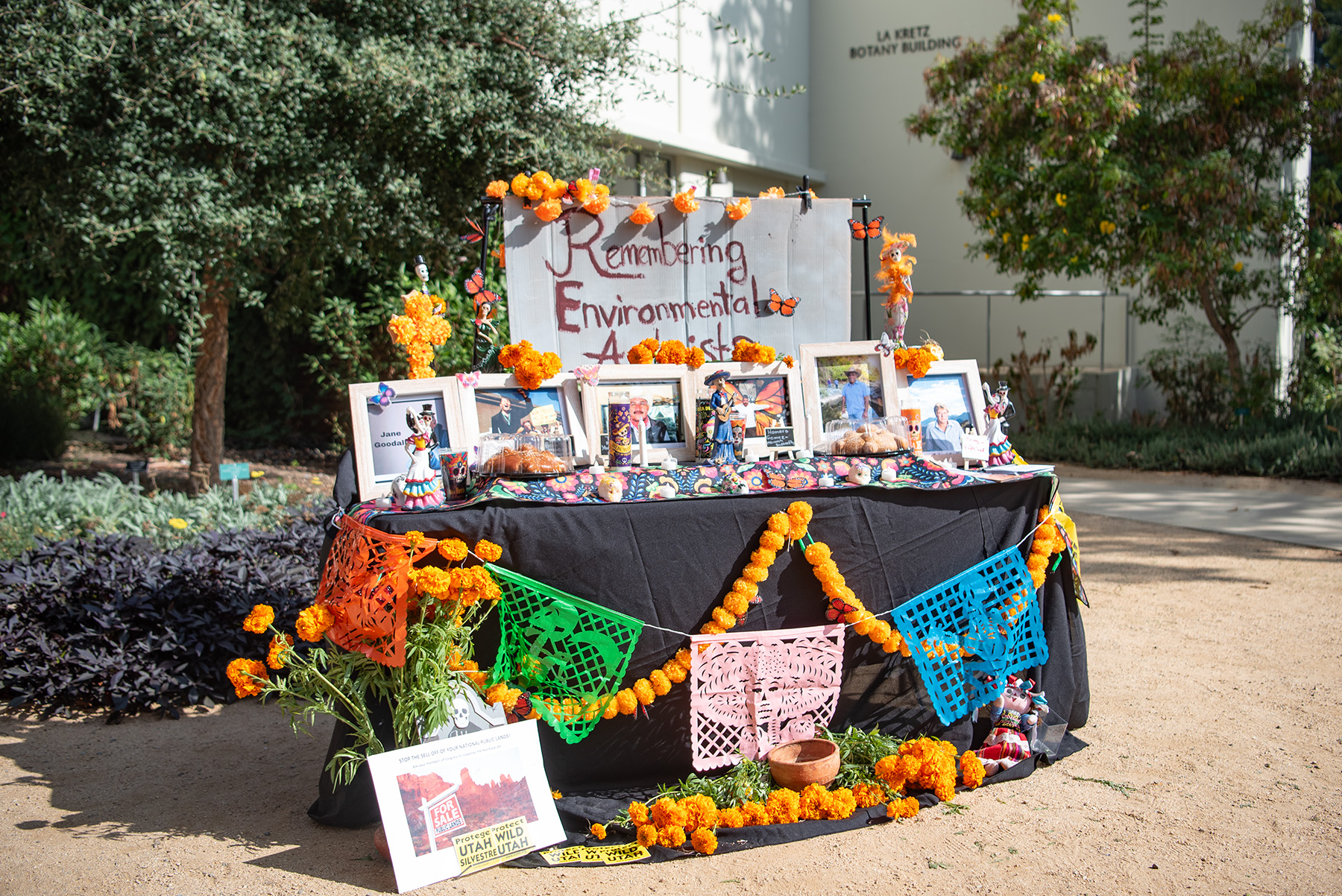
The UCLA Mathias Botanical Garden hosted a free public event called “Día de los Muertos: Mourning and Remembering Through Ecological Change” on Saturday. The event included a guest appearance by environmentalist Isaias Hernandez and merged the holiday’s traditional ofrendas – altars decorated with flowers, food, candles and photos – with reflections about the environment.
Katherine Hernandez, a doctoral student at the UCLA Institute of the Environment & Sustainability and organizer of the event, said she was drawn to the holiday’s place in her heritage and the overlap she saw between grief and perceptions of the environment.
“It (Día de los Muertos) is a celebration of the ones who have passed coming close,” Katherine Hernandez said. “I thought, ‘How is that so much a different way of thinking about grief.’”
Katherine Hernandez said her academic background is in ecology, and her research focuses on human-wildlife coexistence and the interactions between conservation and animal behavior. She added that she and her colleagues have experienced grief and despair at the environmental losses they record, which caused her to think more about the connection between grief and the land.
Katherine Hernandez said she wanted to create an event to encourage reflection about ecological grief that could acknowledge what efforts have been made. It can also address what lessons can be learned from that grief to make further changes in the future, she added.
The idea for Saturday’s event was first proposed in June, Katherine Hernandez said, and the function was co-sponsored by the Botanical Garden and the Center for Developing Leadership in Science. Several other campus organizations co-hosted the event, including the Laboratory for Environmental Narrative Strategies, the Environmental Humanities Reading Group and the Radical Imagination Coalition.
The decision to hold the event at the Botanical Garden was influenced by the variety of plant life showcased at the venue, Katherine Hernandez said. It could also provide a literal representation of nature and encourage a connection between attendees and the land, she added.
After opening remarks by Katherine Hernandez, the event featured a presentation from Isaias Hernandez – known for his educational social media content under the name “Queer Brown Vegan.” During his presentation, Isaias Hernandez said it is important to remember that genocide, ecocide and femicide can occur in the same places as ecological grief. This view is more complex than the way the Western lens – that romanticizes the outdoors – interprets climate disasters, he added. He said it was challenging to call himself an environmentalist because he grew up in Los Angeles, came from a low-income background and is a person of color.
“When I think about environmentalists today, I have to critically ask everyone, ‘Can you think of five Black environmentalists? Can you think of five indigenous environmentalists?’” Isaias Hernandez said. “If you’re getting stuck already but you can name five white environmentalists easily, I would ask, ‘How are you reframing your relationship and your connection to understanding all the people who have it?’”
Isaias Hernandez also said he believes that eco-anxiety is not a mental health disorder and is a natural response to uncertainty in the world. He said the frequency with which people seek therapists or climate psychologists to talk about climate-related emotions is increasing. He added that his work since graduating from UC Berkeley in 2018 has been focused on educating others through environmental media and expanding the use of environmental terminology.
“People may be like, ‘OK, you’re doing all this interesting work, but how is that impacting generations?’” Isaias Hernandez said. “I truly believe that what we’re in today – and the crisis that we’re facing in our system – is also a crisis of the imagination.”
In addition to ofrendas decorated in tribute to environmentalists such as Jane Goodall, some of the art showcased at the event was created by UCLA students in Ursula K. Heise’s English M30: Introduction to Environmental Humanities. Heise, a distinguished professor in the Department of English and the Institute of the Environment & Sustainability, said she has been teaching about the intersection of environmental humanities and literary studies since the 1990s but began teaching this specific course five years ago. Since she is one of Katherine Hernandez’s faculty advisors, Heise said she decided to design an assignment where her students created ofrendas connecting to biodiversity losses and wrote 750 words about the meaning of their pieces.
“Environmental processes and environmental crises that are similar or identical around the world from a scientific or technological point of view are actually very, very different when you approach them from the viewpoint of different languages, different historical memories, different social structures, different cultural practices,” Heise said. “Giving a sense of those kinds of differences is the main goal of the class.”
Brielle Asakawa, a second-year neuroscience student and one of the students from Heise’s class, had her original origami piece featured at the event and said she attended because of the potential the event provided for connecting with others while sharing in passion, joy and grief for the environment. Asakawa said her origami piece was inspired by the loss of Torrey pines, a critically endangered tree species found in her hometown near San Diego. These trees are important not only because of the foliage and tree coverage they provide to the ecosystem, Asakawa said, but also because of childhood memories spent enjoying parks and beaches.
“I made an origami structure because it is made of multiple smaller pieces,” Asakawa said. “I feel like every small piece of an ecosystem or of an environment or of a community is just as important to create a whole thing.”
Katherine Hernandez said she wants people to realize that despite the emotional weight carried by ecological mourning, there is also a chance to remember and honor the past. She said environmental change can be challenging to face, but forward progress will be dependent on a combination of time, love and memory.
“Understanding how much is changing around us can be paralyzing, and that can make it hard to ever hold you to touch it or think about it,” Katherine Hernandez said. “I’m hoping by offering another way to hold grief … to find joy in remembering what we lost, (we) can start finding new ways to really respect that loss and start thinking of the future.”

Comments are closed.