
This post was updated Nov. 2 at 11:43 p.m.
California will hold a statewide special election Nov. 4, and it is critical that we participate.
On the ballot is Proposition 50, the Election Rigging Response Act. The referendum asks Californians to approve a statewide redistricting plan that state legislators mapped out in August as a direct response to partisan gerrymandering in Texas.
We must vote Yes on Proposition 50.
A “yes” vote will allow the California legislature to effectively equalize Texas’s partisan gerrymandering and stand up to Republicans’ unfair attempt to protect their congressional majority. It also could help protect UCLA from further research freezes, reduced financial aid and federal incursion on our First Amendment rights, stemming from the Republican Party’s policies.
First coined in the early 19th century, the term “gerrymandering” describes a process in which politicians manipulate electoral district boundaries to gain an advantage for a particular party or group.
States redistrict, or redraw electoral districts, every 10 years based on the national census. This is done to ensure that every district represents roughly the same number of people. Redistricting determines how many of the United States House of Representatives’ 435 seats each state gets, as House seats are reallocated based on population changes reflected in the census.
The next census will not take place until 2030. However, Republican lawmakers in Texas are engaging in an atypical mid-decade redistricting to get ahead of the game.
“President Trump, apparently concerned that … Republicans might lose control of the House of Representatives after the 2026 midterm elections, had been pressuring the state of Texas to draw again its district lines in a way that would favor the Republican Party even more than the original set of lines,” said Richard Hasen, a professor of law and political science.
In hopes of maintaining their slim majority in the U.S. House of Representatives, Republicans in the Texas legislature approved an ultra-partisan redistricting plan that would likely give the Republican Party five additional House seats in the midterms.
This move by Texas is not an act of fairness or representation for its people – it is a clear-cut case of partisan gerrymandering.
California’s counteractive proposal, if approved, could give Democrats five more seats in the U.S. House of Representatives and protect Democratic candidates from losing their seats in up to four swing districts in the 2026 midterm elections.
“We’re neutralizing what occurred, and we’re giving the American people a fair chance because when all things are equal, we’re all playing by the same set of rules,” Gov. Gavin Newsom said in an August press conference before signing the referendum proposal.
Notably, California’s redistricting plan is only temporary, and the state will revert to using the census and the California Citizens Redistricting Commission – a body separate from the legislature that redraws congressional and state districts – in 2030.
With the map being temporary, voters can be sure that California’s redistricting will not develop into a long-term trend of gerrymandering.
Proposition 50 importantly asks for voter approval of California’s redistricting plan, a difference between the state and Texas, which redistricted without consulting its people first. While reciprocating a mid-decade redistricting is not ideal, California is taking the steps to do it as democratically as possible.
One criticism of California’s plan is that it could trigger a larger redistricting war between Democratic and Republican-led states.
“What it might create is a series of mid-decade redistricting plans being passed now, and then in the next decade, drawing the plans initially but trying to secure the most partisan advantage possible,” Hasen said.
Imagining a future where American districts are redrawn for party politics is scary. But we cannot let the Trump Administration and the Republican Party in Texas bend the rules to stay in power without putting up a fair fight.
Partisan mid-decade redistricting could determine which party holds control of the U.S. House of Representatives, which carries significant implications for federal policies affecting students.
So, not only is it imperative we vote “yes” on Proposition 50 to safeguard democracy, but also to protect UCLA and its student body from further harm.
A renewed Republican-controlled Congress would allow the party to continue passing policies like the recent “One Big Beautiful Bill Act,” which included significant cuts to Medicaid, food benefits through the federal Supplemental Nutrition Assistance Program and federal financial aid for students. It could also embolden immigration enforcement to act on UCLA’s campus, jeopardizing undocumented students.
“There are issues with free speech being under threat, with any law that could potentially restrict the rights of protests,” said Adam Peddie, a third-year history student and external vice president of Bruin Democrats.
Because much of the UCLA community is continually affected by the second Trump administration, we must exercise our privilege to vote in an effort to combat a continuation of its harmful policies and gerrymandering.
“It’s nice to live in a country where it’s really easy to vote,” said Cooper Phillips, a third-year linguistics and computer science student. “One of the reasons that we find ourselves in the landscape that we do politically is because young people don’t vote.”
The UC has a rich history of inspiring social change. As UCLA students at such a pivotal moment in time, the responsibility to continue this tradition lies with us.
By casting a “yes” vote on Proposition 50, we can ensure we continue this Bruin legacy.
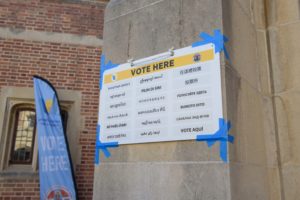
Los Angeles residents can vote in person Nov. 4 at Kerckhoff Charles E. Young Grand Salon and Hammer Museum’s Bay-Nimoy Studio, among other locations across the county. Voters can also submit a vote-by-mail ballot as long as it is postmarked by Election Day.



Comments are closed.