This post was updated Nov. 4 at 10:11 p.m.
Millions of Americans may experience delays in food stamp benefits this November.
The government shutdown has led to a steady decrease in provisions from government services. The Supplemental Nutrition Assistance Program, called CalFresh in California, is the next program to be affected.
Oct. 31, two federal judges said the Trump administration must utilize contingency funds to make SNAP payments. But Trump has a track record of ignoring court orders.
As we enter the second month of a government shutdown, UCLA is obligated to give robust support to thousands of students who may become food insecure.
Leyla Karimli, an associate professor of social welfare at the UCLA Luskin School of Public Affairs, said in an emailed statement there will be serious consequences if CalFresh benefits are cut.
“SNAP benefits cuts may lead to longer lines at campus food pantries, more students skipping meals, and elevated stress levels,” she said in an emailed statement. “For first-generation and low-income students, this it not an abstract policy shift — it is a direct barrier to their ability to engage fully with their studies.”
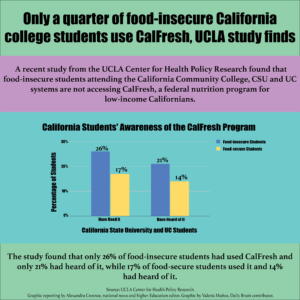
She added that a UCLA study showed about half of California college students experience food insecurity. Also, a report from the California Policy Lab said around 50,000 undergraduate and nearly 10,000 graduate UC students received CalFresh benefits in the 2022-2023 year.
To combat the possibility of SNAP cuts, many states have sued the Trump administration over the “unlawful refusal” to fund SNAP. Gov. Gavin Newsom has also sent 80 million dollars in state funds to support food banks. Kristina Meza, the executive director of the Poverty Alleviation Initiative at LA County’s Chief Executive Office, added that her office is providing support for the LA Regional Food Bank.
But amid all of this, UCLA has been silent. As of Nov. 1, the university has sent no email to students about protocols if CalFresh becomes limited.
Summer Sun, an assistant professor of social welfare at the Luskin School of Public Affairs, said the university must be proactive, since they know there is an impending SNAP crisis.
“When the system fails us, we need to take care of each other, and of course, the university has resources,” they said. “The first step I would think is to be proactive because we already see it coming.”
But so far, there is no sign of proactivity. On Tuesday, ASUCLA released a statement addressing cuts to CalFresh.
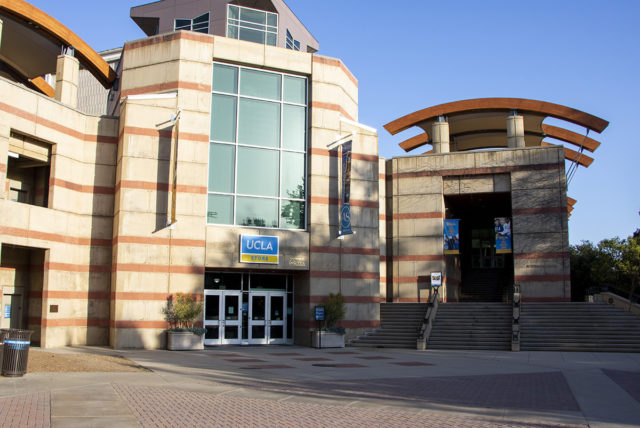
“As part of UCLA’s ongoing commitment to support students, Associated Students UCLA (ASUCLA) introduced a temporary $7 Market voucher that can be redeemed at the UCLA Store in Ackerman Union for CalFresh eligible items,” the spokesperson said.
While this action is important in supporting students, there is still very little public information regarding the issue. ASUCLA’s website does not display information about food vouchers for those on CalFresh.
This statement was also released multiple days after benefits were cut. Many students could have benefited from this information, yet likely did not have the knowledge to properly utilize this service. Who knows how many students could have received necessary food assistance if only UCLA and its partnering organizations had properly advertised the services they offered.
“We are working closely with campus partners to minimize the impact of delayed benefits to ensure students have access to food and other essential support. The well-being of the Bruin community remains our highest priority,” a UCLA spokesperson said in an emailed statement.
That may be so, but as the cuts get closer, the ways in which the impact will be “minimized” have not been made clear to students in any meaningful way.
Even if the cuts do not happen, UCLA is failing its students by not having a clear and public plan of action in the worst case scenario. Now it is up to students to figure out how they will stay fed if the rug is pulled out from under them.
Luckily, separate from Newsom’s initiative, LA County is providing resources for LA food banks. While an important first step, food banks will not solve everything.
“From a social science perspective, the evidence consistently shows that food banks and charitable distribution systems, while vital in crisis and emergency, have limited capacity to offset systemic gaps in income support and federal nutrition policy,” Karimli said in the emailed statement. “Their impact, although immediate, is not transformative.”
There are other solutions to possible cuts that UCLA could seek to implement to support students.
For instance, Meza said a gift card program could help alleviate the stress on grocery stores. In UCLA’s context, that could exist with meal vouchers at the UCLA Store.
Karimli added that extending the hours of the Basic Needs Pantry and drop-in CalFresh enrollment clinics is also important.
It is unclear what UCLA will do to protect its students. However, it must start by centering the needs of food-insecure populations and providing support preemptively, despite any lingering fears they may have over threats from the Trump administration.
“Everybody, regardless of age, nationality, immigrant status, disability status, gender, race, ethnicity, everybody deserves food. I think it’s a human right,” Sun said. “And when the system fails, we all need to be more proactive and take it as a collective responsibility to take care of each other.”

Comments are closed.