Proposition 50 will appear on the Nov. 4 special election ballot, giving California voters the chance to decide on changes to the state’s congressional district maps.
The proposition, also known as the “Election Rigging Response Act,” aims to redistrict California’s congressional maps in a non-census year, and, if passed, would likely increase the number of Democratic stronghold districts in the state.
Proposition 50 proposes to suspend the maps drawn by the California Citizens Redistricting Commission in 2021, with the new maps in effect until 2030. The effort is designed to give Democrats more U.S. House of Representatives seats in California after Texas passed a similar effort earlier this year to increase Republican representation in the state.
In the United States, states have the control over the processes to redraw their congressional maps. Most states redraw their maps every 10 years based on U.S. census data through the state legislature, but some states use an independent or bipartisan commission. States will occasionally redraw maps in non-census years, including in response to court orders.
In California, the independent California Citizens Redistricting Commission redraws district boundaries following each federal census. The commission relies on community input and census data when redrawing district lines, aiming to prevent partisan or racial gerrymandering in accordance with the U.S. Constitution and the Voting Rights Act, and promote fair representation across the state. This system was originally established through Proposition 11 in 2008 and expanded to include Congressional seats in 2010 through Proposition 20, according to a legislative analysis by UC Law San Francisco.
This commission is meant to keep redistricting in California nonpartisan, said Richard Hasen, the Gary T. Schwartz Endowed Chair in Law at the UCLA School of Law, in an emailed statement.
“California voters adopted a commission (made up of Democrats, Independents and Republicans) to choose new maps after each census following a number of criteria set out in the law,” Hasen, the director of UCLA’s Safeguarding Democracy Project, said in the statement. “The design is meant to insulate the commission from normal partisan politics.”
However, in Texas, the state legislature approved new congressional maps designed to increase representation for Republicans in the state. The new maps come after President Donald Trump’s demands to ensure Republicans gain five more congressional seats before the upcoming 2026 midterm elections. Using past state voting records, the legislature passed the new maps Aug. 22, and the bill was signed into law a week later by Texas Gov. Greg Abbott.
Proposition 50 in California was written in an attempt to neutralize or reverse this seat gain for Republicans in Congress, Hasen said in the statement. If passed, the measure will suspend the Citizens Redistricting commission maps until the 2030 elections and give Democrats up to five more safe Democratic districts, essentially equalizing the five additional seats predicted in Texas for Republicans in the 2026 election, he added in the statement.
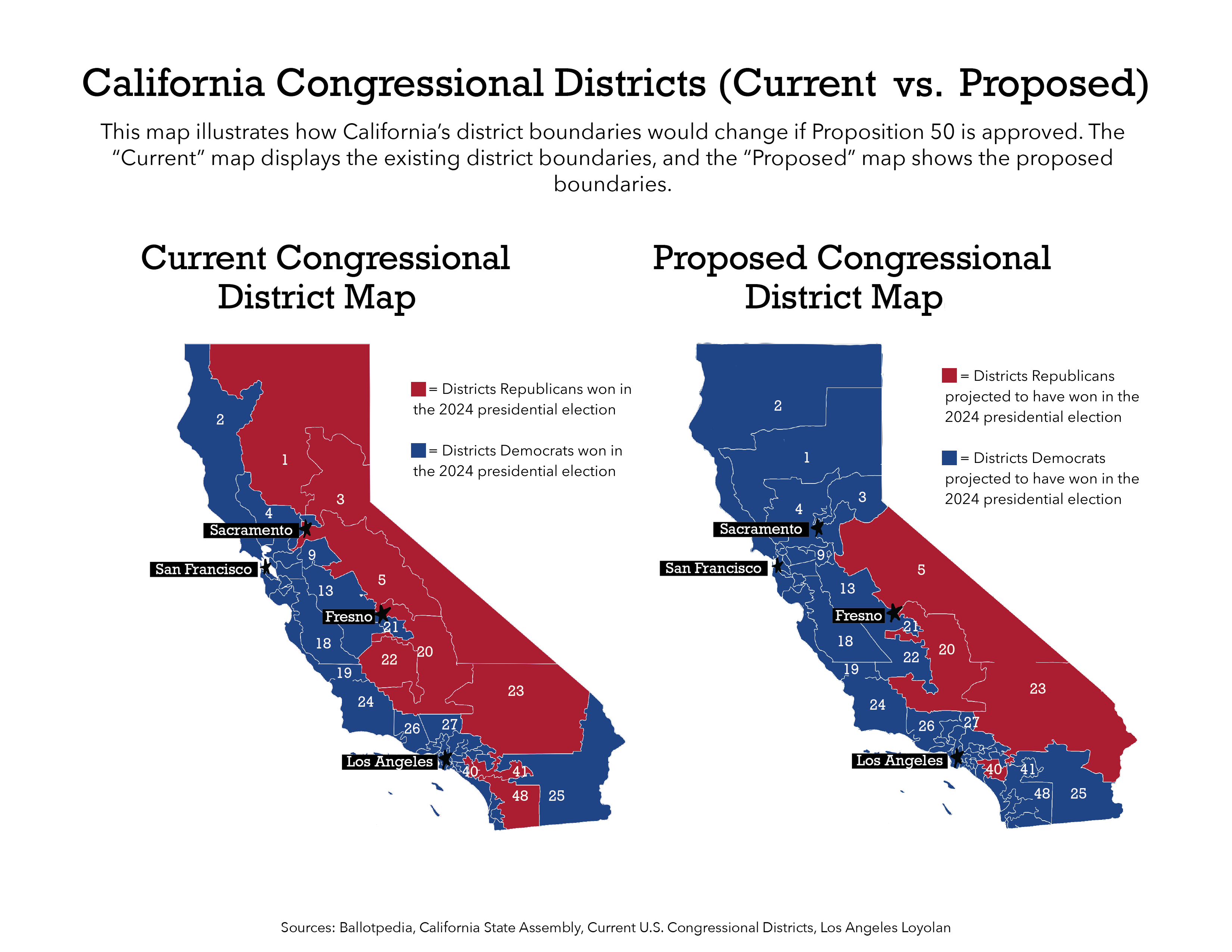
According to Ballotpedia, the measure would shift five Republican congressional districts in California to lean Democratic and make 12 Democratic districts more solidly Democratic, reducing the number of districts with close margins between the two parties.
In California, voters of different parties are not evenly distributed across the state. Registered Republican voters are clustered in the northeast region of the state and Registered Democrat voters are clustered in the coasts and around urban cities, according to the Public Policy Institute of California.
Proposition 50 uses these geographical distributions of registered voters to redraw maps and connect urban centers that consistently vote for Democrats to rural areas that consistently vote Republican, according to KCRA. This makes the newly drawn district lean Democrat because of the higher number of registered Democrats in these urban regions.
However, Proposition 50 differs from Texas’ redistricting effort, said Adam Peddie, a third-year history student and external vice president of Bruin Democrats.
“The difference though … is that in California they’re going to vote on it,” Peddie said. “In Texas, it was just passed from the state legislature, there was no vote.”
Proposition 50 initially included “trigger language,” specifying that the new maps would only take effect if another U.S. state carried out mid-decade redistricting, according to CNN. This language was removed by the California Legislature on Aug. 21, when the redistricting bill was approved by the body to be placed on the special election ballot in November.
The proposition has been supported and condemned on both sides of the political spectrum.
The California Citizens Redistricting Commission said in an emailed statement that it has no official position regarding the proposed redistricting, and has no affiliation with organizations supporting or opposing the proposition.
Patricia Sinay, a member of the 2020 Citizens Redistricting Commission, said she believes if Proposition 50 is passed, there is no guarantee that independent redistricting through the Commission will return in California.
“Democrats can always say that there’s a crisis and use this election as an excuse to draw their own maps and bring those maps to the people and say it’s democratic,” Sinay said. “But people have not had a voice in these maps.”
Notable politicians and political figures have also spoken about Proposition 50.
New York Representative Alexandria Ocasio-Cortez endorsed the proposition and framed it as an effort to fight Trump’s demands to Republican-leading states. Former President Barack Obama also endorsed Proposition 50, appearing in an ad stating that Republicans want to steal seats in Congress to hold “unchecked power.”
Conversely, former California Gov. Arnold Schwarzenegger pushed voters to reject Proposition 50 and called the measure “insane” in a September public forum at the University of Southern California. Charles Thomas Munger Jr., who fought to establish independent redistricting in California, has also donated $32 million to the campaign against Proposition 50, according to NBC News.
Despite the partisan debate surrounding Proposition 50, the new maps could influence how effective California voters are able to voice their needs and demands to federal representatives.
According to CalMatters, the proposed map contains more cities and counties that are split among three or more districts, potentially splitting up communities that were previously represented by fewer representatives in the House. As a result, the Brennan Center for Justice found that voters who belong to the political minority in gerrymandered districts often struggle to advocate for their needs because their smaller electoral presence limits their influence.
According to the Public Policy Institute of California, the proposition will not have major impacts on racial and ethnic representation in the districts. Both the Commission-drawn and Proposition 50 proposed maps are similar in maintaining fair representation for voters of color who hold politically cohesive views.
Sinay said this partisan redistricting effort presents larger issues about voter representation in California.
“My concern is that we are disenfranchising independent and Republican voters,” Sinay said. “We are disenfranchising our Californian neighbors for something that’s not guaranteed.”
Peddie said, however, Proposition 50 represents an opportunity for Democratic party leadership to fight back against President Trump’s demands to Texas.
Despite the temporary nature of the proposed congressional maps and the possibility of Proposition 50 failing, Hasen said in an emailed statement that the measure has potential long term consequences for voting in California and across the U.S.
“It is potentially a race to the bottom to draw as many safe districts as a party in power can,” Hasen said in an emailed statement. “It will affect representation throughout the country.”
Los Angeles residents can vote in person Nov. 4 at Kerckhoff Hall Grand Salon and Hammer Museum’s Bay-Nimoy Studio, among other locations across the county. Voters can also submit a vote-by-mail ballot as long as it is postmarked by Election Day.

Comments are closed.