Bats have fascinated Joseph Curti since he first encountered them in seventh grade.
Now, as a postdoctoral fellow for the UCLA La Kretz Center for California Conservation Science, Curti not only researches and works with different bat populations but also works to get other people interested in bats as well.
“If you see them up close, you fall in love,” Curti said. “I think we fear a lot of what we don’t know. You don’t know something you can’t see, and bats are nocturnal and never really see them flying around.”
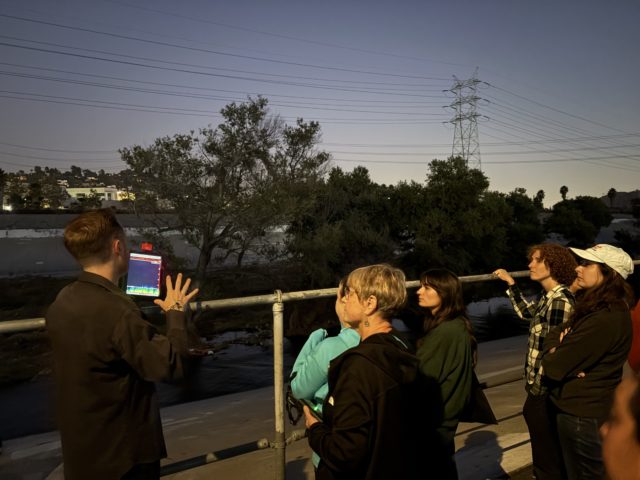
Curti leads “bat walks” throughout the year, often in coordination with different environmental or historical organizations, including Friends of the LA River and the Natural History Museums of Los Angeles County. At these events, Curti uses devices – including ultrasonic microphones – to track bats as he walks, giving attendees a chance to view the nocturnal mammals in their natural habitat.
Curti led a bat walk on Oct. 23 in coordination with the Theodore Payne Foundation, a native plant organization and nursery based in LA that promotes educational events.
The walk was held in Frogtown, which is about an hour-long drive from UCLA. Attendees strolled along one of three restored sections of the LA River as dusk approached, using sound tracers to hear bats and later search for them.
The LA River is both channelized and concretized, Curti said, which means only three sections of the river bottom are actually substrate. The areas with a substrate base allow sycamore, oak and other trees to grow out, providing a habitat for different wildlife, including bats, he added.
Mya Gates, one of the attendees, said she was excited to observe bats in their natural habitat.
“I absolutely adored the bat walk,” Gates said in a text message. “Going out at night to look for bats, especially around Halloween, was a spooky-fun experience. My favorite part was when I actually saw the bat that we had just detected a few seconds prior. My first time seeing a bat!”
Prior to the walk, Curti hosted an informational Zoom session for attendees to teach them about the bat species that they could spot on the walk. During the actual walk, attendees saw the Mexican free-tailed bat and the Yuma myotis bat.
Curti said he hopes his session and walk show people that there is more to bats than their stereotypes, which often elicit fear.
And for Gates, Curti followed through on that goal, with her saying the event solidified her appreciation for – and knowledge of – bats.
“I feel more confident in sharing my love for bats with credible information rather than more conspiracies,” she said in a text.
Nori Angulo, another attendee, said she was initially scared of bats given their portrayal in movies and television shows but has come to realize their value to the environment. Angulo, who works on the South Coast Botanic Garden horticulture team, said she was excited to learn about bats’ roles in pollination and plant growth.
“As I’ve gotten older, working with plants and learning about pollinators, and realizing there are misconceptions with these animals, and they’re actually really cute,” Angulo said.
Bats also help in agriculture and food production, Curti said.
“There’s a lot of science that shows that bats are good for the ecosystem,” Curti said. “They pollinate and disperse the seeds of and eat the pest species of many plants that are really important to us: mangoes, bananas, guavas, agave – which we make tequila from – and chocolate and coffee have associations with bats too. So life without bats is depressing.”
Curti is currently working on researching how urban stressors like light and sound pollution vary with altitude and impact the LA bat population, he said. He added that land-use change – including deforestation and the conversion of habitats to cities and agricultural land – is the primary reason for the decline of bat populations.
While his bat walks are most popular around Halloween, Curti said he hosts events all year. He added that his primary goal is to encourage people who are fearful of bats to get curious and learn more about them.
“I love doing this,” Curti said. “I think a lot of demystifying bats is getting them (people) to see them up close.”



Comments are closed.