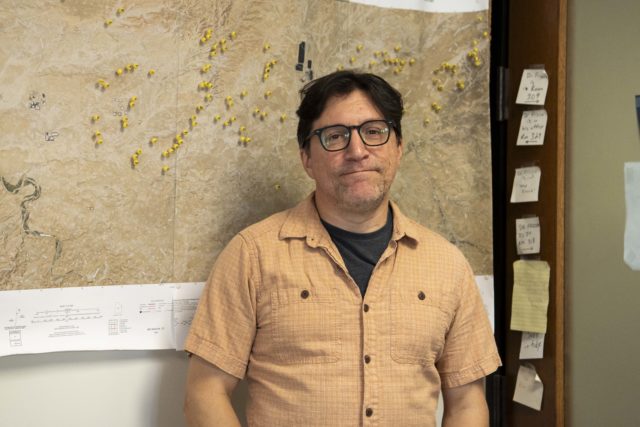
Anthony Friscia, the director of the UCLA Cluster Program – a year-long general education program for first-year students – sat down with Daily Bruin reporter Caitlin Brockenbrow to discuss the goals for the program, budgetary challenges and upcoming changes.
Aside from leading the cluster program and teaching the Evolution of the Cosmos and Life cluster, Friscia is an associate teaching professor in the department of integrative biology and physiology. Friscia, who teaches many of UCLA’s undergraduate human anatomy courses, earned his doctoral degree from UCLA in 2005 and has been involved with the university for 28 years.
This interview has been edited for length and clarity.
Daily Bruin: How has the cluster program changed since you first became involved as a TA?
Anthony Friscia: I started as a TA in 2001, so definitely a few things. It’s gotten bigger. Right now, we enroll about 2,500 incoming first-year students. When I started, we were enrolling about half of the incoming class – but the incoming classes have gotten bigger, so right now it’s a little over a third of the incoming class that takes a cluster.
DB: What would you say makes the cluster program special? Why is it integral to UCLA?
AF: There are two sides to this. It fulfills a very specific niche in that it helps students satisfy a bunch of general education requirements. That’s why students like it – they get to check a bunch of boxes. If they finish the whole thing, they satisfy four GEs, they satisfy their writing requirement, and most of the clusters satisfy their diversity requirement. If the cluster program were to go away, they would need classes that would give all those credits. It tends to group a bunch of credits together.
But really, what makes it special is all the other stuff. One part of that is that all the clusters are interdisciplinary – they’re all taught by teams of faculty from multiple departments and TAs from all over campus. Students really get a broad perspective on some big-idea topic – we always like to call the clusters “big ideas.” Things like Biotechnology and Society, or Evolution of the Cosmos or America in the 60s – they get these interdisciplinary teams; they get to hear from lots of different perspectives. For instance, in the biotech cluster, they hear from a biologist, they hear from sociologists, they hear from people from English. They do a unit on genetically modified organisms and they will hear, “How do we put fish genes in a tomato?” from the biologist, and then the sociologist will talk about, “Should we be putting fish genes in tomatoes?” So, they get lots of different perspectives.
The other part that I think makes it really special is that it is a year-long course for first-year students, so you get that community-building aspect of it. You’ve got the same fellow students, the same faculty, the same TAs for an entire year, and you have this built-in community to help you with that transition to college. The students make connections that they carry with them throughout their time at UCLA and even beyond. There are students that I had when I was a TA that I still keep in touch with. When they come to town, they let me know, “Hey, do you want to get together?” These are students from 20 years ago.
I had a student who really exemplifies what clusters do and what general education does more broadly. She came in as an art student in the School of Art and Architecture. She took my cluster. Because of what she found out in there, she switched her major to geology, and she ended up coming out to the field with me and collecting fossils with me, because my research is in paleontology. Those are the sorts of connections that are harder to make in a 10-week course, but to be able to make those connections over a whole year is much easier.
There are numbers to back this up: students who take a cluster tend to graduate a little bit earlier, they tend to graduate with a slightly higher GPA, things like that. On the senior survey that everybody has to do when they leave, we’ve put questions on there about the clusters, and over 95% of students who take a cluster say they would recommend it to somebody else.
We used to struggle to fill the clusters, to get the 100% enrollment in each of the clusters, and we have never had that problem anymore. We’re bursting at the seams. We added 250 seats this year – and we still could have added more.
DB: How has the start of the year been for the department?
AF: The budgetary things that are going on right now definitely hit us, and we had to make some changes to the program. The biggest change we had to make was we increased the number of students in each discussion section from 20 to 25. A 25% increase doesn’t sound like a lot, but when you’re teaching writing and you want that community aspect of it, it’s a big deal. We’ve had to make some adjustments – things like taking into account TA workloads, since now they’ve got 25% more students.
The other thing that people are dealing with on campus now is AI and figuring out how to do it. The cluster is a big program, and we have first-year students – this is the first year where most of them have had ChatGPT for all of their high school, and we can definitely see the difference.
[Related: UCLA math department TA, grader cuts spark concern over student learning support]
DB: Do you have any goals for the cluster program?
AF: Over the past few years, there’s been a review of the entire general education curriculum – which the clusters are a big part of. The recommendations are going to come out soon, and then people have to figure out what we’re going to do about them.
One of the recommendations that will come out of that is that every student should have some sort of first-year, year-long experience – whether that’s the cluster, some other sequence of classes or a series of seminars. It helps with that community-building aspect. It helps lay the groundwork for a lot of skills that you need. We spend a lot of time in the cluster teaching basic things like writing and using the library. If you’re not learning that stuff until later in your time at UCLA, that may not be as helpful. We should be doing those sorts of fundamental things in their first year. That recommendation hopefully means that the clusters will continue to grow, both in terms of the number of students in any given cluster and also the number of clusters as well.
[Related: General education task force seeks to revise program]
DB: Have there been any new initiatives, programs or courses introduced recently or any updates to the General Education Task Force’s work to revise the program?
AF: We’re always bringing in new clusters. We have a cluster that just started last year on building climates, which is all about looking at the environment and sustainability, but through the lens of the places we live and work. That’s been a really popular cluster – it was started by people in the architecture school, so the students actually do some design stuff in it. We have a new cluster that will hopefully be starting next year on innovation and entrepreneurship. There’ll be a business-y part of it – but it’s also going to be putting it in a historical and sociological context. For instance, a question that they might ask is, “Why are certain areas more prone to innovation and entrepreneurship?” “Why is Silicon Valley where it is?” and things like that. That’ll be a nice addition.
This GE task force is going to have a number of recommendations, and they’re going to be rethinking the GE curriculum. I don’t think it’s going to be a complete overhaul, but I think they’re going to be looking less at subjects and more thinking about skills – making sure that students get the writing, making sure they’re getting things on information literacy and things like that. There’s going to be a lot of massaging what’s already there into these new foundational areas, but it’ll be a new way of looking at general education.
DB: Has the current political climate influenced the cluster program? Do you anticipate impacts in the next few years?
AF: Nothing super directly. We have clusters on topics like sex and gender and on race and indigeneity in the U.S. These are things that are the target of what’s going on right now in the political climate. So while there hasn’t been anything specific, it’s definitely something that those teams are looking at and keeping in mind. It’s not like we’ve been targeted directly yet, but I think people are just trying to be a bit more careful about some of this stuff.
DB: Are there any trends you’re noticing in the program that might shape its future direction?
AF: As the incoming classes get bigger, we’re wanting to get bigger to accommodate that. More broadly across the campus, with the budgetary constraints, with AI and things like that – we’re going to be at the forefront of doing a lot of new things to address those sorts of things, whether it’s larger class sizes, using AI, both on the teaching and the student end. Because we have this unique program, we often get used as a kind of experimental place to do those things. I think that we’re going to be at the forefront of a lot of the changes in higher ed more broadly that are coming.
DB: Is there anything else you wanted to say?
AF: To have this sort of program at a big research institution is pretty unique. One of the things that we like to say is that the cluster program is a way to kind of get that small liberal arts experience at a big school, because you do have that built-in community, that interdisciplinarity that you often don’t get at a big place.
When these budget cuts came over the last year, it looked like we were going to have to make really big cuts to the cluster program, to the point where we were going to have to cut down enrollment by 50%. There were people up high who said, “We can’t do that to the clusters. The clusters are why students come here.” That saved us quite a bit.

Comments are closed.