When UCLA marched off the field victorious against Maryland on Oct. 18, confidence was at an all-time high.
But after a 56-6 loss on the road against No. 2 Indiana that snapped a three-game win streak, UCLA will have a chance to rebound against another Big Ten squad that has faced its fair share of adversity.
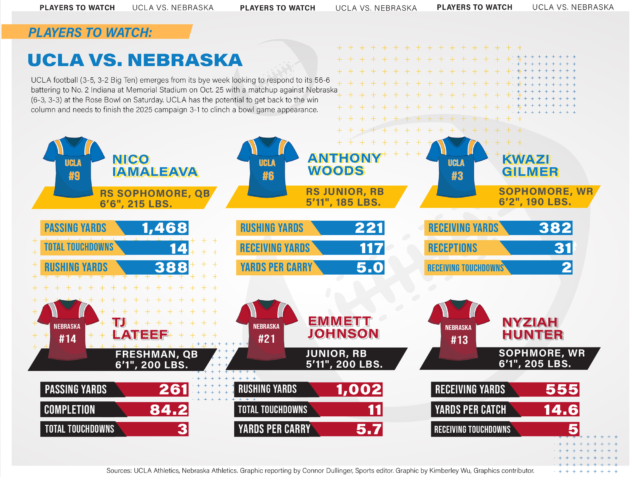
UCLA football (3-5, 3-2 Big Ten) will take on Nebraska (6-3, 3-3) Saturday in the Rose Bowl – the second meeting between the two sides in two years. As part of UCLA’s annual family weekend, the showdown between the Bruins and Cornhuskers has significant implications for interim head coach Tim Skipper’s squad as they pursue bowl eligibility.
Nebraska’s offense:
Offensive scheme: Spread
Run-pass percentage: 53% run, 46% pass
Strength: Rushing attack
Weakness: Passing
X-factors: RB Emmett Johnson
Early in the 2025 campaign, many in the college football universe were expecting Nebraska’s offense to be a dangerous unit.
The Huskers returned their leading rusher Emmett Johnson, former five-star quarterback Dylan Raiola for his second full season as a starter and a complement of high-impact transfers.
Despite an early loss to Michigan by three points, the Huskers found themselves ranked No. 25 in the week eight AP poll with a high-caliber offense that averaged 41 points per game in its first six contests.
However, since receiving the ranking, the Huskers have averaged 17 points per game, including a meager six against the Golden Gophers that constituted their second loss of the season.
The offense would encounter further difficulties when Raiola – who had recorded 18 touchdowns to six interceptions thus far – suffered a season-ending broken fibula in the team’s most recent loss to USC.
Now, without his dynamic signal-caller, offensive coordinator Dana Holgorsen has turned to true freshman backup quarterback TJ Lateef to lead the Huskers on Saturday.
Lateef – a former four-star recruit in the class of 2025 – registered seven passing yards in the game against the Trojans.
With Lateef’s limited sample size of just 19 passing attempts, all of which took place at Memorial Stadium in front of his home crowd, expect Holgorsen to place a further emphasis on the rushing attack to reduce pressure on his young quarterback.
The familiar presence of Johnson, who leads Nebraska in rushing, in the offensive backfield should lead to an emphasis on zone-running concepts against the Bruins’ defensive front. The Minneapolis local registered a career-high 29 carries in the contest against USC, with 165 rushing yards and a touchdown.
Johnson’s athleticism in space and his ability to make defenders miss should also provide ample opportunities for counter and power-running schemes, especially on first downs and short third downs.
His athleticism is most on display when running north to south when the seam opens on running concepts, a challenge for the Bruins’ defensive box that has surrendered 195.5 rushing yards per game – the Big Ten’s highest figure.
Despite the likely emphasis on the rushing attack Saturday, labeling the Husker offense as one-dimensional is unwise.
If Holgorsen does decide to throw the ball, Lateef has solid pass-catching options across the board. California transfer Nyziah Hunter leads all Husker pass-catchers with 555 receiving yards and five touchdowns in his first season at Nebraska.
The frequency of runs that should be expected on Saturday is likely to be paired with a high frequency of bootlegs and play-action shots to break tendencies and keep the Bruins on their toes defensively.
While the loss of Raiola might increase confidence among Bruin fans, one of the nation’s most explosive rushing attacks from the Huskers will force UCLA to adjust its scheme to remain competitive.
Nebraska’s defense:
Defensive scheme: 3-3-5
Strength: Passing defense
Weakness: Rushing defense
X-factor: S DeShon Singleton
Redshirt sophomore quarterback Nico Iamaleava played his worst game of the season from a passing perspective against Indiana, completing just 48% of his passes alongside two interceptions.
Now, freshly removed from the bye week, Iamaleava and assistant head coach and tight ends coach Jerry Neuheisel will have to contend with a defensive unit that ranks second in the country in passing yards allowed.
Playing a 3-3-5 scheme that is difficult to prepare for, the Huskers have continued to limit big plays through the air with their five-defensive back personnel group. Most recently, the Huskers limited USC quarterback Jayden Maiava to a season-low 135 passing yards and an abysmal 39% completion percentage.
Anchoring the secondary is safety DeShon Singleton, who leads the Huskers in interceptions and was named Big Ten Defensive Player of the Week for his role in Nebraska’s win over Michigan State on Oct. 4.
Alongside Singleton, linebacker Javin Wright is another key player in the Huskers’ defense. The Chandler, Arizona, local has led the Huskers in tackles in five of their eight games, including 11 total tackles against the Trojans.
Defensive coordinator John Butler has shown a habit of breaking the traditional 3-3-5 personnel groups that former defensive coordinator Tony White emphasized in Lincoln, Nebraska. In the game against USC, players played multiple positions and dropped into coverage from a variety of alignments, making the defense more complex for a quarterback to read.
Despite an abundance of success in limiting the pass, Butler’s unit has had difficulty stopping the run.
The Trojans registered 202 yards on the ground and two touchdowns that propelled them to victory. USC running back King Miller, who was responsible for one of the scores on the ground, averaged over seven yards per carry against the Huskers’ defense.
The 3-3-5 defense places a much stronger emphasis on the defensive front to win one-on-one battles with offensive linemen to limit big runs than schemes such as the 4-3. This inability to effectively plug gaps against physical offenses has contributed to Nebraska’s opponents averaging 171.3 rushing yards per game.
To achieve success Saturday, Neuheisel should build a run-heavy attack that heavily involves Iamaleava as a designed ball-carrier. By running a diverse scheme of rushing concepts against the Huskers, the Bruins can reduce an emphasis on deep passing concepts that Nebraska has excelled in stopping.
Play-action should be another effective tool when paired with this run-focused offensive strategy. Placing Iamaleava and the offensive line in manageable third downs will be critical for reducing the unpredictability of 3-3-5 blitzes.
When playing against this style of defense, havoc and confusion are all but guaranteed. With athletic outside linebackers and five defensive backs, reading and effectively picking up a blitz from a 3-3 stack can be incredibly difficult at game speed.
However, playing assignment-sound football and communicating at a high level can neutralize this threat of confusion and allow an offense to achieve success.
The potential for explosive plays on both sides of the ball makes Nebraska an exciting opponent for the Bruins’ return to Pasadena.
A victory over the dangerous Huskers could signal to the Big Ten and the country that UCLA’s story in 2025 is far from finished.


Comments are closed.