This post was updated Nov. 13 at 7:24 p.m.
It was like clockwork. Every single evening, I expected my dining room to rumble and teeter like it was hit by a Southern California earthquake.
Except I lived in rural Ohio, and there was no earthquake. Just my twin baby brothers throwing a disastrous temper tantrum.
Even though I was only six years old when my brothers went through their terrible twos, I could already relate to my teenage cousins who hated sitting near toddlers on flights.
These negative feelings toward kids persist among my peers over a decade later. When I tell classmates I want to be a pediatrician, they are often perplexed. After all, when a family with small children enters a restaurant, young adult diners tend to let out a collective groan.
Despite these seemingly universal sentiments and my own first-grade pessimism, young adults don’t need to hate kids. In fact, we can learn from them.
Children don’t choose to express their emotions the way they do. When a child bursts into tears, they’re not trying to create chaos.
“It’s more of, the child is not able to communicate, so the only thing that is quick to react with an emotion is to cry,” said Carol Cunningham, an assistant adjunct professor at the UCLA Joe C. Wen School of Nursing.
The reality is that adults and infants alike experience intense emotions. The only difference is that over time, we’ve gained the tools to handle them.
And so when we hear a little one start to whimper, instead of rolling our eyes, we should give kids grace and meet them where they are.
To do this, Cunningham said we should make sure we sit down with children eye-to-eye and be in the moment since the present is what kids value and think about the most.
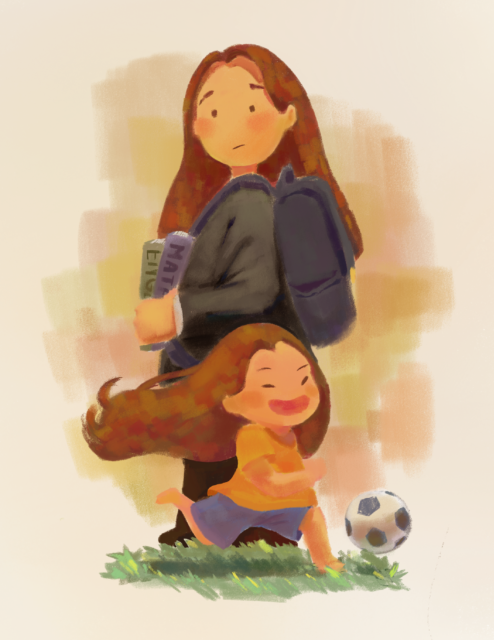
Having a four-year age gap with my brothers, I hadn’t yet learned to grasp how to navigate their vast and varying feelings when I was six years old.
Though still a child myself at the time, I was constantly reminded of the difference in my and my brothers’ emotional development. I was also constantly reminded of our vastly different lifestyles.
I often complained to my mom about my younger brothers’ lack of drive when I was a 14-year-old overwhelmed with new high school classes.
Looking back, I should have taken a page out of their book.
As I screeched through off-pitch, fourth-position notes on my violin, my brothers enthusiastically practiced their subpar basketball shots in our driveway. Truthfully, I would have much rather spent my time perfecting my backhand, but I was told that being a competitive violinist would look better on my college application.
My brothers’ childlike excitement propelled them to spend time doing what made them happy, rather than what society deemed most productive.
Andrea Tabuenca, a licensed clinical psychologist at the UCLA Semel Institute for Neuroscience and Human Behavior, said children are able to explore the world without being hindered by the responsibilities and expectations that adults have.
“One of the advantages is that there’s a whole lot of openness and flexibility to experience the environment without preconceived assumptions and biases,” she added.
When something piques my interest – a pop-up concert in front of Kerckhoff Hall or the possibility of discovering a new hobby – I usually shut it down, telling myself I should study for my next exam or ramp up my clinical hours.
But the reality is, curiosity is not a distractor. It is a crucial practice for upholding quality of life – more so than any form of time management.
“Curiosity is very important. I think curiosity is part of joy,” said Anna Markowitz, an associate professor at the UCLA School of Education & Information Studies.
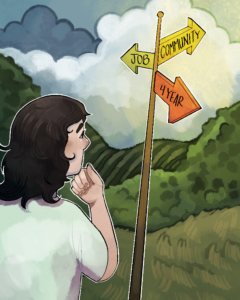
At a university with such driven students, it can be easy to get overwhelmed by the looming presence of post-grad jobs and graduate school.
But if we can’t focus on the present, we rob ourselves of the chance to experience the joy of the undergraduate experience.
One weekend this past summer, my brother came to me with a slew of complaints. He was not able to finish his SAT practice set because all afternoon, my three-year-old cousin had badgered him with nonsensical questions and giggled nonstop.
The irony was not lost on me. My brother, once a pesky toddler himself, was bemoaning the endless curiosity of our baby cousin.
To my cousin, the practice set was nothing but a stack of papers. My brother’s room was a treasure trove full of trinkets and colors.
Though he’s only three, my cousin understands something that a lot of us have yet to learn: There is so much to see in the world around us, and the things that keep us from exploring it are extremely arbitrary.
In other words, we can and should learn from kids.
Next time you’re feeling in a rut, remember these lessons: processing your emotions unapologetically, exploring without restraints and staying curious without shame.



Comments are closed.