This post was updated Nov. 13 at 9:27 p.m.
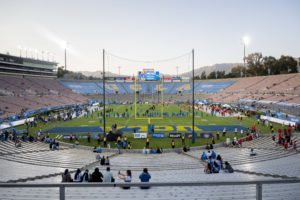
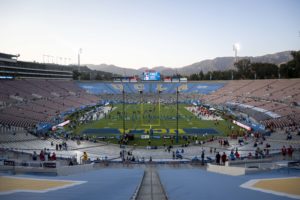
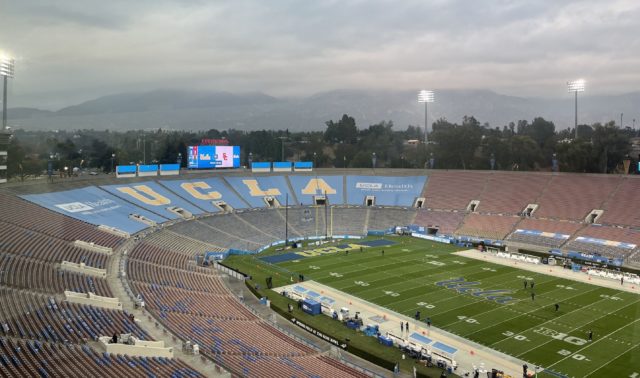
A judge denied the City of Pasadena and the Rose Bowl Operating Company’s motion to file a preliminary injunction and temporary restraining order against UCLA on Wednesday morning.
The order would have required the university to continue holding home football games at the Rose Bowl Stadium. It would also bar the university from terminating its agreement with Pasadena and RBOC while a lawsuit – filed by the two parties that accused UCLA of breaching its contract by trying to move its home football games from the Rose Bowl to SoFi stadium – plays out in court.
“At this stage, it is denied from lack of an emergency,” said presiding judge James C. Chalfant.
Chalfant added that the plaintiffs could re-apply for an injunction after both parties obtain more evidence.
Attorney Nima Mohebbi, representing the plaintiffs, told reporters at the Los Angeles County Superior Court that the plaintiffs intend to file another preliminary injunction motion following the judge’s recommendations for discovery. He added that the judge clearly identified that there is irreparable harm in what the plaintiffs say UCLA is attempting.
“We’re very happy with the judge’s statements,” Mohebbi said.
Lisa Derderian, Pasadena’s chief communications officer, said in an emailed statement that UCLA waived its right to terminate its lease agreement. UCLA cannot terminate the agreement unless the Rose Bowl Operating Company prevents the football team from playing in the stadium – with an exception for renovations – according to the lease agreement submitted by Pasadena and the Rose Bowl Operating Company in its initial lawsuit.
Derderian added that UCLA breaching its lease would cause irreparable harm to Pasadena’s taxpayers and local economy, as well as the stadium itself.
Pasadena and RBOC filed a motion Nov. 10 for the injunction and TRO. Both plaintiffs had filed a suit against the UC Board of Regents on Oct. 29, alleging the university breached its contract with the stadium by planning to move football home games to SoFi Stadium.
Their agreement, signed in 2010, states that UCLA football cannot play home games at any other stadium in LA County until the contract expires in 2044.
[Related: Lawsuit accuses UCLA of trying to move home football games to SoFi Stadium]
Mary Osako, UCLA’s vice chancellor for strategic communications, said in an emailed statement that the ruling “speaks for itself.”
“As we have said, while we continue to evaluate the long-term arrangement for UCLA football home games, no decision has been made,” Osako said in the statement.
Attorney Maurice Suh, representing the UC, said in court that the problems identified by the plaintiffs – “everything they’re talking about” – could be solved with money damages. The plaintiffs have said both in court and in the lawsuit that monetary relief would be inadequate.
Suh said the notion that UCLA football only plays home games in one stadium for a long period of time is a “remarkable one.”
The Oct. 29 lawsuit alleges that plaintiffs were told UCLA met with SoFi stadium representatives as early as March 2025, which the plaintiffs claimed was an attempt to violate their 2010 agreement.
“It’s essentially bullying,” Mohebbi said in court.
Attorney Jordan McCrary said the plaintiffs were “assuming the worst” and “making accusations” when their problems could be solved with mediation.
On Oct. 28, the plaintiffs sent a cease-and-desist letter to UCLA, asking it to comply with their agreement, according to the lawsuit. An attorney representing UCLA sent a response on the same day stating the football team would continue to play at the Rose Bowl for the rest of the current season, which ends in December.
The attorney added that “there are ongoing disputes and issues that the parties should work together in good faith to try to resolve,” according to an email record filed as a court exhibit.
The plaintiffs’ attorney said Oct. 29 that UCLA had never identified any disputes under their contract before, according to the complaint. The plaintiffs said in the complaint that they interpreted the attorney’s message as UCLA announcing they would leave for SoFi.
The plaintiffs claimed in the complaint that their lawyers were later told by UCLA there is “no way we’re (UCLA is) staying long term” and that UCLA “will leave.” Mohebbi reiterated in court that attorneys representing the plaintiffs were contacted privately.
“Their lawyer told us directly, ‘We’re leaving,’” Mohebbi said.
Counsel on both sides cited cases related to personal service, which are services based on an individual’s unique skill, as reasons for the judge to grant or not grant a TRO in the case. However, Chalfant said he was unconvinced that UCLA playing football at the Rose Bowl constituted a personal service.
“UCLA is integral to the Rose Bowl … The Rose Bowl has been UCLA since the 1980s,” Mohebbi said. “They’re a public institution that made a promise.”