This post was updated Nov. 16 at 7:31 p.m.
The Trump administration’s suspension of UCLA’s National Institutes of Health funding jeopardized monumental research.
It’s a frightening reality to witness politics impede scientific innovation and progress. UCLA should never tolerate attempts to undermine its invaluable research. Going forward, UCLA laboratories must diversify their funding sources to ensure research is supported.
Having a mixture of funding from the state government, private businesses and nonprofit foundations to support research can mitigate the risk of relying on a singular source.
The funding cuts slowed research progress and put financial pressure on labs, among other impacts. Though funding was temporarily restored in September, the short-term suspension hurt undergraduate student research assistants and their programs.
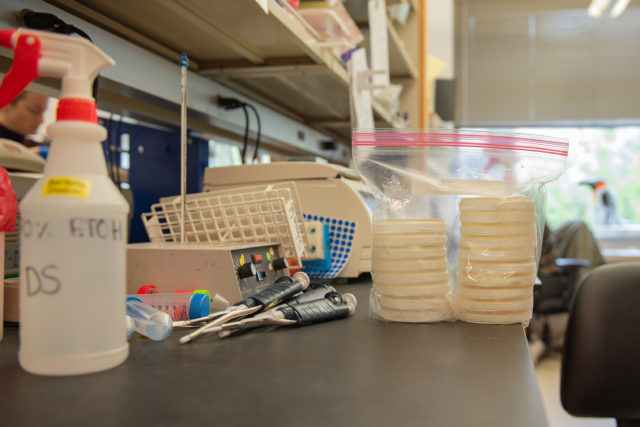
Researchers at Philip Scumpia’s Lab investigate transcriptional control of skin disease immune responses such as wound healing, infection and skin cancer. They primarily rely on NIH R01 grants, which fund independent research projects on various timelines.
“We had two R1 (R01) grants suspended, which wasn’t great, so we ended up having to put a pause on some of those projects,” said Sissi Zhang, a third-year human biology and society student working in Scumpia’s lab. “All of the scientific progress and this lifesaving work can be impacted because of political tension.”
While politics play a large role in supporting research, they should never be a detracting factor. Keeping politics and research separate prevents corruption and protects innovation.
NIH cuts also impact job opportunities for undergraduate students. I have witnessed as an undergraduate how competitive it is to obtain a research assistant position. With fewer projects, the job hunt gets even more competitive and reserved for those with connections.
Sophia Jin, a third-year human biology and society and molecular, cell and developmental biology student works in a lab in the radiation oncology department at the David Geffen School of Medicine. She said her hours have been shortened because the projects were paused.
“We lost two grants during that time, and a lot of our projects were put on pause or stopped,” Jin said. “I feel like tensions have been high, and people are still very wary that our funding could be pulled again.”
The UCLA Liquid Biopsy Laboratory, which receives NIH funding, develops technology for detecting liquid biopsy components such as tumor cells within peripheral blood of cancer patients.
Unfortunately, the two-month funding suspension cut their momentum. Even short-term budget cuts can ripple down the line, delaying and reducing support for accessible public health.
Scientists are frustrated that research won’t be carried out on the same scale, said Hsian-Rong Tseng, a professor of molecular and medical pharmacology and a principal investigator at the Liquid Biopsy Lab.
“We are trying to minimize the impact on our undergrad students,” Tseng said. “In fact, our undergrad students’ role become more important because we can no longer afford a big group with 10 post docs.”
Tseng added that job insecurity and role shifts have been demoralizing. Laying off scientists and failing to adequately support their research could mean discouraging future generations.
“The university now is taking action to try to explore other funding opportunities – for example, charity funds, potential collaboration or contracts from pharma companies or medical device companies,” Tseng said.
Diversification might be a more stable way to secure funding and save lives.
Federal funding has been volatile in the past, like in times of heightened national defense, so there should be more of a shift to state funding. UC Faculty have proposed the California Futures Fund – which would provide long-term stability and sustained investments – as one such source. This multi-billion-dollar state safety net would balance funding and come from multiple sectors, including state endowments, private investment and nonprofits.
“Save Our Science remains committed to advocating for sustainable funding solutions for California research, acknowledging that research topics and funding shouldn’t be determined by ideological whims,” said Anna Markowitz, president of the UCLA Faculty Association, in an emailed statement. “We are working on multiple fronts and advocating for a few solutions, most notably at the moment what is currently SB 607.”
SB 607 is a bill that would enact the California Science and Health Research Bond Act, authorizing $23 billion to finance grants and loans for research. Markowitz added that she is working with Sen. Scott Wiener on a launch event for SB 607 soon.
Markowitz also said UC labor unions and the UC faculty associations are fighting to prove the funding revocations were illegal to ensure grants that were awarded stay awarded.
But this won’t solve the broader problem of partisanship, which can only be fixed through federal advocacy and other public funding mechanisms, she added.
UCLA leaders must act now to expand collaborations and partner with state leaders to protect research from further political turbulence. They must solidify support by making funding multifaceted to protect the security and future of research at UCLA.
UCLA Media Relations responded in an emailed statement by redirecting questions to the UCLA Federal Guidelines.
The White House Press Office did not respond in time to a request for comment.



Comments are closed.