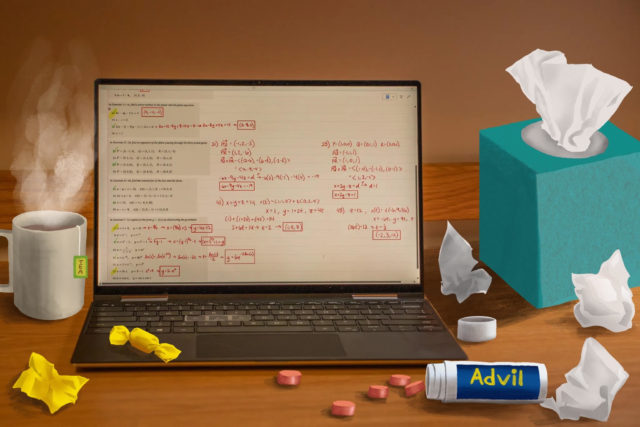
Each quarter, countless Bruins battle seasonal illnesses, yet many still push themselves to attend class.
As finals approach, many sick students may ignore their symptoms because of academic pressure or limited awareness of resources, putting vulnerable peers at risk. Students can use on-campus resources to get a better understanding of their symptoms and learn how to distinguish between the flu, COVID-19, colds and allergies.
Although the flu circulates year-round in the United States, flu season typically falls in the fall and winter months and peaks in December and February, according to the Centers for Disease Control and Prevention. Other respiratory illnesses also spread during flu season because cold air weakens the immune response in the nose, destroying nearly half of the bacteria-fighting cells and viruses in the nostrils, according to The Journal of Allergy and Clinical Immunology.
Cathy Luong, a fourth-year biochemistry student, said she is unable to rest when she is sick because she feels professors are not very accommodating. She added that this pressure creates a hustle culture at UCLA where sick days are not encouraged.
“I just feel like if I don’t do well during school at UCLA, then I feel like my entire future is at stake,” Luong said.
Many graduate and professional students at UCLA also feel the need to sacrifice their physical health for their academic responsibilities, according to the UCLA Student Affairs Information & Research Office. This pressure was even more pronounced among students of color, students with disabilities and LGBTQ+ students.
However, attending class while sick can be dangerous for other students, Shira Shafir, a professor at the UCLA Fielding School of Public Health, said.
“While it may be a very mild illness for you, you don’t know if one of your classmates has an immunosuppressive condition or a risk-increasing condition,” Shafir said.
Individuals who are immunocompromised have a weakened ability to fight off infections due to certain diseases, conditions and genetic disorders, according to the National Cancer Institute.
For students who cannot afford to miss class, wearing face masks is an effective alternative, Shafir said. She added that masks filter out any infectious viruses in the air, helping prevent the spread of many common illnesses.
“The skin in your lungs are so thin and specialized for absorbing oxygen that they can also absorb viruses,” Alexander Hoffmann, a professor of microbiology, immunology and molecular genetics, said.
Handwashing is also an effective preventative measure to stop the spread of respiratory infections.
According to the CDC, washing hands can reduce the spread of respiratory infections by 20%. Washing hands for approximately 15-30 seconds with soap can help remove disease-causing germs, and drying them properly after is necessary as germs are transferred more easily when hands are wet.
Hoffmann also added that one of the most important ways students can support their immune systems is receiving sufficient sleep because if the body is over exerted, then it can become immunocompromised.
A study published in the National Library of Medicine recruited healthy male and female participants between the ages of 18 and 55 years and found that those who had slept less than six hours a night the week before were around four times more likely to catch the cold as compared to those who got more than seven hours of sleep.
Another reason Bruins may attend class when sick is that they misjudge their symptoms.
The flu, COVID-19, colds and seasonal allergies have many overlapping symptoms, so it may be hard to distinguish between conditions, Sandy Lai, the medical director of the UCLA Arthur Ashe Student Health and Wellness Center, said in an emailed statement.
“However, a fever does not generally occur with seasonal allergies, so the presence of a fever suggests that an infection (e.g. flu, COVID, strep, etc.) is more likely happening,” Lai said in the statement.
Allergens, such as tree or grass pollen trigger symptoms of seasonal allergies like congestion, sneezing and itchiness, all of which are not contagious, according to the National Institutes of Health.
For students concerned they might have COVID-19, the loss of smell or taste is a common sign, but the only way to be certain is through testing.
According to the U.S. Food and Drug Administration, molecular tests and antigen tests are the two main types of diagnostic COVID-19 tests. Molecular tests, like PCR tests, detect the virus’s genetic material, while antigen tests – often called rapid or at-home tests – detect proteins (antigens) from the virus.
Lai said students can test themselves for flu, COVID and strep at the Ashe Center by scheduling an e-visit in their MyStudentChart portal.
“Typically within 1 business day, a health care provider reviews the student’s E-visit questionnaire about their respiratory symptoms and will order the tests to be done at the student health center,” Lai said.
There are also free COVID-19 self-test options offered on campus, according to the Arthur Ashe Center website.
With more clarity about their condition, students are able to better treat themselves and take the proper medications.
Lai said the Ashe Center also offers video visits and in-person appointments that students can schedule in the MyStudentChart portal. She added that students should schedule their appointments in advance because there are limited same-day appointments for urgent concerns.
If students need to miss class or receive an extension on an assignment due to an acute medical condition, they can request a medical excuse note from the Ashe Center, according to the Arthur Ashe Center website.
Students also have access to the Bruin Health Pharmacy, which provides myriad prescription medications along with over 70 over-the-counter medications in Ackerman Union, according to the Arthur Ashe Center website.
Vaccinations are also an option for students who want to prepare themselves ahead of the flu season, according to the CDC.
[Related: UCLA staff react to RFK Jr.’s vaccine advisory committee dismissals, appointments]
Hoffmann said the flu vaccine exposes the immune system to the virus, prompting the body to create specialized cells that produce antibodies. This helps the body fight the virus more quickly if exposed, reducing the length of the illness.
He said that the flu and COVID-19 vaccines do not necessarily prevent people from getting sick but are effective in reducing the impact.
In other words, vaccinated students can still spread or contract illnesses when attending class.
“I know that there can be an incentive to go to class even if you’re sick because you don’t want to miss information, but that’s really where we can see a lot of transmission of infection,” Shafir said.



Comments are closed.